
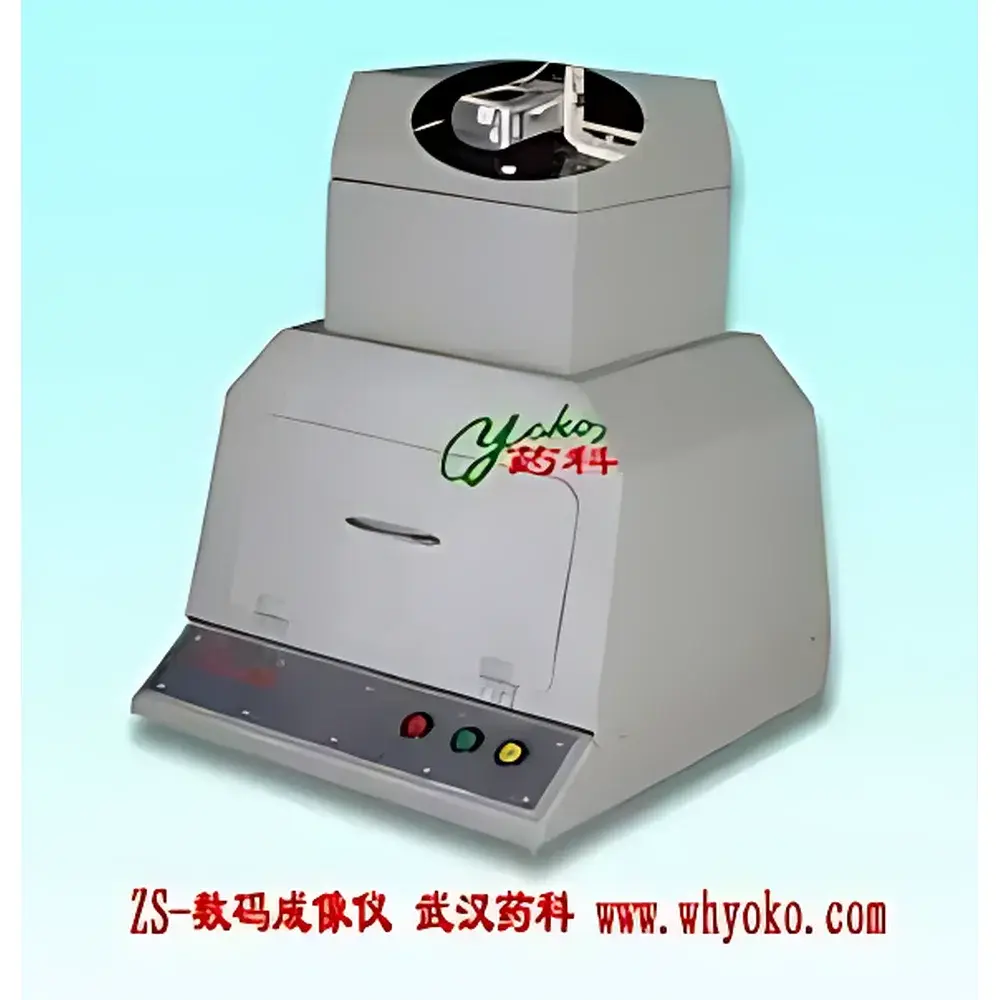
whYOKO ZS Thin Layer Chromatography Imaging System
| Brand | whYOKO |
|---|---|
| Origin | Hubei, China |
| Manufacturer Type | Authorized Distributor |
| Product Category | Domestic |
| Model | ZS |
| Instrument Type | TLC Imaging System |
| Operation Mode | Automated |
| Light Sources | 2 × 6 W UV lamps at 254 nm, 2 × 6 W UV lamps at 365 nm, 2 × daylight fluorescent lamps |
| Transmittance | ≥68% at 254 nm, ≥86% at 365 nm |
| UV Transmission Filters | 50 × 200 mm (2 pcs) |
| Power Supply | 48 W, 220 V ±10%, 50–60 Hz |
| Compliance | Meets technical requirements specified in Chinese Pharmacopoeia (ChP) for TLC imaging systems |
Overview
The whYOKO ZS Thin Layer Chromatography Imaging System is a dedicated digital documentation platform engineered for high-fidelity visualization and qualitative analysis of thin-layer chromatography (TLC) plates under multiple illumination conditions. It operates on the principle of controlled ultraviolet and visible-light excitation to induce fluorescence emission or quenching in analyte bands—enabling precise spatial mapping of separated compounds without destructive elution. Designed as an integrated dark-box imaging station, the ZS system eliminates ambient light interference through fully enclosed optical chambers for both sample illumination and image capture. Its dual-purpose architecture supports both analytical documentation and routine laboratory UV inspection tasks—including fluorescent compound screening, TLC plate archiving, and document digitization—making it a versatile asset in pharmaceutical QC labs, natural product research, and academic teaching environments.
Key Features
- Modular optical design with independent UV/visible light source compartments and camera enclosure—ensuring zero external light leakage during acquisition.
- Dual-wavelength UV excitation: four 6 W lamps (two at 254 nm, two at 365 nm) paired with high-transmittance bandpass filters (50 × 200 mm; ≥68% @ 254 nm, ≥86% @ 365 nm) for optimal signal-to-noise ratio in fluorescence detection.
- Integrated daylight lamp array for white-light visualization of non-fluorescent or iodine-stained plates.
- Compact, benchtop footprint with front-access hinged door (large aperture) facilitating rapid plate insertion and alignment without repositioning.
- Energy-efficient electronic ballast drivers eliminate flicker and ensure stable lamp output—resolving synchronization issues commonly encountered with DSLR or CMOS sensors in pulsed UV environments.
- Universal mounting interface compatible with standard C-mount lenses, industrial USB cameras, DSLRs, and scientific-grade CCD/CMOS imagers.
Sample Compatibility & Compliance
The ZS system accommodates standard TLC plates (e.g., silica gel 60 F254, alumina, cellulose, RP-18) up to 20 × 20 cm in size. Its uniform illumination field ensures consistent excitation across the entire plate surface—critical for reproducible band intensity quantification and comparative analysis. The system complies with imaging performance criteria outlined in the Chinese Pharmacopoeia (2020 Edition, General Chapter 0502), including spectral purity, irradiance homogeneity, and minimum detectable fluorescence threshold. While not certified to ISO/IEC 17025 or FDA 21 CFR Part 11 out-of-the-box, its hardware architecture supports integration into GLP/GMP workflows when paired with validated third-party image acquisition and analysis software featuring audit trail, user access control, and electronic signature capabilities.
Software & Data Management
The ZS system functions as a hardware platform—not a closed-software instrument—thereby enabling full interoperability with industry-standard imaging packages (e.g., ImageJ with TLC Analyser plugin, GelAnalyzer, VisionWorks LS, or custom Python-based pipelines). Users may connect USB3/UVC-compliant cameras or DSLRs via tethered capture protocols for real-time preview, exposure control, and RAW file export. All acquired TIFF or PNG images retain embedded EXIF metadata (wavelength, exposure time, lens focal length), supporting traceable documentation per ALCOA+ principles. When deployed in regulated environments, laboratories are responsible for qualifying the complete imaging chain—including camera firmware, driver versions, and post-acquisition software—against their internal validation SOPs.
Applications
- Routine identity testing and purity assessment of active pharmaceutical ingredients (APIs) and herbal extracts per ChP monographs.
- Method development support for HPTLC and preparative TLC workflows, including Rf value determination and solvent system optimization.
- Fluorescence-based detection of polycyclic aromatic hydrocarbons (PAHs), mycotoxins (e.g., aflatoxin B1), and alkaloids without derivatization.
- Educational demonstration of separation mechanisms, migration behavior, and visualization principles in undergraduate analytical chemistry curricula.
- Archival digitization of legacy TLC records for long-term storage and cross-lab reference comparison.
FAQ
Does the ZS system include proprietary image analysis software?
No—the ZS is a hardware-only imaging platform. Users must supply compatible third-party or open-source software for band detection, densitometry, and reporting.
Can the system be used for quantitative analysis?
Yes, provided that users implement calibrated reference standards, consistent exposure parameters, and validated image processing protocols—though absolute quantification requires additional validation per ICH Q2(R2).
Is the UV output intensity adjustable?
No—the lamps operate at fixed nominal power. Intensity modulation is achieved indirectly via exposure time control in the connected camera system.
What safety certifications does the unit carry?
It conforms to GB 4793.1–2007 (Chinese national standard for electrical safety of laboratory equipment) and includes interlocked door switches to deactivate UV lamps when opened.
Is remote operation supported?
Yes—when paired with network-capable cameras and compatible software, the system enables headless acquisition via LAN/WiFi, suitable for shared core facility deployment.




