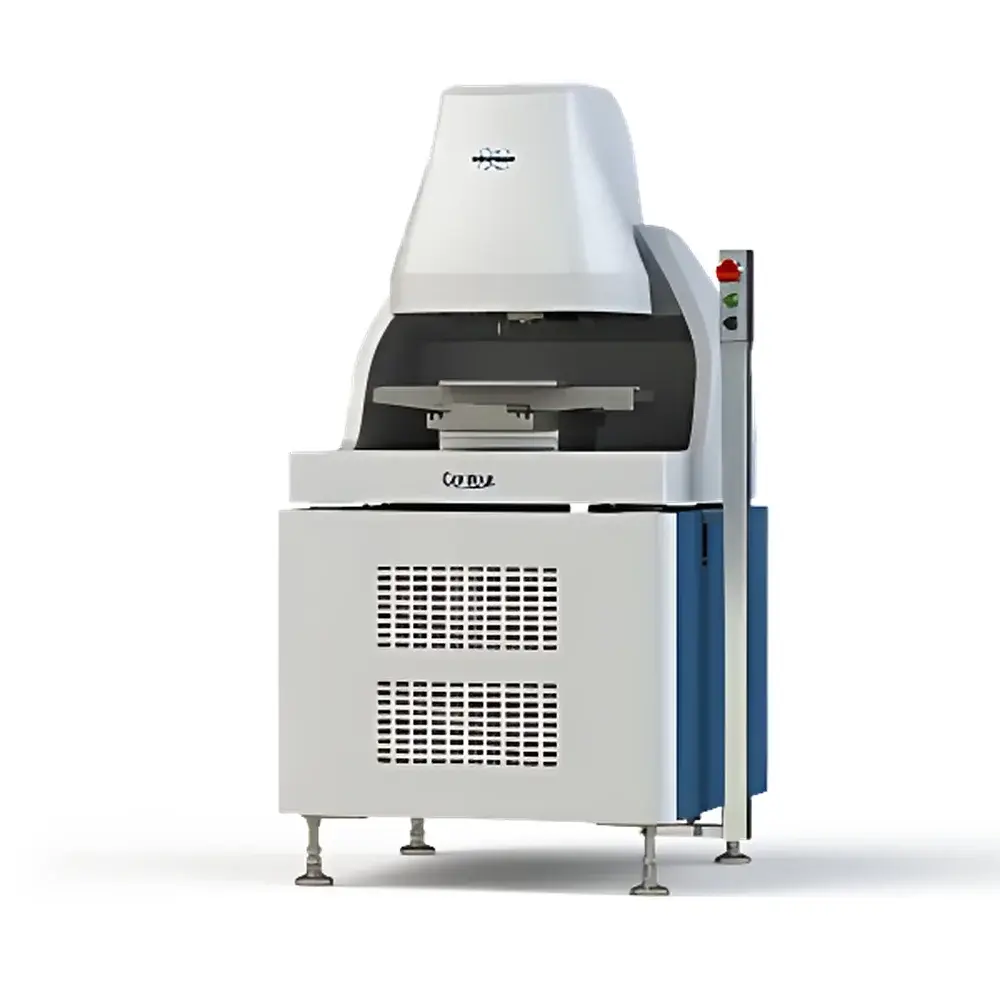
Bruker ContourX-1000 3D Optical Profilometer
| Brand | Bruker |
|---|---|
| Origin | USA |
| Model | ContourX-1000 |
| Product Type | Non-contact Profilometer / Surface Roughness Analyzer |
| Operating Principle | White Light Interferometry (WLI) |
| Optical Head | Tilt/Tip Adjustable |
| Automation Features | Auto-focus, Auto-illumination, Advanced Find Surface, Motorized Objective Turret & Stage |
| Software Platform | VisionXpress GUI with USI (Universal Scanning Interferometry) Adaptive Mode |
| Compliance | Designed for ISO 25178, ISO 4287, ASME B46.1, and ASTM E2903 surface metrology standards |
Overview
The Bruker ContourX-1000 is a floor-standing, non-contact 3D optical profilometer engineered for high-precision surface topography, texture, and roughness characterization across R&D laboratories and production environments. At its core, the system employs white light interferometry (WLI), a coherence-based optical measurement technique that delivers sub-nanometer vertical resolution and exceptional repeatability over large fields of view. Unlike stylus-based profilers or confocal systems, WLI enables rapid, damage-free measurement of delicate, reflective, transparent, or highly structured surfaces—including MEMS devices, semiconductor wafers, optical coatings, medical implants, and microfluidic channels. The ContourX-1000 integrates Bruker’s proprietary tilt/tilt optical head design, dual illumination sources, and a fully motorized objective turret and XY stage—enabling dynamic alignment and optimal fringe contrast acquisition across complex geometries and steep sidewalls (>85°). Its robust mechanical architecture includes an integrated active vibration isolation platform and an internal self-calibrating HeNe reference laser, ensuring long-term stability and traceable metrology performance—even in semi-controlled industrial settings.
Key Features
- Tilt/Tip-adjustable optical head for real-time optimization of interference fringe contrast on inclined or curved surfaces.
- Dual-source illumination (halogen + LED) supporting both high-dynamic-range imaging and low-noise phase analysis.
- Advanced Find Surface algorithm: automatically locates sample surface within seconds, eliminating manual Z-search and reducing operator dependency.
- Universal Scanning Interferometry (USI) adaptive mode: intelligently selects scan speed, integration time, and sampling density based on local surface slope and reflectivity—ensuring optimal signal-to-noise ratio without user intervention.
- VisionXpress software interface: guided workflow with context-sensitive prompts, preconfigured measurement templates, and one-click report generation compliant with ISO 25178-2 and ASME B46.1.
- Motorized objective turret (5×–100× magnifications) and precision XYZ stage support automated multi-site mapping, wafer-level inspection, and batch processing.
Sample Compatibility & Compliance
The ContourX-1000 accommodates a broad spectrum of sample types—from bare silicon wafers and patterned photomasks to polished metals, polymer films, and bioengineered scaffolds. Its non-contact nature eliminates risk of surface damage or tip wear, making it suitable for soft materials (e.g., hydrogels), fragile thin films (10 µm deep). The system supports optional vacuum-compatible wafer chucks and environmental enclosures for controlled-atmosphere measurements. Metrological compliance includes full alignment with ISO 25178 series (areal surface texture parameters), ISO 4287 (profile roughness), ASME B46.1 (surface characterization terminology), and ASTM E2903 (standard practice for WLI calibration). Data integrity meets GLP/GMP requirements via audit-trail-enabled software logging and optional 21 CFR Part 11 compliance modules.
Software & Data Management
VisionXpress serves as the unified software environment, combining intuitive operation with rigorous metrology-grade analysis. It features embedded SureVision for real-time focus assessment, multi-region stitching for extended-area mapping, Vision64 Map for statistical process control (SPC) dashboards, and dedicated thin-film measurement modules for thickness and refractive index extraction. All measurement data are stored in Bruker’s native .bruker format, supporting metadata-rich export to CSV, TIFF, and industry-standard STEP AP210 files. Batch scripting via Python API enables integration into automated manufacturing lines and LIMS environments. Raw interferograms, phase maps, and height data are preserved for retrospective reanalysis—critical for root-cause investigations and regulatory submissions.
Applications
- Semiconductor process control: trench depth, step height, CMP uniformity, and lithographic fidelity assessment.
- Optics & photonics: surface flatness (λ/20), scratch/dig verification, and microlens array form error.
- Medical device QA: surface finish of orthopedic implants, stent strut roughness, and drug-eluting coating homogeneity.
- MEMS/NEMS development: actuator displacement, resonator topology, and packaging-induced warpage.
- Automotive & aerospace: thermal barrier coating porosity, turbine blade leading-edge erosion, and additive-manufactured part surface integrity.
FAQ
What vertical resolution can the ContourX-1000 achieve?
Vertical resolution is typically ≤0.1 nm RMS under optimized conditions, dependent on optical configuration, integration time, and surface reflectivity.
Does the system require external vibration isolation?
No—the integrated active vibration isolation platform provides sufficient damping for most lab and cleanroom environments; no additional optical table is required.
Can the ContourX-1000 measure transparent or multilayer films?
Yes—via spectral reflectance analysis and phase-shifting WLI, it supports quantitative film thickness and interface roughness measurement down to ~1 nm thickness resolution.
Is remote operation or network deployment supported?
Yes—VisionXpress supports client-server architecture, enabling centralized instrument management, remote monitoring, and secure data sharing across enterprise networks.
How is calibration maintained over time?
The internal HeNe reference laser continuously monitors and corrects for thermal drift and mechanical hysteresis; NIST-traceable step-height standards are used for periodic verification per ISO/IEC 17025 protocols.