
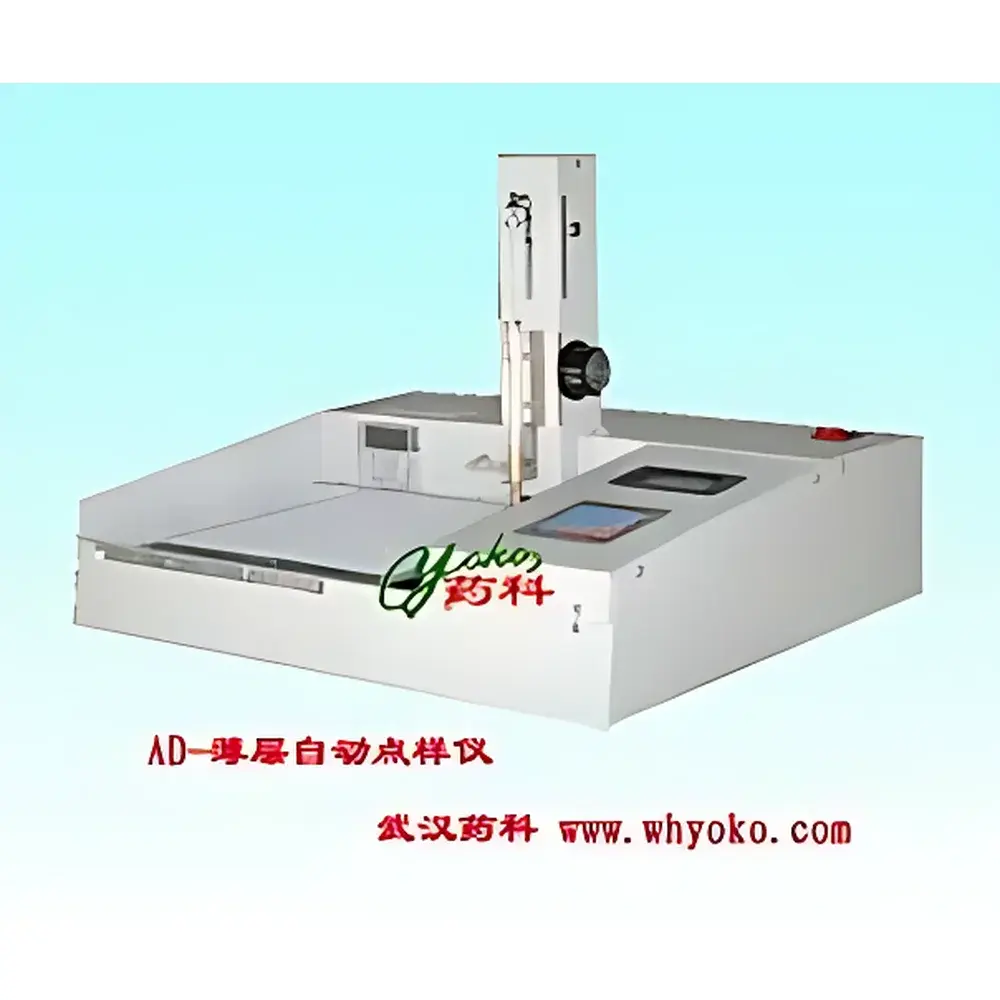
YOKO YOKO-FD1 Full-Directional Automated TLC Sample Spotter
| Brand | YOKO |
|---|---|
| Origin | Hubei, China |
| Model | YOKO-FD1 |
| Spotting Mode | Contactless Pneumatic Spray & Precision Needle Deposition |
| Programmable Methods | 50 (100 steps each) |
| Heating Platform | 0–200 °C, 200 × 200 mm stainless steel |
| Spotting Accuracy | ≥99% |
| Spotting Reproducibility | ≥99% |
| Syringe Options | 10 µL, 50 µL (standard) |
| Air Supply | Oil-free compressor, 0–0.12 MPa adjustable, gas flow 0.1–2.0 L/min |
| Dimensions | 480 × 420 × 390 mm |
| Weight | 20 kg |
| Power | 220 V ±10%, 50–60 Hz, 650 W |
Overview
The YOKO YOKO-FD1 Full-Directional Automated TLC Sample Spotter is an engineered solution for high-precision, programmable sample application in thin-layer chromatography (TLC) and preparative TLC workflows. Unlike conventional manual or single-axis automated spotters, the YOKO-FD1 implements a dual-motor Cartesian coordinate system combined with a pneumatically actuated non-contact spray module and precision syringe-based deposition—enabling true multidimensional spotting geometry on planar stationary phases. Its operational principle integrates controlled air-assisted nebulization for uniform low-volume droplet formation and microstepping motor-driven XYZ positioning (X/Y resolution ≤0.02 mm) to execute complex spotting patterns—including linear bands, diagonal arrays, concentric rectangles, overlapping grids, and reverse-direction sequences—without mechanical contact or plate displacement. Designed for compatibility with standard silica gel, alumina, and reversed-phase TLC plates (up to 200 × 200 mm), the instrument supports both analytical-scale quantitation and semi-preparative isolation protocols under ambient or thermally stabilized conditions.
Key Features
- Full-directional spotting capability: Programmable X-Y-Z motion enables spot placement in any orientation—horizontal, vertical, oblique, bidirectional, rectangular tiling, and multi-layer overlap—eliminating manual repositioning and enabling reproducible pattern-based assay development.
- Dual-mode deposition architecture: Switchable between non-contact pneumatic spray (for uniform low-viscosity solutions) and high-accuracy syringe-based contact deposition (for viscous or particulate-containing samples), both governed by synchronized step-motor control.
- Integrated thermostatic platform: Digitally regulated stainless steel heating stage (0–200 °C) ensures rapid solvent evaporation post-spotting, minimizing spot diffusion and improving Rf reproducibility and resolution—critical for quantitative densitometric analysis per USP and ICH Q5C guidelines.
- Robust programmability: Onboard LCD interface supports creation and storage of up to 50 independent methods; each method accommodates 100 discrete positional and parameter steps (e.g., volume, dwell time, air pressure, temperature ramp). All programs retain settings indefinitely without battery backup dependency.
- Modular consumables handling: Standard Luer-lock syringes (10 µL and 50 µL included; 25/100/500 µL optional) permit rapid exchange and direct cleaning—no dedicated wash station required. Integrated auto-purge function clears residual sample from the needle path before and after each run.
Sample Compatibility & Compliance
The YOKO-FD1 accommodates a broad range of sample matrices—including aqueous buffers, organic solvents (e.g., chloroform, ethyl acetate, methanol), polymer solutions, and nanoparticle suspensions—without clogging or cross-contamination. Its non-contact spray mode operates effectively at viscosities up to 10 mPa·s, while the syringe module handles viscosities exceeding 50 mPa·s when using larger bore needles. The instrument meets mechanical safety requirements per IEC 61010-1 and electromagnetic compatibility standards EN 61326-1. While not certified for GMP environments out-of-the-box, its deterministic motion control, audit-ready parameter logging (via optional USB export), and thermal stability profile support alignment with GLP documentation practices and FDA 21 CFR Part 11-compliant data integrity frameworks when deployed with validated software extensions.
Software & Data Management
The YOKO-FD1 operates via an embedded real-time control firmware with local LCD navigation—requiring no external PC for routine operation. For advanced method development and batch documentation, optional Windows-compatible configuration software provides graphical workflow design, drag-and-drop pattern generation, and CSV-based method import/export. All executed runs log timestamped metadata—including method ID, plate dimensions, ambient temperature, heater setpoint, and total spotting duration—to internal flash memory. Exported logs include full positional coordinates (X, Y, Z), applied volumes, and pneumatic pressure values per step, facilitating traceability in QC/QA audits and method transfer across laboratories.
Applications
- High-throughput screening of synthetic reaction mixtures in medicinal chemistry
- Standardized impurity profiling per ICH Q3B(R3) for pharmaceutical intermediates
- Development and validation of stability-indicating TLC methods for biologics and peptides
- Semi-preparative isolation of natural product fractions (e.g., flavonoids, alkaloids) using 200 × 200 mm plates
- Multi-component fingerprinting of herbal extracts with overlapping band optimization
- Educational use in undergraduate chromatography labs requiring reproducible, visually verifiable spotting patterns
FAQ
Does the YOKO-FD1 support integration with third-party densitometers or imaging systems?
Yes—the instrument outputs standardized XY coordinate files compatible with common TLC imaging platforms (e.g., CAMAG Scanner 4, GelQuant.NET). Manual synchronization of spotting coordinates with image acquisition is required unless using the optional software bridge module.
Can the heating platform accommodate irregularly shaped or custom-cut plates?
The stage accepts any rigid flat substrate up to 200 × 200 mm and 5 mm thickness. Non-rectangular plates must be secured manually using heat-resistant clamps; automatic edge detection is not implemented.
Is calibration required before first use or after maintenance?
No routine calibration is needed. The system employs factory-trimmed stepper motor microstepping and optical end-stop homing. Users may perform optional verification using a calibrated stage micrometer and reference grid plate.
What maintenance intervals are recommended for the pneumatic system?
The oil-free compressor requires filter replacement every 12 months under continuous use. Tubing and fittings should be inspected quarterly for microcracks or moisture accumulation in humid environments.
How does the YOKO-FD1 ensure spot volume consistency across different solvents?
Volume accuracy relies on syringe plunger displacement linearity and pneumatic pressure stabilization. For solvents with high vapor pressure (e.g., diethyl ether), users must enable pre-spotting purge cycles and reduce dwell time to mitigate evaporation-induced under-delivery.





