
whYOKO YOkO-YS Automated Immersion Derivatization System for Thin-Layer Chromatography
| Brand | whYOKO |
|---|---|
| Origin | Hubei, China |
| Manufacturer Type | Authorized Distributor |
| Regional Classification | Domestic (PRC) |
| Model | YOkO-YS |
| Instrument Category | TLC Ancillary Equipment |
| Operation Mode | Manual |
| Vertical Speed | 40 mm/s |
| Immersion Time Range | 1–60 s (adjustable in 1-s increments) |
| Compatible Plate Heights | 10 cm and 20 cm |
| Standard Immersion Bath | 20 × 20 cm Sintered Glass Reservoir |
| Input Voltage | AC 220 V |
| Power Consumption | 20 W |
Overview
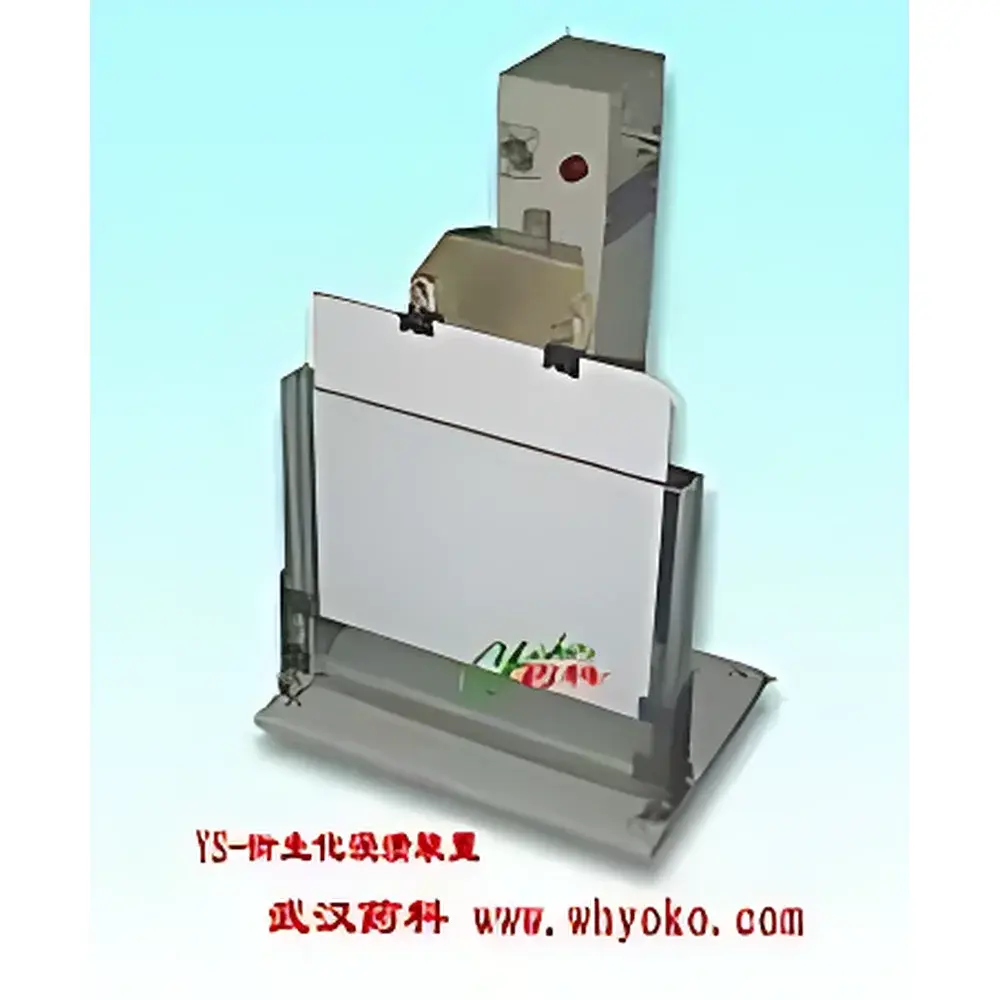
The whYOKO YOkO-YS Automated Immersion Derivatization System is a purpose-engineered ancillary device designed specifically for post-development chemical derivatization of thin-layer chromatography (TLC) plates. Unlike conventional spray-based derivatization—prone to uneven reagent distribution, aerosol generation, and operator exposure—the YOkO-YS employs controlled vertical immersion to ensure uniform, reproducible, and solvent-efficient reagent contact across the entire active surface of silica gel or alumina-coated plates. The system operates on a gravity-assisted, motor-driven vertical translation mechanism that lowers and lifts the TLC plate at a precisely regulated speed of 40 mm/s, minimizing mechanical stress on fragile layers while enabling consistent dwell time (1–60 seconds, adjustable in 1-second increments). Its design conforms to fundamental principles of mass transfer kinetics in planar chromatography: by eliminating turbulent air–liquid interfaces and reducing evaporation-driven concentration gradients, immersion derivatization delivers higher spot integrity, improved detection sensitivity, and enhanced inter-laboratory reproducibility—particularly critical for quantitative densitometric analysis and regulatory-compliant herbal medicine profiling.
Key Features
- Programmable immersion timing (1–60 s) with manual override capability for method optimization and exploratory development.
- Dual-height compatibility: accommodates standard 10 cm and 20 cm analytical TLC plates without adapter modification.
- Integrated 20 × 20 cm sintered glass immersion bath—chemically inert, thermally stable, and resistant to common derivatization reagents including anisaldehyde–sulfuric acid, p-anisaldehyde, ninhydrin, and diazotized sulfanilic acid.
- High-precision imported linear motion assembly ensures repeatable positioning accuracy (< ±0.3 mm) and eliminates lateral wobble during immersion cycles.
- Corrosion-resistant engineering: housing fabricated from electrostatically sprayed industrial-grade polymer; no exposed ferrous components—suitable for long-term use in acidic, basic, or halogenated solvent environments.
- Low-power operation (20 W @ 220 V AC) supports continuous benchtop deployment without thermal buildup or dedicated circuit requirements.
Sample Compatibility & Compliance
The YOkO-YS supports all commercially available rigid-backed and flexible TLC plates—including silica gel 60 F254, aluminum oxide, cellulose, and reversed-phase C18 media—across thicknesses ranging from 0.1 mm to 0.5 mm. Its immersion geometry preserves layer adhesion and prevents edge chipping or delamination under controlled descent velocity. While not a standalone analytical instrument, the system facilitates compliance with pharmacopoeial methods requiring derivatization prior to UV/Vis densitometry (e.g., Chinese Pharmacopoeia ChP 2020 Vol. IV, USP , and EP 2.2.27). When integrated into GLP-compliant workflows, operators may document immersion parameters (time, reagent lot, plate ID) manually or via external LIMS linkage to satisfy audit-trail requirements per ISO/IEC 17025:2017 Clause 7.7.
Software & Data Management
The YOkO-YS is a hardware-only platform with no embedded microcontroller or digital interface. All operational parameters are set manually via tactile controls, ensuring electromagnetic compatibility in electromagnetically noisy laboratory environments and eliminating firmware validation burdens under FDA 21 CFR Part 11. This analog architecture aligns with risk-based validation strategies for ancillary equipment: users define and record immersion protocols within their SOPs, and calibration verification is performed quarterly using calibrated stopwatch and vernier caliper (traceable to NIM-certified standards). For laboratories implementing electronic lab notebooks (ELN), the device integrates seamlessly as a documented step in chromatographic assay sequences—no driver installation or API integration required.
Applications
- Routine derivatization of alkaloids, flavonoids, terpenoids, and glycosides in traditional Chinese medicine (TCM) extracts—enabling visualization under 254 nm and 366 nm UV irradiation.
- Preparative TLC plate conditioning: pre-immersion washing with methanol/water or dilute acetic acid to remove interfering salts or adjust surface pH prior to separation.
- Acid–base activation of silica layers for improved resolution of polar analytes (e.g., amino acids, organic acids).
- Method development support for ICH Q5A-compliant impurity profiling, where reproducible derivatization is essential for distinguishing structurally related degradants.
- Teaching laboratories: demonstrates core concepts of reagent–analyte interaction kinetics and phase-transfer limitations in planar chromatography.
FAQ
Is the YOkO-YS compatible with HPTLC plates?
Yes—its vertical travel range and bath depth accommodate high-performance TLC plates up to 20 cm in height and 0.25 mm layer thickness.
Can the immersion bath be replaced with custom geometries?
The standard 20 × 20 cm sintered glass reservoir is replaceable; users may fabricate alternative inert baths (e.g., PTFE-lined stainless steel) provided dimensional tolerances maintain ±1 mm alignment with the carriage guide rails.
Does the system require exhaust ventilation?
No forced ventilation is required during immersion, though general lab fume hood use is recommended when handling volatile or toxic derivatization reagents such as chlorinated solvents or concentrated sulfuric acid mixtures.
What maintenance intervals are recommended?
Lubrication of the linear guide rails every 6 months using silicone-based grease; visual inspection of drive belt tension and sintered bath integrity prior to each daily use.
Is third-party IQ/OQ documentation available?
whYOKO provides a vendor-supplied Functional Specification and Factory Acceptance Test (FAT) report; site-specific Installation Qualification (IQ) and Operational Qualification (OQ) protocols must be developed by the end-user per ISO/IEC 17025 or internal quality management system requirements.




