
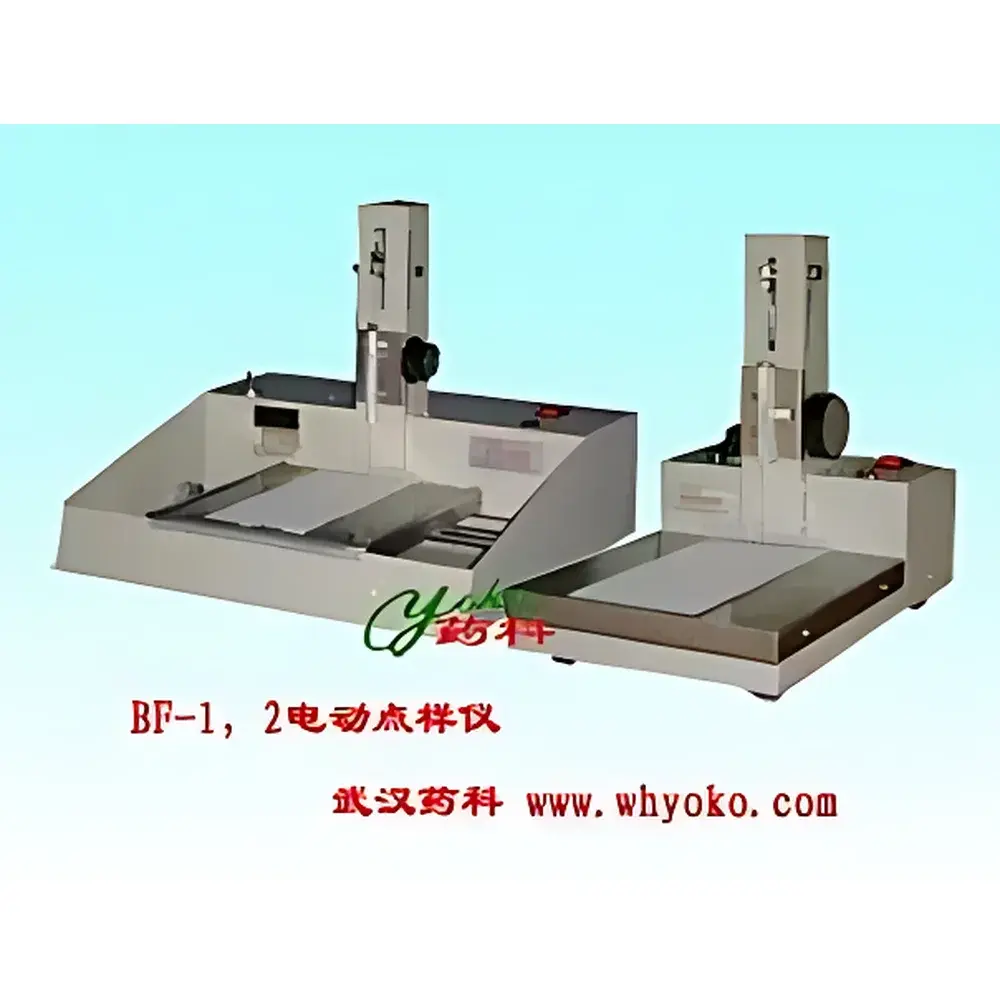
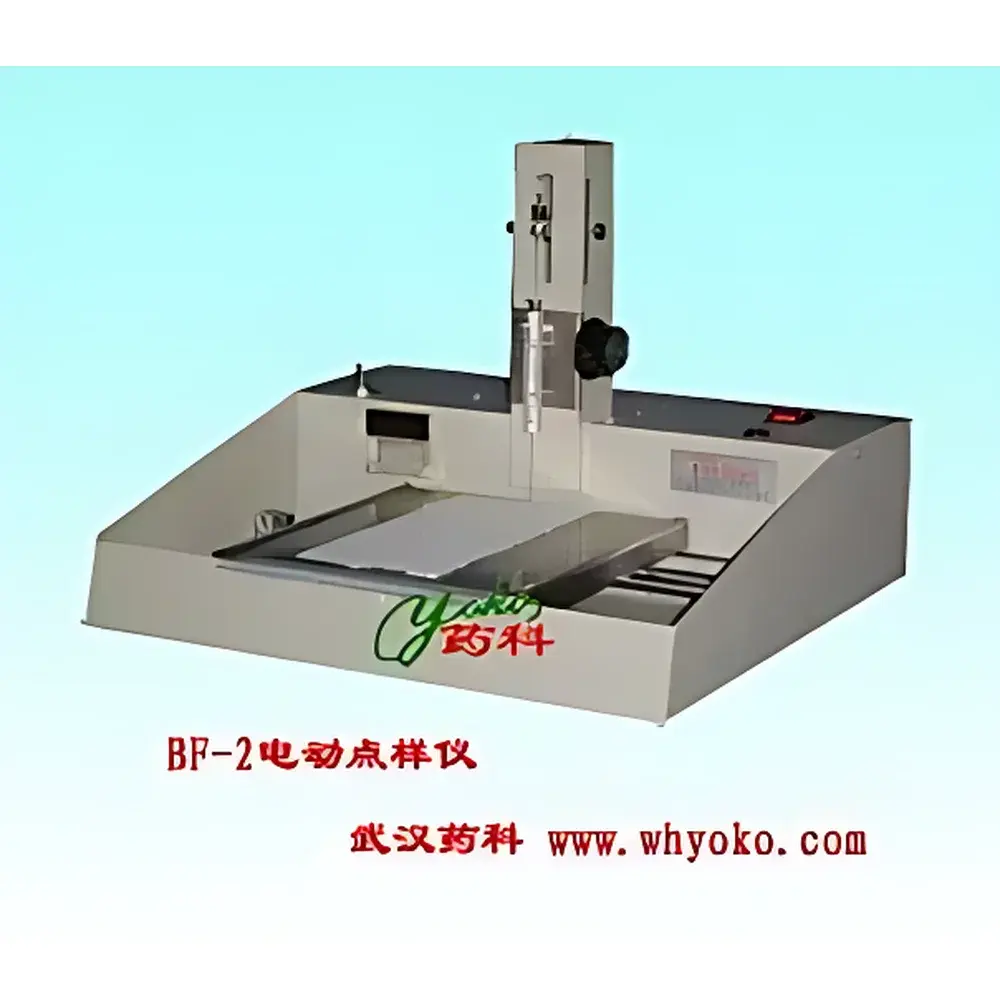
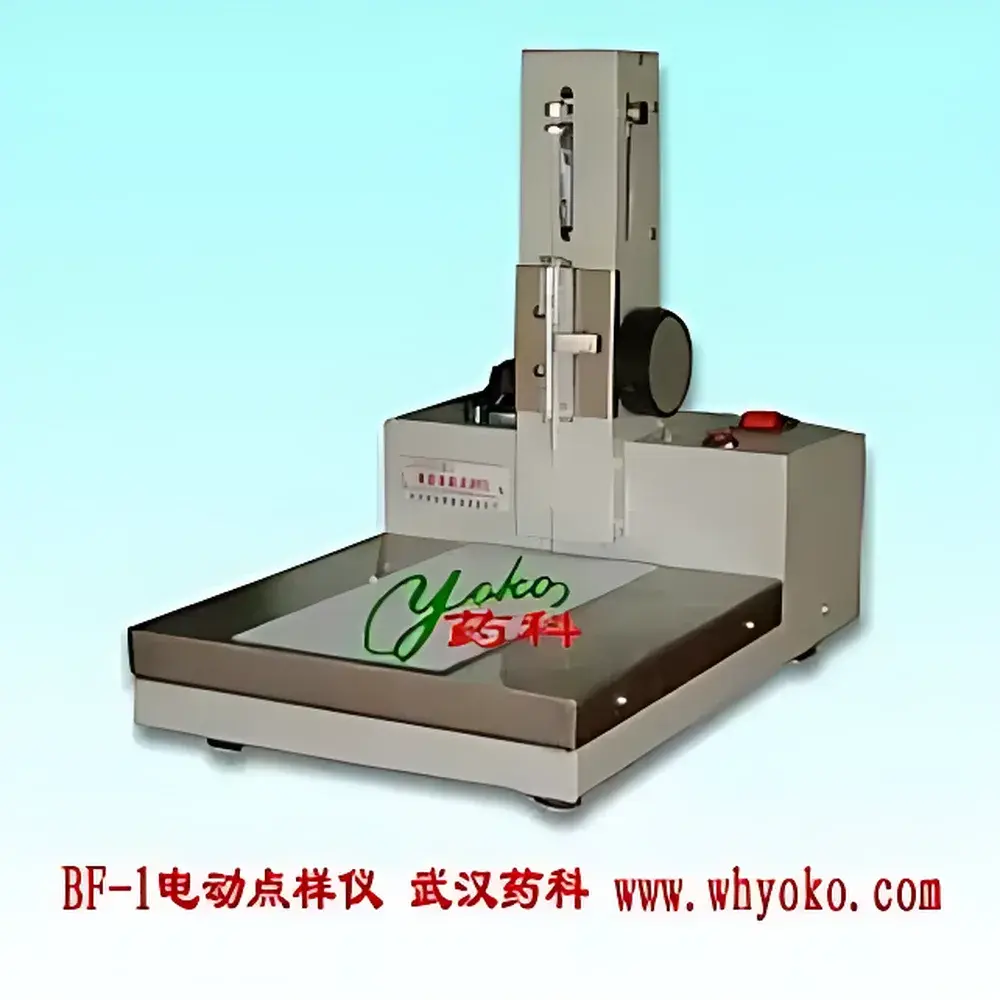
YOKO BD-II Electric TLC Spotter
| Brand | YOKO |
|---|---|
| Model | BD-II |
| Type | Electric Thin-Layer Chromatography Spotter |
| Spotting Mode | Contact-based circular spotting |
| Max Plate Size | 200 × 200 mm |
| Heating Platform Power | 600 W |
| Temperature Control Range | 0–200 °C (digital display & setpoint control) |
| Heating Stage Travel | 0–180 mm (bidirectional, stepper motor-driven with auto-limit protection) |
| Syringe Drive | Stepper motor actuation with downward行程 auto-protection |
| Syringe Options | 10 µL and 50 µL glass microsyringes included |
| Spotting Accuracy | < 1.0% RSD |
| Spotting Reproducibility | < 1.5% RSD |
| Sample Uptake | Direct capillary aspiration (bubble-free operation) |
| Cleaning | Removable syringe for manual cleaning |
| Input Power | 630 W, 220 V ± 10%, 50–60 Hz |
| Heating Platform Material | Stainless steel |
Overview
The YOKO BD-II Electric TLC Spotter is an engineered solution for precise, repeatable, and thermally assisted sample application in thin-layer chromatography (TLC) workflows. Designed for laboratories performing qualitative and semi-quantitative analysis of organic compounds, pharmaceuticals, natural products, and forensic samples, this instrument implements contact-based circular spotting using calibrated glass microsyringes. Its core operational principle relies on controlled vertical needle descent—actuated by a stepper motor—to ensure consistent sample deposition without mechanical vibration or layer damage. Integrated temperature-controlled stainless steel heating platform enables real-time solvent evaporation during spotting, minimizing spot diffusion and improving resolution—particularly critical for volatile solvents or high-boiling-point matrices. The BD-II builds upon the BD-I platform with enhanced mechanical stability, bidirectional plate-stage translation, and digital temperature regulation compliant with standard laboratory thermal management protocols.
Key Features
- Stepper motor-driven syringe actuation with downward travel limit protection ensures reproducible needle penetration depth and eliminates manual variability.
- Bidirectional (left-right) plate-stage movement (0–180 mm range) reduces manual repositioning during multi-spot sequences—ideal for calibration curves, dose-response studies, or comparative screening.
- Digital temperature controller (0–200 °C) with ±1 °C stability provides precise thermal management of the stainless steel heating platform, accelerating solvent volatilization and minimizing spot bloom.
- Contact-mode circular spotting with 10 µL and 50 µL calibrated glass syringes supports flexible volume selection across analytical and preparative TLC applications.
- Direct capillary aspiration mechanism prevents air bubble formation during sample uptake—preserving volumetric accuracy and eliminating post-aspiration priming steps.
- Modular syringe design allows rapid disassembly and thorough cleaning with common laboratory solvents, ensuring cross-sample integrity and long-term system reliability.
Sample Compatibility & Compliance
The BD-II accommodates standard commercial and custom-prepared silica gel, alumina, cellulose, and reversed-phase TLC plates up to 200 × 200 mm. It supports aqueous, alcoholic, chlorinated, and low-polarity solvent systems—including methanol, ethyl acetate, hexane, and dichloromethane—without compromising syringe seal integrity or thermal stage performance. While not certified to ISO/IEC 17025 or ASTM D1193, the instrument’s mechanical repeatability (<1.5% RSD) and thermal consistency align with internal QC requirements for method validation under GLP-compliant environments. Its electrical architecture complies with IEC 61010-1 safety standards for laboratory equipment.
Software & Data Management
The YOKO BD-II operates as a standalone hardware platform with no embedded firmware or proprietary software interface. All parameter adjustments—including temperature setpoint, stage position, and spotting trigger mode (single-shot or continuous)—are executed via front-panel digital controls. No data logging, audit trail, or electronic record functionality is provided; users are expected to maintain manual logbooks or integrate spotting events into external LIMS or ELN systems via timestamped procedural documentation. This design prioritizes operational simplicity, serviceability, and compatibility with regulated workflows where electronic signatures or 21 CFR Part 11 compliance are managed at the enterprise software layer—not the instrument level.
Applications
- Routine identification of active pharmaceutical ingredients (APIs) and degradation products in stability-indicating TLC assays.
- Method development for HPTLC quantification, including linearity verification and limit-of-detection estimation.
- Forensic drug screening where spot morphology, Rf consistency, and thermal stabilization of volatile analytes (e.g., cannabinoids, amphetamines) are essential.
- Natural product isolation tracking—monitoring fraction purity across column chromatography runs using standardized spotting patterns.
- Educational laboratories requiring robust, teachable instrumentation for undergraduate chromatography pedagogy and technique validation.
FAQ
Is the BD-II compatible with pre-coated HPTLC plates?
Yes—it accepts all commercially available HPTLC plates (e.g., Merck Silica Gel 60 F254, CAMAG RP-18W) within the 200 × 200 mm footprint.
Can the heating platform be used independently of spotting?
Yes—the temperature controller functions independently; the stage may be preheated prior to sample loading for ambient-condition optimization.
What maintenance is required for long-term syringe accuracy?
Annual recalibration of syringe plunger travel against gravimetric standards is recommended; routine cleaning with acetonitrile or isopropanol after each solvent class prevents crystallization and seal degradation.
Does the instrument support non-circular spotting patterns?
No—BD-II is configured exclusively for discrete circular spots. For linear or gradient applications, users should consider the YOKO TD Strip Spotter or AD Series automated platforms.
Is CE or UL certification available for export?
The BD-II meets general EMC and safety requirements per IEC 61010-1; however, region-specific conformity marking (CE, UKCA, UL) must be verified through authorized third-party testing prior to import.




