
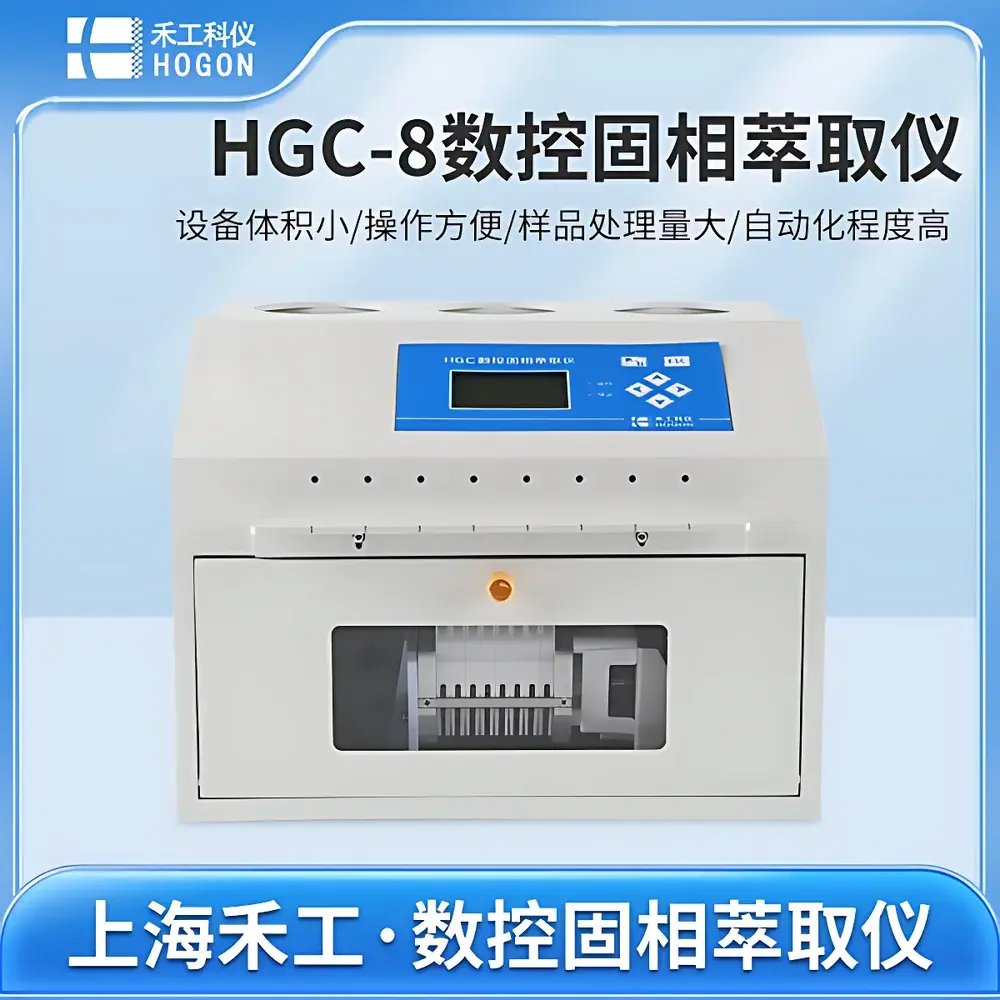
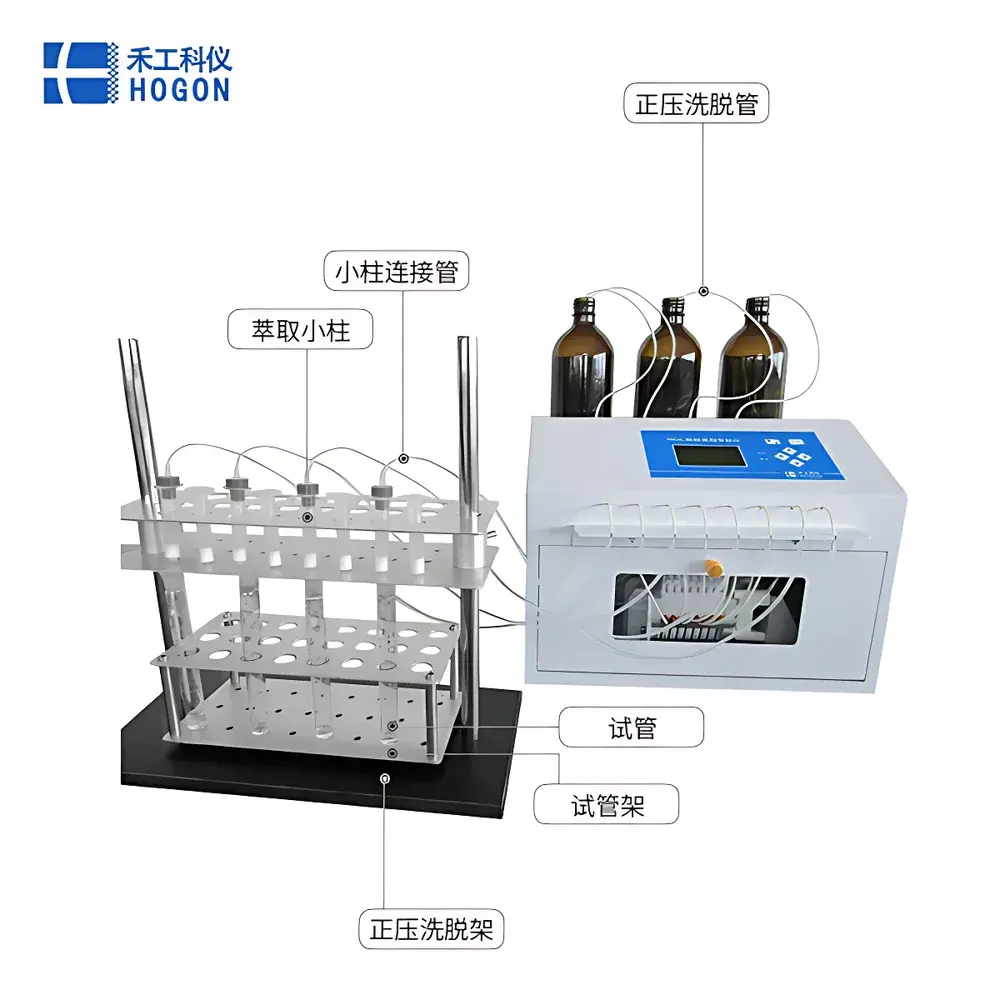
HOGON HGC-8 Numerically Controlled Automated Solid Phase Extraction System
| Brand | HOGON |
|---|---|
| Origin | Shanghai, China |
| Manufacturer Type | Direct Manufacturer |
| Product Category | Domestic |
| Model | HGC-8 |
| Automation Level | Semi-Automatic |
| Number of Channels | 8 |
| Extraction Format | Cartridge-Based SPE |
| Flow Rate Control Range | 0.1–9.9 mL/min |
| Solvent Compatibility | Broad (Customizable Selection) |
| Sample Capacity | 8 Samples per Run |
| Sample Loading Volume | User-Defined |
| Wetted Materials | PTFE (Polytetrafluoroethylene) |
| Power Supply | 220 V / 50 Hz |
| Rated Power | 150 W |
| Maximum Timer Setting | 99 min 59 sec |
| Pump Speed Range | 0.1–100 rpm |
| Flow Accuracy Linearity | High Reproducibility Across Speed–Flow Curve |
| Weight | 12 kg |
Overview
The HOGON HGC-8 Numerically Controlled Automated Solid Phase Extraction System is an engineered solution for high-throughput, reproducible sample preparation in analytical laboratories. Designed around precision peristaltic fluid handling and digitally regulated rotational control, the system implements positive-pressure-driven solid-phase extraction (SPE) using standard 1–6 mL cartridges. Its core architecture integrates a microprocessor-controlled stepper motor drive, calibrated flow-path geometry, and chemically inert PTFE-wetted components to ensure compatibility with aggressive solvents—including acetonitrile, methanol, dichloromethane, hexane, and acidic or basic aqueous matrices—without degradation or leaching. The HGC-8 operates on the fundamental principle of controlled solvent displacement through packed sorbent beds, enabling sequential steps including cartridge conditioning, sample loading, washing, nitrogen-assisted drying, and elution—all programmable and repeatable across up to eight independent channels. It is intended for use in regulated environments where method consistency, operator safety, and solvent containment are critical—particularly in food safety, environmental monitoring, pharmaceutical QC, and forensic toxicology workflows.
Key Features
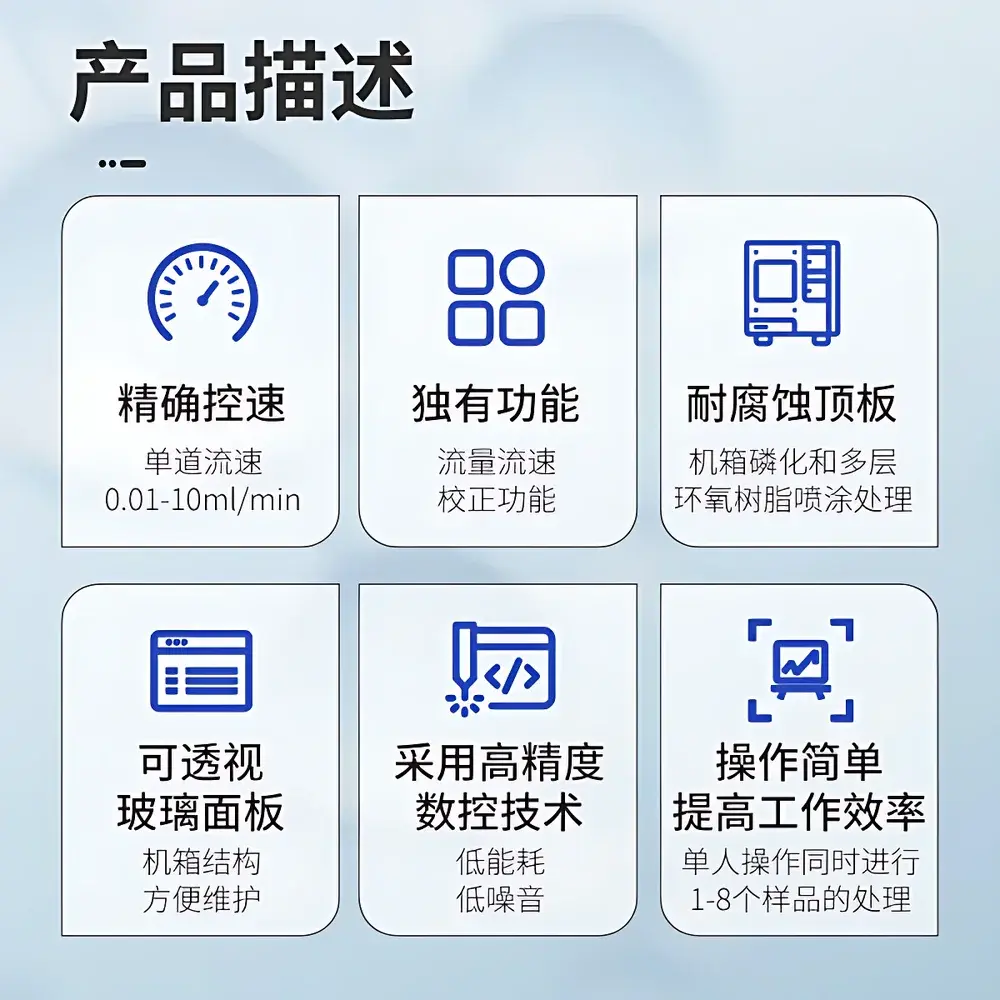
- Precision digital flow control: Adjustable speed range from 0.1 to 100 rpm, correlating linearly to volumetric flow rates between 0.01 and 10 mL/min per channel—validated via built-in flow calibration function.
- Eight parallel SPE channels with independent tubing paths, supporting simultaneous processing of identical or heterogeneous sample sets under individually defined protocols.
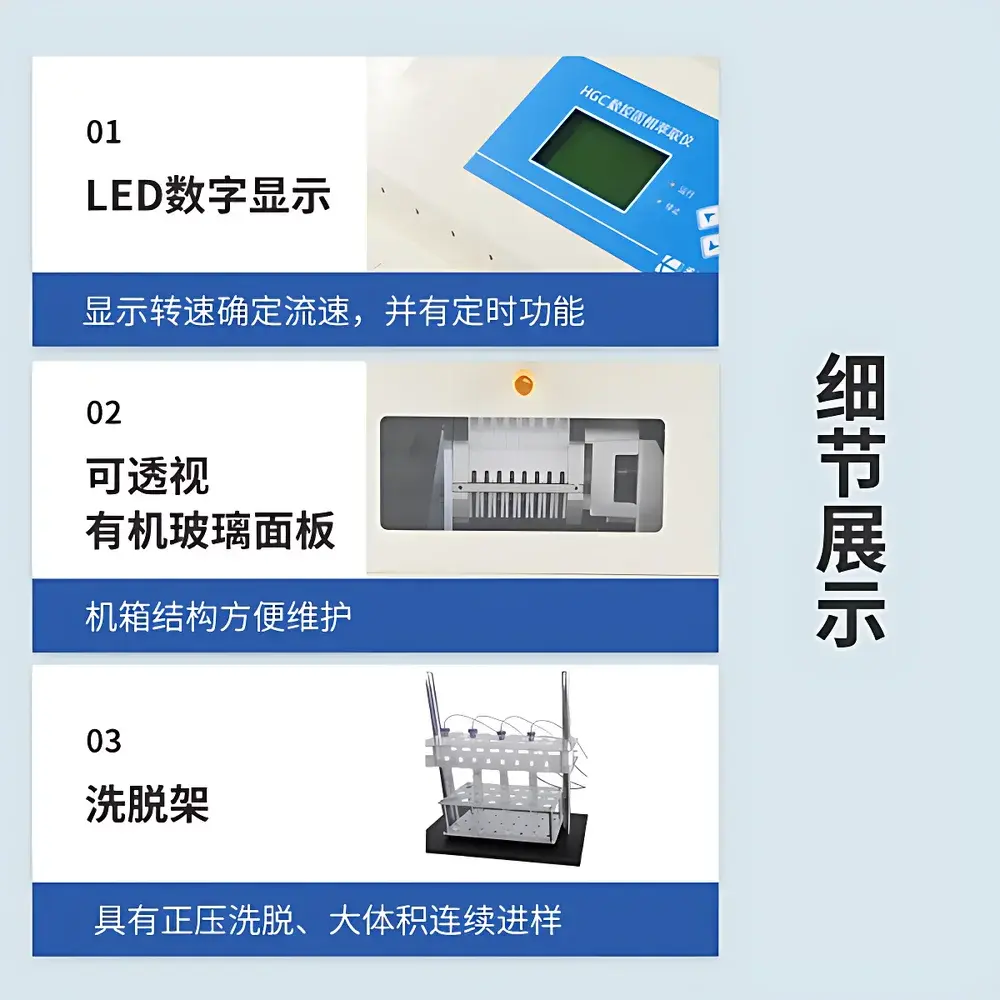
- Chemically resistant construction: PTFE-contact surfaces throughout fluid path; corrosion-resistant anodized aluminum top plate; phosphated and multi-layer epoxy-coated chassis; transparent acrylic front panel for real-time process monitoring and simplified maintenance access.
- Modular hardware configuration: Includes dual-purpose positive-pressure manifolds, 3 mL and 6 mL cartridge adapters, large-volume loading interfaces, and dedicated nitrogen-drying modules—all pre-aligned for leak-free operation.
- Low-noise, energy-efficient operation: 150 W nominal power draw; optimized motor torque profile minimizes mechanical wear and thermal drift during extended runs.
- US-sourced long-life peristaltic pump tubing (standard); optional fluorocarbon (FKM)-rated tubing available for prolonged exposure to aliphatic hydrocarbons such as n-hexane.
Sample Compatibility & Compliance
The HGC-8 accommodates a broad spectrum of sample matrices—including aqueous extracts (e.g., drinking water, wastewater), organic solvent homogenates (e.g., tissue homogenates in ethyl acetate), acidified or buffered biological fluids, and complex emulsions following phase separation. All wetted materials comply with USP Class VI biocompatibility standards and exhibit negligible extractables per ASTM D4291. While the instrument itself does not carry CE or FDA 510(k) certification, its operational design supports compliance with ISO/IEC 17025 method validation requirements, GLP documentation practices, and internal SOPs aligned with AOAC Official Methods®, EPA Methods 500/600 series, and EU Commission Regulation (EU) No 2021/808 for pesticide residue analysis. Sealed manifold architecture prevents solvent vapor escape, meeting OSHA permissible exposure limits (PELs) for laboratory fume hood integration.
Software & Data Management
The HGC-8 operates via embedded firmware with LED-based numeric interface—no external PC required. Time, speed, and step sequencing are set directly via keypad input, with real-time rpm and elapsed time display. Each protocol stores up to four discrete stages (conditioning → loading → washing → elution), with user-defined dwell times (00:01–99:59) and speed values. Though not network-enabled, the system supports full auditability: all parameter entries and runtime logs are retained in non-volatile memory and can be manually transcribed into LIMS or electronic lab notebooks (ELN). For laboratories requiring 21 CFR Part 11 compliance, external timestamped video recording of instrument operation is recommended as supplementary evidence of procedural adherence.
Applications
- Determination of veterinary drug residues (e.g., sulfonamides, tetracyclines) in meat, milk, and honey per EU SANTE/11312/2021 guidelines.
- Multi-residue pesticide screening in fruits, vegetables, and cereals using QuEChERS-compatible SPE cleanup prior to GC-MS/MS or LC-MS/MS.
- Extraction of mycotoxins (aflatoxins, ochratoxin A) from feed and grain samples under AOAC 2005.08.
- Isolation of trace-level endocrine disruptors (e.g., bisphenol A, alkylphenols) from surface water and wastewater per EPA Method 1694.
- Purification of azo dye metabolites from textile leachates prior to HPLC-UV analysis.
- Pre-concentration of polar pharmaceuticals and metabolites from urine and plasma in clinical pharmacokinetic studies.
FAQ
What types of SPE cartridges are compatible with the HGC-8?
Standard 1 mL, 3 mL, and 6 mL polypropylene or glass SPE cartridges with fritted discs—regardless of sorbent chemistry (C18, silica, Florisil, SCX, SAX, mixed-mode)—are fully supported when used with included adapter kits.
Can the HGC-8 perform both positive- and negative-pressure SPE?
It is configured exclusively for positive-pressure elution using compressed air or nitrogen; vacuum-based (negative-pressure) manifolds are not supported due to structural and sealing design constraints.
Is method transfer from manual SPE possible?
Yes—flow rate, dwell time, and solvent sequence parameters can be directly mapped from validated manual protocols; inter-channel variability is typically ≤3% RSD for identically loaded cartridges under identical conditions.
How often does the pump tubing require replacement?
Under typical usage (two 8-sample batches daily), standard tubing lasts ≥6 months; FKM-grade tubing extends service life by ~40% in hydrocarbon-rich applications.
Does the system include data export capability?
No native USB or Ethernet interface is provided; however, all run parameters and timestamps are visible on the front-panel display and may be documented externally for quality records.



