
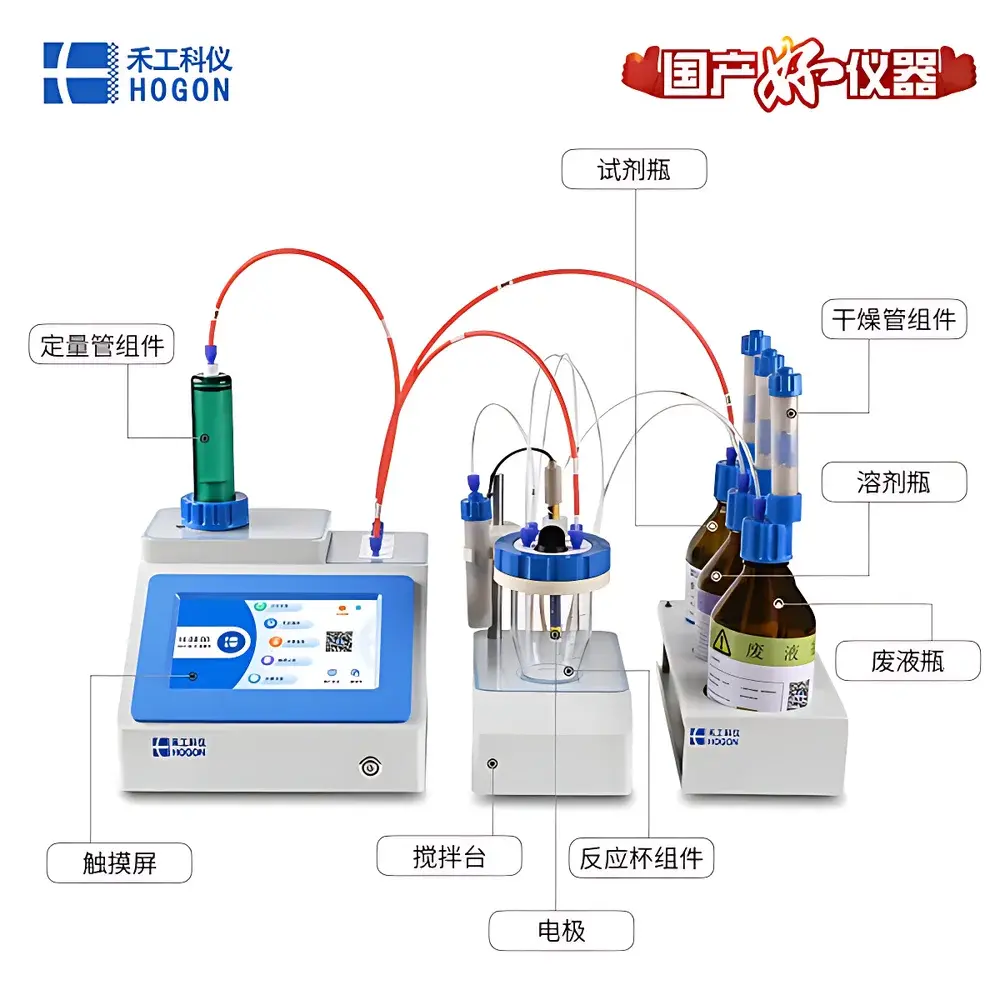
HOGON AKF-V6 Soft Gelatin Capsule Shell-Specific Volumetric Karl Fischer Moisture Titrator
| Brand | HOGON |
|---|---|
| Origin | Shanghai, China |
| Manufacturer Type | Direct Manufacturer |
| Instrument Type | Volumetric Karl Fischer Titrator (with Coulometric option support) |
| Moisture Range | 10 ppm – 100% H₂O (0.001% – 100% w/w) |
| Resolution | 0.1 ppm |
| Precision | RSD ≤ 0.3% (at 1500 µL reagent consumption) |
| Minimum Dispensing Volume | 0.5 µL (20 mL burette) |
| Burette Delivery Accuracy | ±0.5 µL (20 mL burette) |
| Titration Mode | Fully Automated Volumetric Titration |
| Compliance | GLP-compliant audit trail, 3-tier user access control, FDA 21 CFR Part 11–ready data integrity architecture |
Overview
The HOGON AKF-V6 Soft Gelatin Capsule Shell-Specific Volumetric Karl Fischer Moisture Titrator is a purpose-engineered analytical instrument designed to meet the stringent moisture quantification requirements of pharmaceutical solid dosage forms—particularly soft gelatin capsules, hard capsules, excipients, and lyophilized biologics. It operates on the classical volumetric Karl Fischer (KF) titration principle, in which iodine generated *in situ* via stoichiometric reaction with water is quantified using a standardized KF reagent (typically iodine, sulfur dioxide, pyridine or imidazole base, and methanol or chloroform solvent). The AKF-V6 implements a dual-electrode amperometric endpoint detection system coupled with adaptive algorithm-based endpoint recognition, enabling high reproducibility across heterogeneous sample matrices—including viscous, hygroscopic, or low-solubility materials common in capsule shell formulation (e.g., gelatin, hydroxypropyl methylcellulose, plasticizers such as glycerol or sorbitol). Its architecture complies with pharmacopeial methodologies outlined in USP , EP 2.5.12, and JP 2.05, supporting both direct coulometric and volumetric modes, though the AKF-V6 configuration is optimized for volumetric analysis of samples requiring precise reagent dosing and robust endpoint stability.
Key Features
- 7-inch full-color capacitive touchscreen interface with bilingual (English/Chinese) operation menus and real-time display of titration curves, electrode potential, reagent consumption, and calculated moisture content
- Hermetically sealed titration cell assembly constructed from chemically resistant PTFE and borosilicate glass, minimizing atmospheric moisture ingress and reagent degradation during extended operation
- HOGON proprietary high-precision burette drive mechanism delivering ±0.5 µL accuracy over 20 mL capacity, supported by automatic zero-point calibration and dynamic flow compensation
- Fully automated liquid handling: auto-sampling (via optional external autosampler), reagent aspiration, titrant delivery, cell rinsing, waste evacuation, and electrode conditioning—all programmable per method
- Multi-mode endpoint detection: fixed potential, dynamic slope, and derivative-based algorithms; configurable thresholds to accommodate slow-reacting or matrix-interfering samples (e.g., aldehydes, ketones, or acidic excipients)
- Integrated method library with pre-validated protocols for gelatin-based capsule shells, PVA films, freeze-dried proteins, and organic solvents (acetonitrile, chloroform, glacial acetic acid)
- Onboard data storage for ≥1000 complete test records including timestamp, operator ID, method name, raw titration curve, and statistical summary (mean, SD, RSD)
Sample Compatibility & Compliance
The AKF-V6 demonstrates validated performance across solid, semi-solid, and liquid pharmaceutical materials. It routinely analyzes soft and hard gelatin capsule shells, HPMC-based vegetarian capsules, lyophilized monoclonal antibodies, plasma-derived products (e.g., albumin, immunoglobulins), small-molecule APIs (amoxicillin, ibuprofen), and excipients including lactose monohydrate, starch, povidone K30, magnesium chloride hexahydrate, and talc. For low-solubility or thermally labile samples, optional accessories—including a heated headspace sampler (up to 250 °C), magnetic stirring hotplate, and micro-reaction vials (1–5 mL)—extend applicability without derivatization. All data workflows adhere to Good Laboratory Practice (GLP) and Good Manufacturing Practice (GMP) requirements. The system supports full electronic audit trails compliant with FDA 21 CFR Part 11, including immutable user authentication logs, change history of methods and results, and time-stamped electronic signatures. Regulatory documentation packages—including IQ/OQ/PQ templates, traceable calibration certificates, and validation support files—are provided upon request.
Software & Data Management
The embedded firmware runs a deterministic real-time operating system ensuring deterministic response times for titration control loops and endpoint evaluation. Data export is supported via USB 2.0, Ethernet (TCP/IP), and optional Wi-Fi modules, enabling seamless integration into LIMS environments. Raw data files (.csv and proprietary .akf formats) retain full metadata: electrode impedance, drift correction values, background current, and titration kinetics. The software enforces role-based access control (RBAC) with three permission tiers—Administrator, Supervisor, and Analyst—each with granular rights over method editing, result deletion, audit log viewing, and system configuration. All user actions are timestamped and cryptographically logged; no record modification or deletion is permitted without dual-authorization and full contextual annotation. Exported reports include ISO/IEC 17025–recommended uncertainty statements derived from repeatability studies conducted under controlled environmental conditions (20–25 °C, RH <40%).
Applications
- Quantification of residual moisture in soft gelatin capsule shells to ensure mechanical integrity, dissolution profile consistency, and shelf-life prediction
- Stability-indicating assay of lyophilized biologics (e.g., recombinant enzymes, vaccines, mAbs) where water content directly correlates with aggregation propensity and potency loss
- QC release testing of excipients per ICH Q5C guidelines, particularly for hygroscopic polymers (PVP, HPMC) and crystalline carriers (lactose, mannitol)
- Verification of solvent drying efficiency in API synthesis (e.g., residual acetonitrile or toluene in final isolated batches)
- Moisture mapping across batch homogeneity studies for solid oral dosage forms, supporting Process Analytical Technology (PAT) initiatives
- Method transfer support between R&D, QC, and contract manufacturing organizations (CMOs) via standardized .akf method file exchange
FAQ
Is the AKF-V6 compliant with pharmacopeial standards for moisture determination?
Yes—the instrument conforms to USP , EP 2.5.12, and JP 2.05 for volumetric Karl Fischer titration, including specifications for reagent standardization, system suitability testing, and endpoint validation.
Can it analyze samples with high viscosity or poor solubility, such as gelatin melts or polymer films?
Yes—optional heated headspace sampling and integrated magnetic stirring enable reliable analysis of viscous or sparingly soluble matrices without manual pretreatment.
Does the system support electronic signature and audit trail for regulated environments?
Yes—it provides full 21 CFR Part 11–compliant audit trail functionality, including immutable operator logs, electronic signatures, and tamper-evident data archiving.
What is the minimum detectable water mass using the AKF-V6?
At 0.1 ppm resolution and typical 1–2 g sample weights, the practical lower limit of quantitation (LOQ) is ~10 µg absolute water, verified per ICH Q2(R2) guidelines.
How does the AKF-V6 handle reagent stability and carryover between analyses?
The closed-loop fluidic design includes automatic solvent flush cycles, inert gas purging (N₂ or dry air), and real-time reagent titer monitoring to flag drift before it impacts result accuracy.
Related Products





