
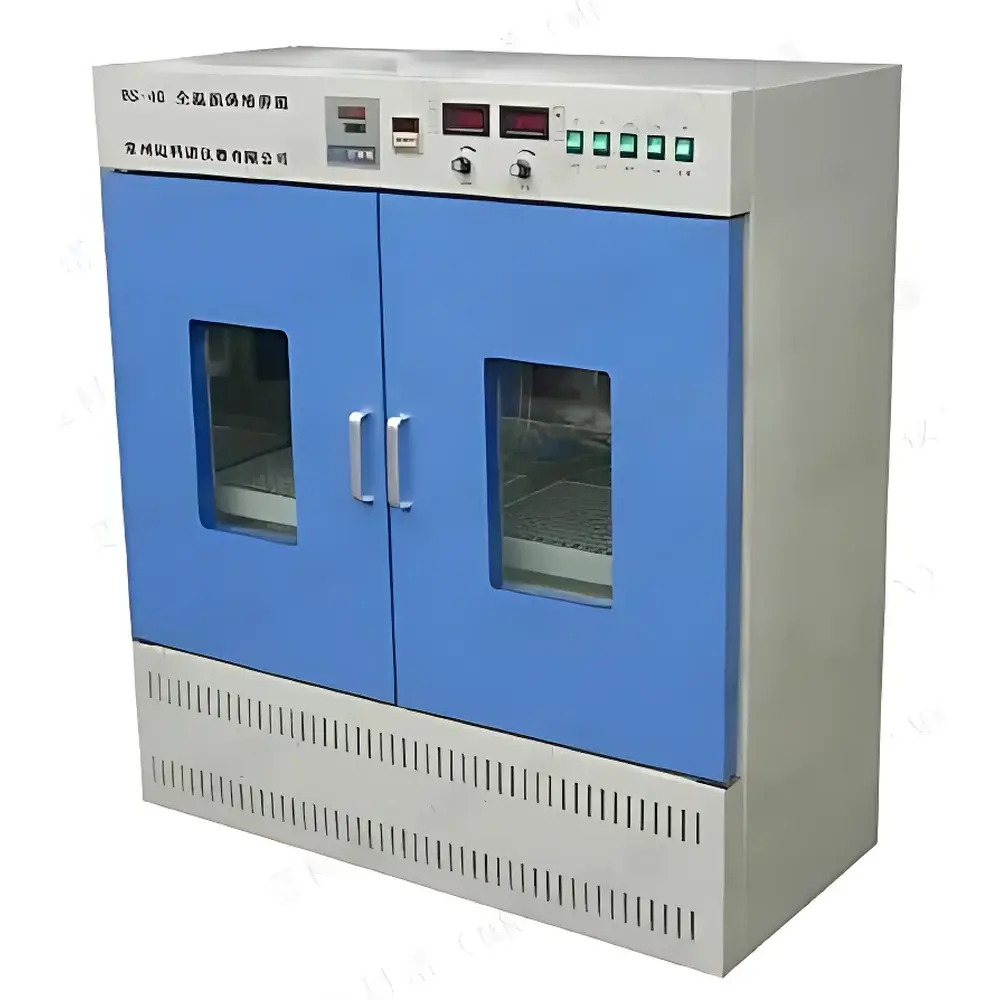
MKN BS-4G Digital Shaking Incubator
| Brand | MKN |
|---|---|
| Origin | Jiangsu, China |
| Model | BS-4G |
| Capacity | 480 L (4-tier configuration) |
| Temperature Range | 5–50 °C |
| Temperature Uniformity | ±1 °C |
| Shaking Speed | 0–300 rpm (adjustable steplessly) |
| Orbit Diameter | 20 mm (circular motion) |
| Power Supply | AC 220 V, 50 Hz |
| Heating Power | 800 W |
| Compressor Power | 180 W |
| External Dimensions | 1440 × 770 × 1700 mm (W × D × H) |
| Chamber Material | Stainless Steel (304) |
| Insulation | In-situ polyurethane foam |
| Air Circulation | Forced-air convection with optimized duct design |
| Bottle Capacity per Tier | 4 × (100 mL × 15 or 200 mL × 9 or Ø16 × 200 mm test tubes × 4) |
Overview
The MKN BS-4G Digital Shaking Incubator is a precision-engineered dual-function bioreactor platform integrating temperature-controlled incubation with programmable orbital shaking. Designed for reproducible cultivation of aerobic microorganisms, suspension cell cultures, and biochemical reaction systems, it operates on the principle of forced-air convection combined with consistent mechanical agitation—enabling uniform thermal distribution and efficient oxygen transfer across culture volumes. Its operational envelope (5–50 °C) supports mesophilic microbial growth, enzyme kinetics studies, and small-scale fermentation protocols under controlled environmental conditions. The unit complies with fundamental laboratory safety and performance expectations outlined in ISO 13485–aligned manufacturing practices and meets structural requirements for Class II biosafety cabinet–adjacent placement per ANSI/NSF 49 guidelines.
Key Features
- Four-tier stacked chamber architecture delivering 480 L total working volume, optimized for high-throughput parallel culture experiments.
- Polyurethane foam insulation applied via in-situ foaming process ensures low thermal conductivity (<0.022 W/m·K), minimizing external ambient influence during extended incubation cycles.
- Stainless steel (AISI 304) interior chamber resists corrosion from repeated sterilization cycles, organic solvents, and acidic/basic media residues.
- Microprocessor-based PID temperature control system with LED digital display offers ±1 °C setpoint accuracy and real-time deviation monitoring.
- Brushless DC motor drive enables stepless speed regulation from 0 to 300 rpm with torque stability across load variations; integrated overload protection prevents motor stall during viscous medium agitation.
- 20 mm circular orbit provides gentle yet effective mixing suitable for sensitive eukaryotic cells and filamentous fungi without shear-induced lysis.
- Universal spring-loaded bottle clamps accommodate multiple vessel formats simultaneously—including test tubes (Ø16 × 200 mm), Erlenmeyer flasks (100 mL × 15 per tier), and wide-mouth bottles (200 mL × 9 per tier).
Sample Compatibility & Compliance
The BS-4G accommodates standard microbiological and cell culture vessels used in academic, pharmaceutical QC, and industrial R&D labs. Its chamber geometry supports common shaker flask configurations compliant with ASTM D2510 (Standard Practice for Laboratory Shaking of Liquids). While not certified for GLP/GMP production environments, its construction and calibration traceability support data integrity requirements for preliminary screening assays, method development, and training applications. Temperature uniformity validation reports can be generated using calibrated NIST-traceable thermistors placed at nine standardized locations per tier (per ISO/IEC 17025 recommendations).
Software & Data Management
The BS-4G operates via embedded firmware without external PC dependency; all parameters are configured directly through front-panel membrane keys and confirmed via real-time LED readouts. Though lacking network connectivity or cloud-based logging, the controller retains last-used settings after power interruption and includes password-protected parameter lockout to prevent accidental modification during unattended operation. For laboratories requiring audit trails, optional external data loggers (e.g., Omega OM-DAQPRO-5300 series) may be interfaced via analog voltage outputs (0–5 VDC) corresponding to chamber temperature and motor RPM.
Applications
- Maintenance of bacterial stock cultures (E. coli, Bacillus spp.) in liquid LB or TB media under aerobic conditions.
- Suspension culture of CHO or HEK293 cells during transfection optimization and early-stage bioprocess scouting.
- Enzymatic hydrolysis assays requiring precise thermal and kinetic control (e.g., cellulase activity at 50 °C).
- Environmental microbiology studies involving soil slurry enrichment or wastewater inoculum propagation.
- Pre-incubation of samples prior to downstream analysis by HPLC, GC-MS, or spectrophotometry.
- Educational use in undergraduate life science laboratories for teaching microbial growth kinetics and environmental response modeling.
FAQ
What is the maximum allowable ambient operating temperature for stable 5 °C cooling performance?
The refrigeration system maintains chamber setpoints down to 5 °C when ambient temperature does not exceed 32 °C and relative humidity remains below 80% RH.
Can the BS-4G operate continuously for 72+ hours without manual intervention?
Yes—designed for unattended long-term incubation, provided ventilation clearance (≥10 cm rear/side) is maintained and no condensate accumulation occurs in compressor compartment.
Is the stainless steel chamber electropolished or passivated?
Chamber surfaces undergo standard acid passivation per ASTM A967 but are not electropolished; routine cleaning with 70% ethanol or diluted citric acid solution is recommended between runs.
Does the unit include factory calibration documentation?
Each unit ships with a Certificate of Conformance referencing internal thermistor and tachometer verification against reference standards; full metrological calibration certificates require third-party service.
What maintenance intervals are recommended for optimal performance?
Compressor oil level and air filter inspection every 6 months; door gasket integrity check quarterly; annual verification of temperature uniformity using multi-point probe arrays.






