
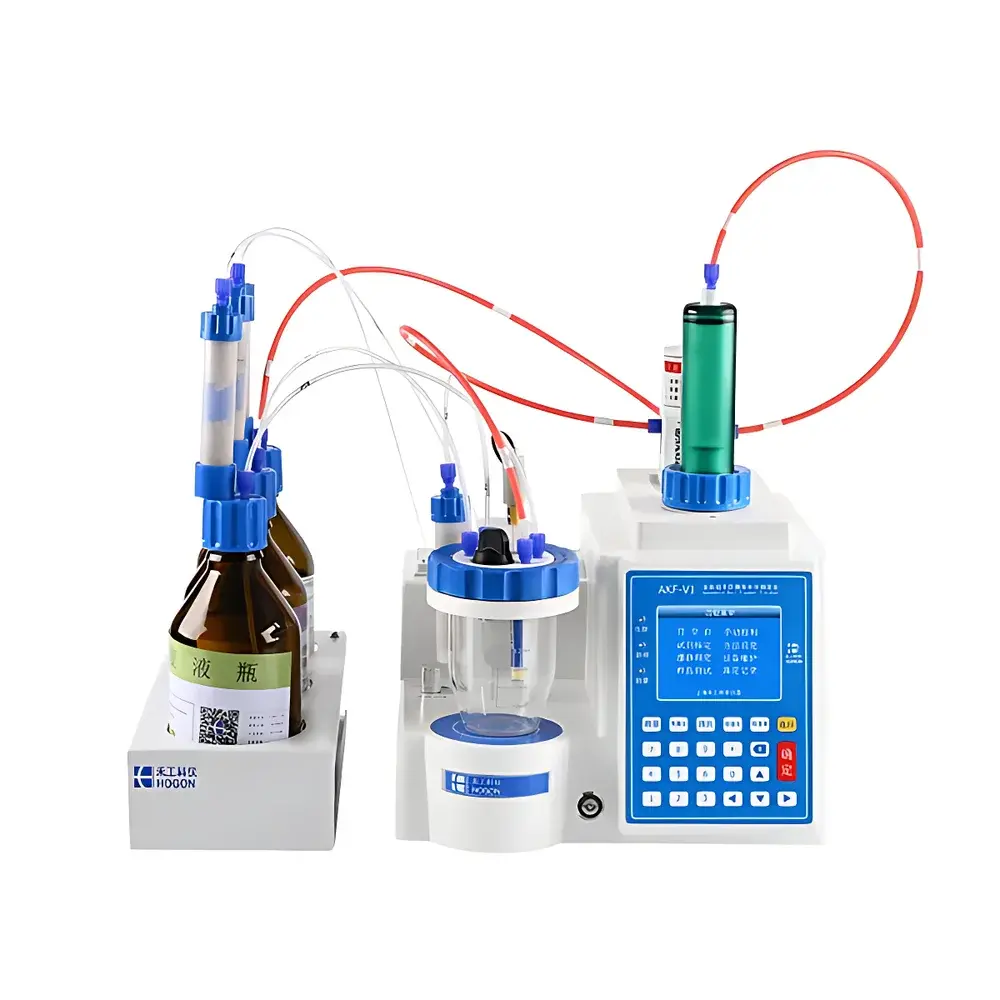
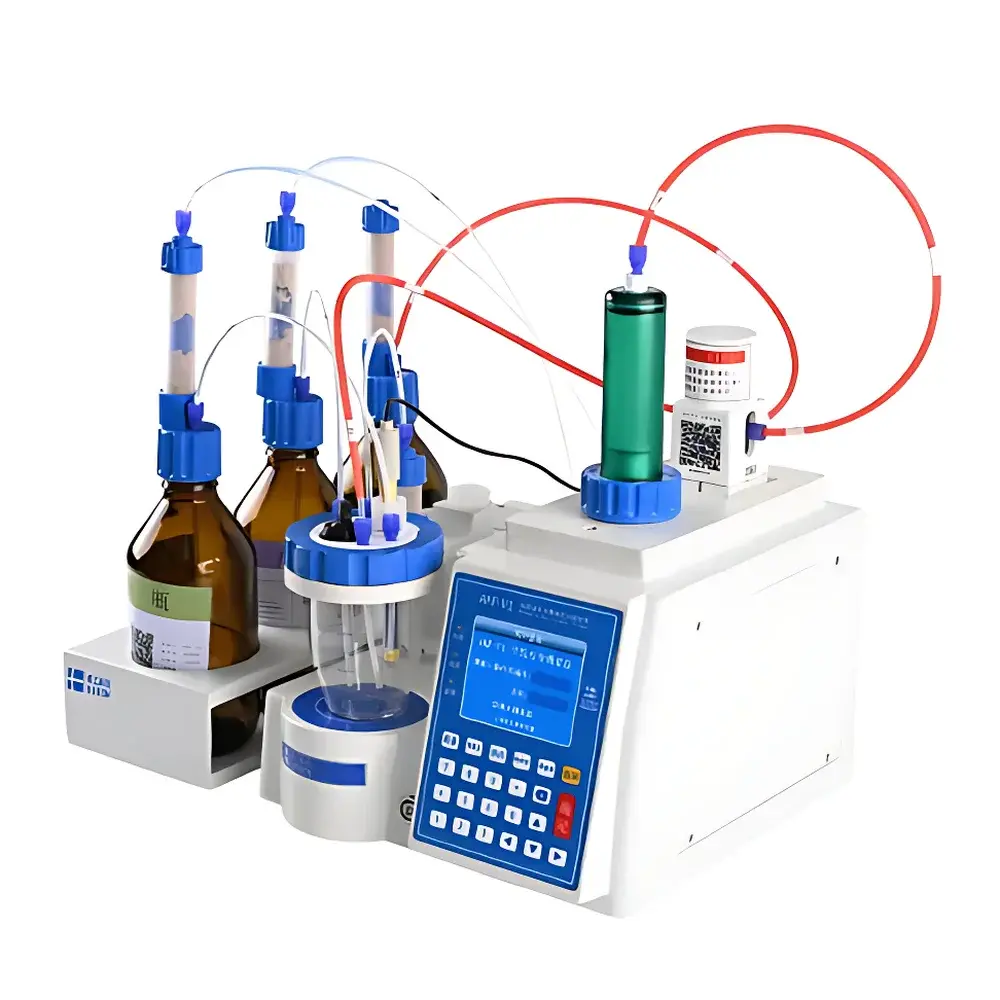
HOGON AKF-V1 Karl Fischer Moisture Analyzer for Cosmetic Foundation Liquids
| Brand | HOGON |
|---|---|
| Origin | Shanghai, China |
| Manufacturer Type | Direct Manufacturer |
| Instrument Type | Volumetric Karl Fischer Titrator |
| Moisture Range | 0.001–100.00% (10 ppm – 100% w/w) |
| Resolution | 1 ppm |
| Measurement Precision | ±1 mV |
| Minimum Dispensing Volume | 1 µL |
| Repeatability | RSD ≤ 0.5% (at 20 mg H₂O) |
| Linearity Correlation Coefficient | ≥0.998 |
| Polarization Voltage Adjustment Range | 0–120 mV |
| Burette | 20 mL Long-Life Automatic Burette |
| Titrant Delivery Accuracy | ±0.001 mL |
| Power Supply | 110–240 V AC, 50–60 Hz |
| Data Storage Capacity | 100 test records |
Overview
The HOGON AKF-V1 Karl Fischer Moisture Analyzer is a volumetric titration-based instrument engineered for precise and trace-level water quantification in complex, low-volatility, or emulsion-based cosmetic formulations—particularly foundation liquids. It operates on the stoichiometric principle of the Karl Fischer (KF) reaction, wherein iodine reacts quantitatively with water in the presence of sulfur dioxide, a base (typically imidazole), and a solvent (e.g., anhydrous methanol). The endpoint is detected potentiometrically using a dual-platinum electrode system, ensuring high sensitivity and robust endpoint discrimination—even in samples with high viscosity, suspended solids, or surfactant-rich matrices. Unlike loss-on-drying (LOD) methods, which suffer from volatile co-evaporation and thermal decomposition artifacts, the AKF-V1 delivers chemically specific, matrix-resistant water determination compliant with ISO 8533, ASTM E203, and USP . Its design prioritizes analytical integrity in regulated cosmetic QC environments where water content directly governs emulsion stability, microbial risk (per ISO 22716 GMP), shelf-life prediction, and sensory performance.
Key Features
- Volumetric KF titration architecture with dual-platinum polarizable electrodes for reliable end-point detection in heterogeneous cosmetic emulsions.
- 20 mL high-precision automatic burette with ±0.001 mL delivery accuracy and extended service life—optimized for routine use with hygroscopic KF reagents.
- Adjustable polarization voltage (0–120 mV) to fine-tune electrode response kinetics across varying sample conductivities and solvent systems.
- Integrated micro-dispensing module enabling 1 µL minimum reagent increments—critical for minimizing reagent consumption and improving titration resolution at sub-0.1% moisture levels.
- Sealed, inert-gas purged titration cell assembly to prevent ambient moisture ingress and reagent degradation during analysis of low-water-content samples.
- Embedded firmware supporting automated blank correction, multi-point calibration verification, and real-time titration curve visualization.
Sample Compatibility & Compliance
The AKF-V1 is validated for direct analysis of O/W and W/O foundation emulsions without derivatization or extraction. It accommodates viscous, pigment-loaded, and silicone-containing formulations via optimized solvent selection (e.g., anhydrous methanol with optional chloroform or formamide co-solvents per ASTM D6304 Annex A3). All hardware and software components conform to IEC 61010-1 safety standards. Data handling meets GLP requirements: each measurement record includes timestamp, operator ID, reagent batch, calibration history, and full titration curve metadata. Audit trail functionality supports FDA 21 CFR Part 11 readiness when deployed with optional networked data management modules.
Software & Data Management
The instrument runs embedded firmware with a touchscreen GUI supporting multilingual operation (English, Chinese, Spanish). It stores up to 100 complete test records locally—including raw titration data, calculated %H₂O, RSD, drift correction values, and user annotations. Export is supported via USB to CSV format for LIMS integration. Calibration logs retain slope, intercept, and correlation coefficient (≥0.998) for every KF reagent standardization event. Firmware updates are delivered via secure firmware image files—not cloud-dependent—ensuring continuity in regulated lab environments.
Applications
- QC release testing of foundation liquids per internal specifications and ISO 22716 Annex C moisture limits.
- Stability-indicating assay during accelerated aging studies (40°C/75% RH) to correlate water migration with phase separation onset.
- Raw material qualification of pigments, thickeners, and emulsifiers where bound vs. free water affects dispersion behavior.
- Process validation of homogenization and filling steps where residual moisture impacts preservative efficacy (e.g., against Pseudomonas aeruginosa per ISO 11930).
- Root cause investigation of microbial spoilage incidents linked to elevated water activity (aw) thresholds.
FAQ
Can the AKF-V1 analyze foundation liquids containing silicones or high concentrations of titanium dioxide?
Yes—using anhydrous methanol with 10–20% v/v chloroform improves solubilization and prevents electrode fouling. Method validation per ASTM D6304 is recommended for new formulations.
Is method transfer possible from older coulometric KF instruments?
Yes—volumetric protocols are inherently more reproducible for emulsions. We provide documented SOPs aligned with ISO 8533 Annex B for seamless transition.
How often must the burette be recalibrated?
Factory calibration is valid for 12 months under normal use; we recommend quarterly verification using certified water standards (e.g., Hydranal 1.00 mg/mL).
Does the system support remote diagnostics or preventive maintenance alerts?
Local diagnostics are accessible via service menu; remote support requires optional Ethernet module and IT-approved firewall configuration.
What documentation is provided for regulatory audits?
Each unit ships with Factory Acceptance Test (FAT) report, IQ/OQ templates, and a full traceable calibration certificate per ISO/IEC 17025-accredited provider.





