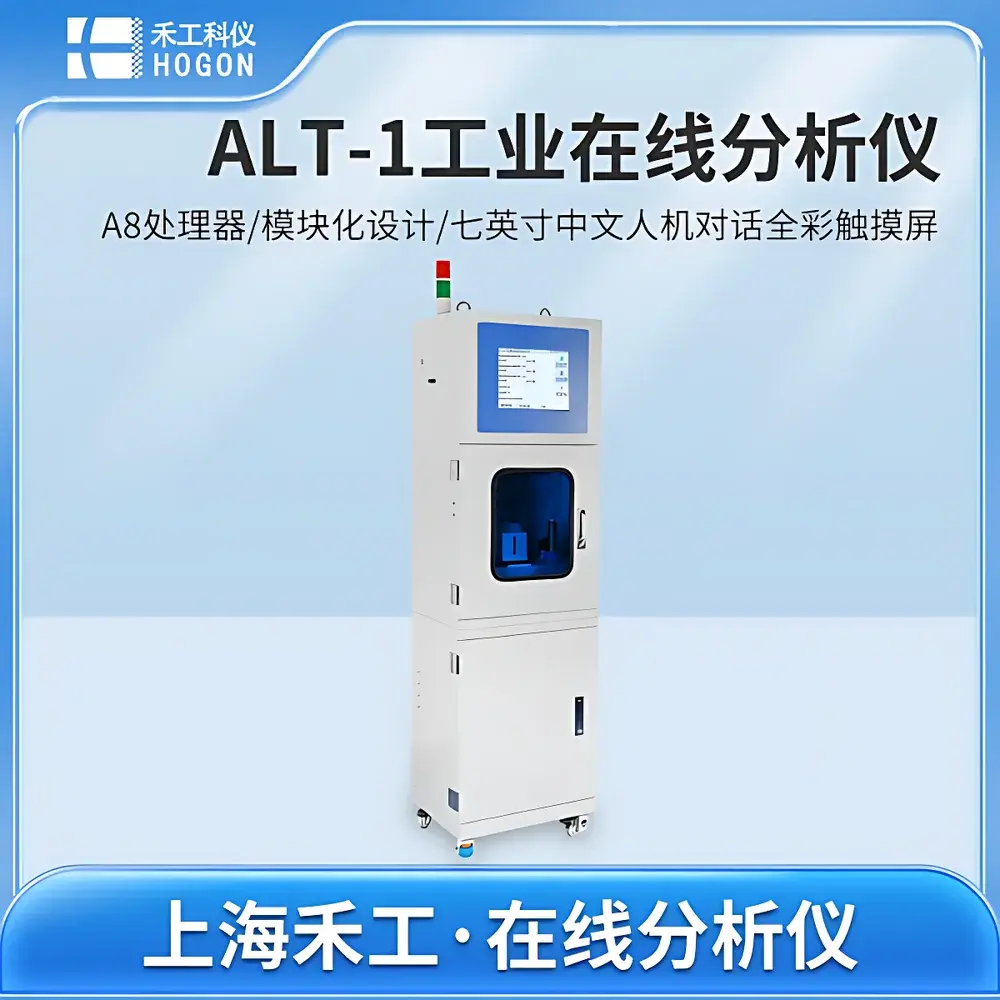
HOGON Online Karl Fischer Coulometric Moisture Analyzer
| Brand | HOGON |
|---|---|
| Origin | Shanghai, China |
| Manufacturer Type | Direct Manufacturer |
| Country of Origin | China |
| Model | Online Karl Fischer Coulometric Moisture Analyzer |
| Pricing | Upon Request |
| Operating Temperature | 5–40 °C |
| Relative Humidity | ≤90% RH (non-condensing) |
| Sample Pressure | Atmospheric (or pressurized via optional pressure regulator) |
| Sample Line | Φ1/8″ or 6–10 mm PFA tubing |
| Sample Flow Path | Standard single-channel |
| Sample Temperature Range | 5–60 °C |
| Reagent-Wetted Materials | Corrosion- and oxidation-resistant high-performance polymers |
| Nitrogen Purge | Optional micro-positive-pressure inert atmosphere |
| Enclosure Rating | IP55/IP65 (customizable) |
| Explosion Protection | Non-explosion-proof standard |
| Analyte Phase | Liquid samples only |
| Measurement Principle | Coulometric Karl Fischer titration |
| Auxiliary Functions | Multi-stream sampling module (1:N), reagent dosing control, anti-crystallization heating jacket |
| Detection Module | Potentiometric endpoint detection |
| Output Interfaces | Modbus TCP, RS-232/RS-485, CAN bus |
| Status Indicators | Dual-color LED (operational / alarm) |
| Measurement Range | Absolute water mass: 3 µg – 199 mg |
| Water concentration | 1 ppm – 100% w/w |
| Resolution | 0.01 µg (water mass) |
| Electrolysis Current | 0–400 mA |
| Max. Electrolysis Rate | 2241 µg/min |
| User Access Control | Three-tier permission system compliant with GMP/GLP requirements |
| Audit Trail | Full timestamped event logging including method changes, calibration actions, operator logins, and raw measurement data |
Overview
The HOGON Online Karl Fischer Coulometric Moisture Analyzer is an industrial-grade, process-integrated moisture measurement system engineered for continuous, real-time quantification of trace to bulk water content in liquid process streams. It operates on the fundamental electrochemical principle of coulometric Karl Fischer titration—where iodine is generated *in situ* via controlled electrolysis of an iodide-containing reagent, and stoichiometrically reacts with water according to the classic Karlsruhe reaction: I₂ + SO₂ + H₂O + 3RN + CH₃OH → 2RN·HI + RN·HSO₄CH₃. The total charge passed during electrolysis (Q = I × t) is directly proportional to the moles of water consumed, enabling absolute mass-based quantification without volumetric calibration. Designed for unattended operation in demanding chemical, pharmaceutical, and battery electrolyte manufacturing environments, this analyzer delivers laboratory-grade accuracy under field conditions while meeting core regulatory expectations for data integrity and process consistency.
Key Features
- True coulometric detection with sub-microgram resolution (0.01 µg water) and dynamic range spanning 1 ppm to 100% w/w water content
- Robust sample interface supporting atmospheric or pressurized liquid streams (up to 10 bar with optional pressure regulation)
- Chemically inert, temperature-stabilized fluidic path constructed from PFA tubing and corrosion-resistant polymer components, minimizing reagent degradation and crystallization risk
- Integrated anti-crystallization heating jacket and optional nitrogen purge for stable endpoint detection in low-water or high-solvent-volatility applications
- Modular architecture enabling 1:N multi-stream sampling—ideal for monitoring multiple reactors, storage tanks, or distillation columns from a single analyzer
- Three-level role-based access control (administrator, supervisor, operator) with password enforcement and session timeout
- Comprehensive audit trail compliant with FDA 21 CFR Part 11 and EU Annex 11 requirements, recording all user actions, method parameters, calibration events, and raw sensor outputs with immutable timestamps
Sample Compatibility & Compliance
This analyzer is validated for use with organic solvents (e.g., acetonitrile, methanol, DMF, THF, ethyl acetate), battery electrolyte formulations (LiPF₆ in carbonate blends), pharmaceutical excipients, and petrochemical feedstocks. It excludes non-aqueous reactive species (e.g., aldehydes, ketones, strong bases, peroxides) that interfere with the KF reaction stoichiometry. All wetted materials conform to USP Class VI biocompatibility standards. The system meets IEC 61000-6-2/6-4 for electromagnetic compatibility and is certified to IP55/IP65 ingress protection. Optional ATEX/IECEx-certified pressurized enclosures (IICT4) are available for Zone 1/2 hazardous areas. Performance validation follows ISO 12099:2017 and ASTM E203–22 protocols, with documented linearity (R² ≥ 0.9995 across low/mid/high water ranges), repeatability (RSD ≤ 1.29% at 1000 ppm), and trueness (±4.67% bias at 60 ppm).
Software & Data Management
The embedded controller runs a deterministic real-time OS with dual redundant storage for local data retention (≥30 days of full-resolution measurements). Communication interfaces include Modbus TCP (for DCS/SCADA integration), RS-485 (multi-drop configuration), and CAN bus (for distributed sensor networks). Configuration, diagnostics, and historical trend review are accessible via a secure web-based HMI (HTTPS/TLS 1.2) or optional OPC UA server. All exported data files (CSV, PDF reports) retain digital signatures and embedded audit trail metadata. Calibration logs, drift correction records, and reagent consumption tracking are automatically archived and exportable for regulatory submission.
Applications
- Battery Manufacturing: Continuous monitoring of moisture in Li-ion electrolyte filling lines, solvent recovery loops, and dry room ambient air scrubbers—ensuring <10 ppm H₂O to prevent LiPF₆ hydrolysis and SEI layer instability
- Pharmaceutical Production: In-line verification of residual moisture in aprotic solvents (e.g., dichloromethane, toluene) used in API crystallization and lyophilization cycles, supporting ICH Q5C stability protocols
- Fine Chemical Synthesis: Real-time feedback control of dehydration steps in esterification, amidation, and Grignard reactions where water acts as a catalyst poison or side-reaction initiator
- Petrochemical Refining: Monitoring moisture breakthrough in molecular sieve beds and amine gas treating units to prevent corrosion and solvent degradation
FAQ
How does coulometric KF differ from volumetric KF in online applications?
Coulometric KF generates titrant electrochemically, eliminating reagent delivery pumps, burettes, and associated maintenance. This yields superior long-term stability, zero reagent carryover, and inherent traceability of water mass via Faraday’s law—making it ideal for unattended, low-moisture (<100 ppm) process streams.
Can the analyzer handle viscous or particulate-laden samples?
It requires clarified, particle-free liquid streams. Inline filtration (5 µm sintered metal) and heated sample conditioning (up to 60 °C) are recommended for high-viscosity solvents. Slurries or suspensions must be pre-filtered offline.
What validation documentation is provided upon commissioning?
Each unit ships with a Factory Acceptance Test (FAT) report, IQ/OQ protocol templates aligned with ASTM E203, and a Certificate of Conformance referencing ISO/IEC 17025-accredited calibration of the current source and timer circuitry.
Is remote firmware update supported?
Yes—secure over-the-air (OTA) updates are enabled via TLS-encrypted HTTP POST, requiring administrator authentication and SHA-256 signature verification prior to installation.
How is reagent lifetime managed?
The system tracks cumulative electrolysis charge and cross-references it against reagent lot-specific capacity specifications. Predictive alerts trigger at 85% utilization, and endpoint drift compensation algorithms auto-adjust for gradual reagent aging.
Related Products