
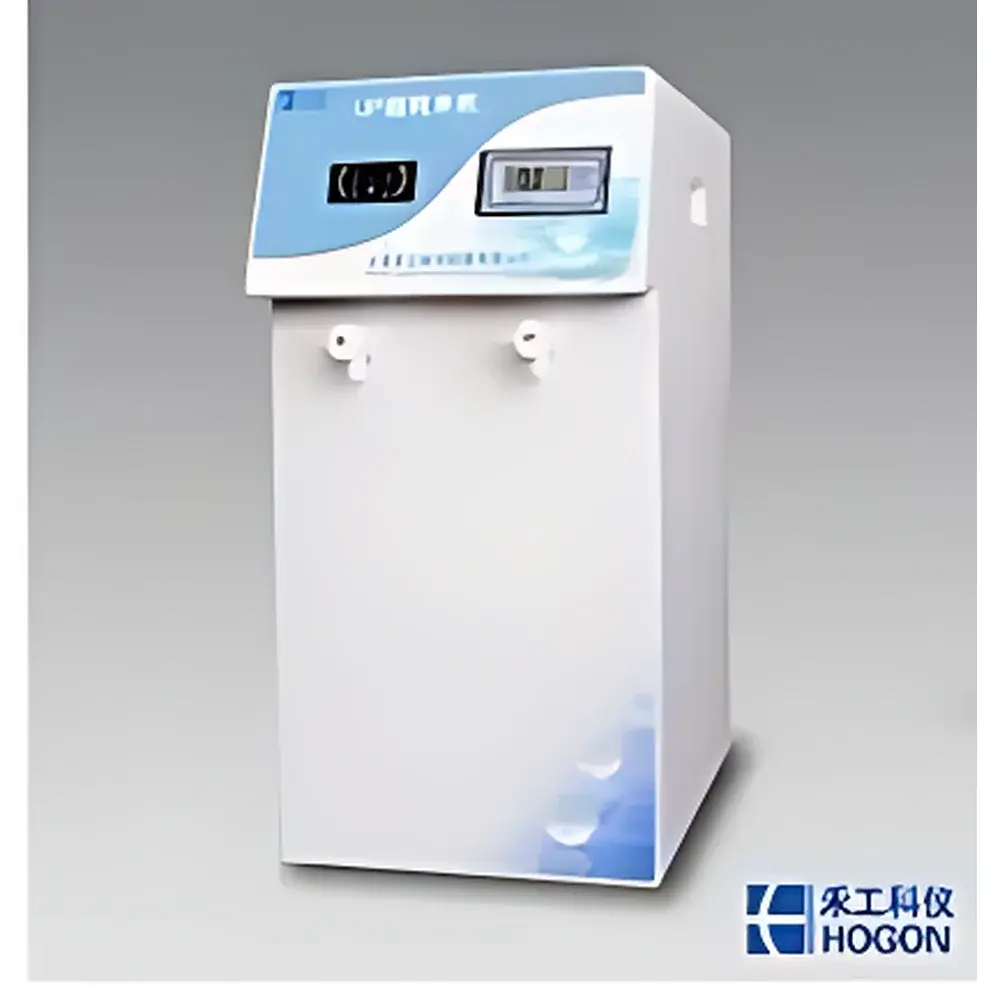
HOGON HUP I Ultra Pure Water System (Municipal Tap Water Feed)
| Brand | HOGON |
|---|---|
| Origin | Shanghai, China |
| Manufacturer Type | Direct Manufacturer |
| Product Category | Domestic |
| Model | HUP I (Basic Edition) |
| Pure Water Grade | ASTM Type I / ISO 3696 Grade 1 |
| Resistivity | 18.2 MΩ·cm @ 25 °C |
| Heavy Metals & Soluble Silica | <0.1 ppb |
| Total Organic Carbon (TOC) | <10 ppb |
| Microbial Count | <0.001 EU/mL |
| Particles (>0.1 � | m): <1 particles/mL |
| Flow Rate | 15 L/h (at 25 °C) |
| UV Wavelengths | 254 nm & 185 nm (optional) |
| UF Cutoff | 5000 Da (optional) |
| Terminal Filtration | 0.2 μm hydrophilic membrane |
| Power Supply | 220 V / 50 Hz |
| Dimensions (H×W×D) | 320 × 450 × 540 mm |
| Weight | 25 kg |
Overview
The HOGON HUP I Ultra Pure Water System is a compact, integrated laboratory-grade water purification platform engineered to produce ASTM Type I (ISO 3696 Grade 1) ultrapure water directly from municipal tap water. It employs a multi-stage purification architecture combining pretreatment (sediment and activated carbon filtration), reverse osmosis (RO), ion exchange, dual-wavelength UV photooxidation (254 nm + 185 nm), and optional ultrafiltration (UF) with a 5000 Da molecular weight cutoff. This configuration ensures consistent removal of particulates, dissolved ions, organic contaminants, microorganisms, endotoxins, and nucleases—critical for sensitive analytical and life science applications. The system operates under full microprocessor control with real-time resistivity monitoring, automated RO membrane antiscalant flushing, and fail-safe protection logic including low-pressure cutoff, high-pressure shutoff, dry-run prevention, and auto-restart after power interruption.
Key Features
- Real-time online resistivity monitoring (18.2 MΩ·cm @ 25 °C) with backlit LCD display showing operational status: production, standby, rinse, low-water alarm, and service alerts
- Modular quick-connect design enabling tool-free replacement of consumables—including four imported mixed-bed ion exchange cartridges, 0.2 μm terminal filter, and dual-wavelength UV lamp assembly
- Integrated 12 L hydropneumatic storage tank with sanitary closed-loop design to minimize atmospheric recontamination and maintain TOC stability below 10 ppb
- Pre-installed 100 GPD RO membrane with programmable automatic flush cycle to extend membrane service life and ensure long-term flux stability
- GLP-compliant housing constructed from corrosion-resistant, electrically insulated polymer with IP20-rated enclosure and CE-marked internal components
- Dual independent output ports: one for RO permeate (suitable for glassware rinsing or feedwater to secondary systems), and one for ultrapure water (Type I grade)
Sample Compatibility & Compliance
The HUP I delivers water meeting or exceeding the purity specifications required by major international standards, including ASTM D1193-20 (Type I), ISO 3696:1987 (Grade 1), CLSI EP23-A (for clinical lab water), and USP . Its ≤0.1 ppb heavy metal and soluble silica content, <0.001 EU/mL endotoxin level, and 0.1 μm) performance support rigorous applications in regulated environments. Optional UF and dual-wavelength UV configurations further enhance suitability for cell culture media preparation, monoclonal antibody purification, and PCR-grade reagent formulation—where nuclease and pyrogen control are essential. All fluid-contact materials comply with USP Class VI biocompatibility requirements and FDA 21 CFR 177.2420 for polymeric components.
Software & Data Management
While the HUP I operates via embedded firmware without external PC connectivity, its control system logs key operational events—including total runtime, number of RO flush cycles, cumulative volume produced, and alarm history—with timestamped entries stored in non-volatile memory. All parameter displays and status indicators conform to IEC 61000-6-2/6-4 electromagnetic compatibility standards. For laboratories requiring audit-ready records, optional RS-232 or analog 4–20 mA outputs can be integrated for connection to building management systems or LIMS platforms. The system supports GLP-aligned documentation practices through printed maintenance logs (via optional thermal printer interface) and user-accessible calibration reset protocols traceable to NIST-traceable resistivity standards.
Applications
- HPLC mobile phase and sample diluent preparation, especially for gradient elution and low-UV detection (e.g., 210 nm)
- ICP-MS and ICP-OES nebulizer feed where sub-ppt elemental background is mandatory
- Cell culture media and buffer formulation for primary neuronal or stem cell work
- Protein crystallization, electrophoresis, and Western blotting wash buffers
- Atomic absorption spectroscopy (AAS), atomic fluorescence (AFS), and graphite furnace analysis
- Calibration standard preparation for trace metal analysis per EPA Method 200.8 and ISO 17294-2
FAQ
What is the expected service life of the RO membrane under typical municipal feedwater conditions?
With proper pretreatment (including optional softener for hard water areas) and adherence to scheduled automatic flush cycles, the 100 GPD RO membrane typically achieves 2–3 years of stable performance before replacement.
Can the system be upgraded to include UF or additional UV modules post-purchase?
Yes—the HUP I chassis supports field-installable UVF upgrade kits containing both dual-wavelength UV lamps and 5000 Da UF cartridges, with plug-and-play integration into the existing flow path.
Is the resistivity sensor factory-calibrated, and does it require periodic recalibration?
The inline conductivity/resistivity sensor is pre-calibrated against NIST-traceable KCl standards; annual verification using certified 18.2 MΩ·cm reference solution is recommended per ISO/IEC 17025 guidelines.
Does the system meet regulatory requirements for pharmaceutical QC laboratories?
When configured with UF and dual-wavelength UV, and operated under documented SOPs with preventive maintenance logs, the HUP I satisfies core water quality requirements of USP , EU GMP Annex 1, and ICH Q5C for non-sterile biopharmaceutical process water.
What consumables require routine replacement, and what is the average annual cost?
Standard consumables include: two 10-inch PP sediment filters (every 6 months), two 10-inch carbon block cartridges (every 6–12 months), one RO membrane (every 24–36 months), four mixed-bed polishing columns (every 12–18 months), and one 0.2 μm terminal filter (every 6 months); typical annual consumable cost ranges from USD 480–620 depending on usage volume and local water quality.



