
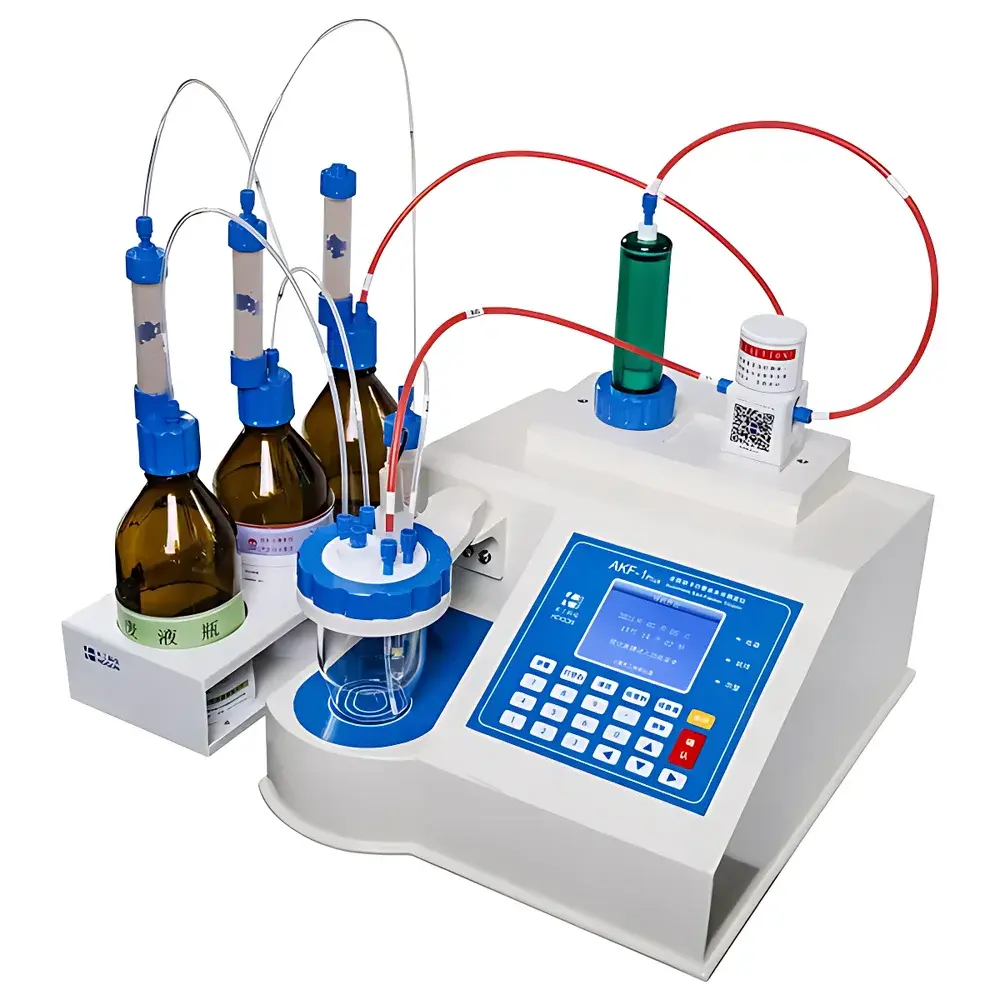
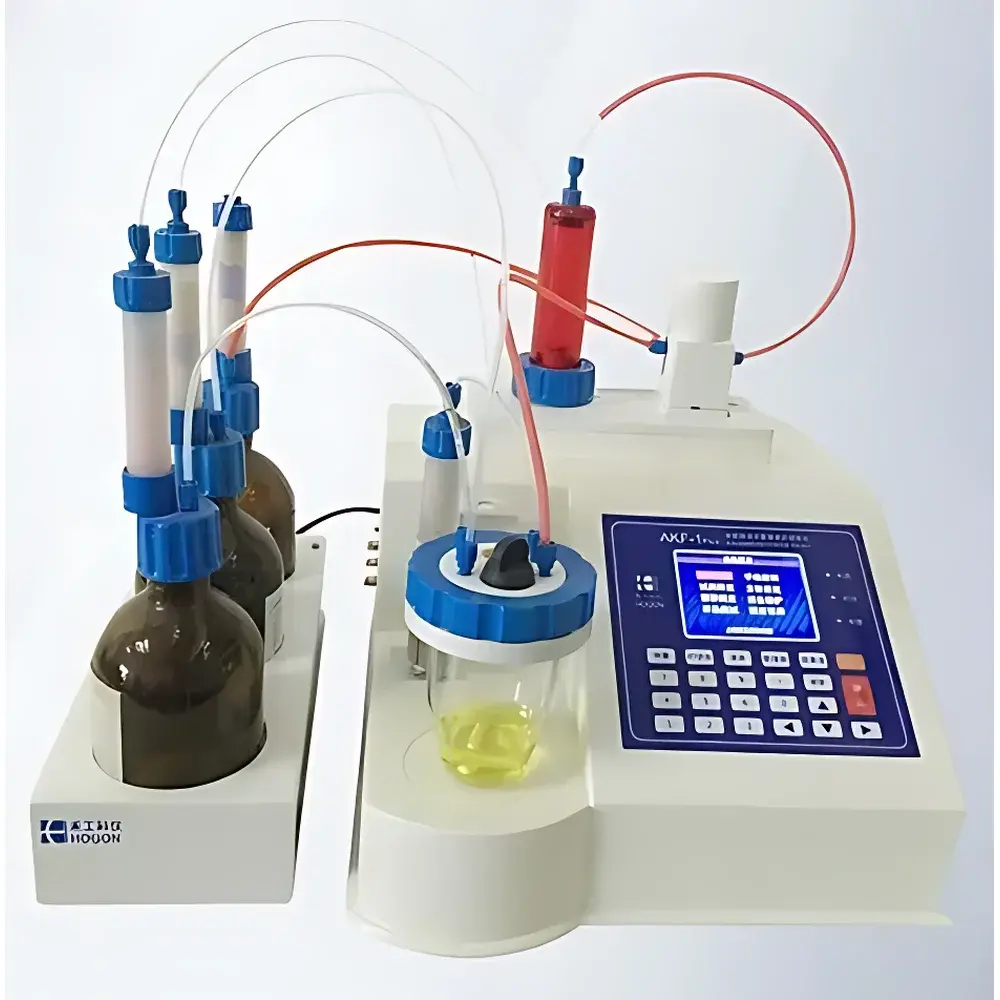
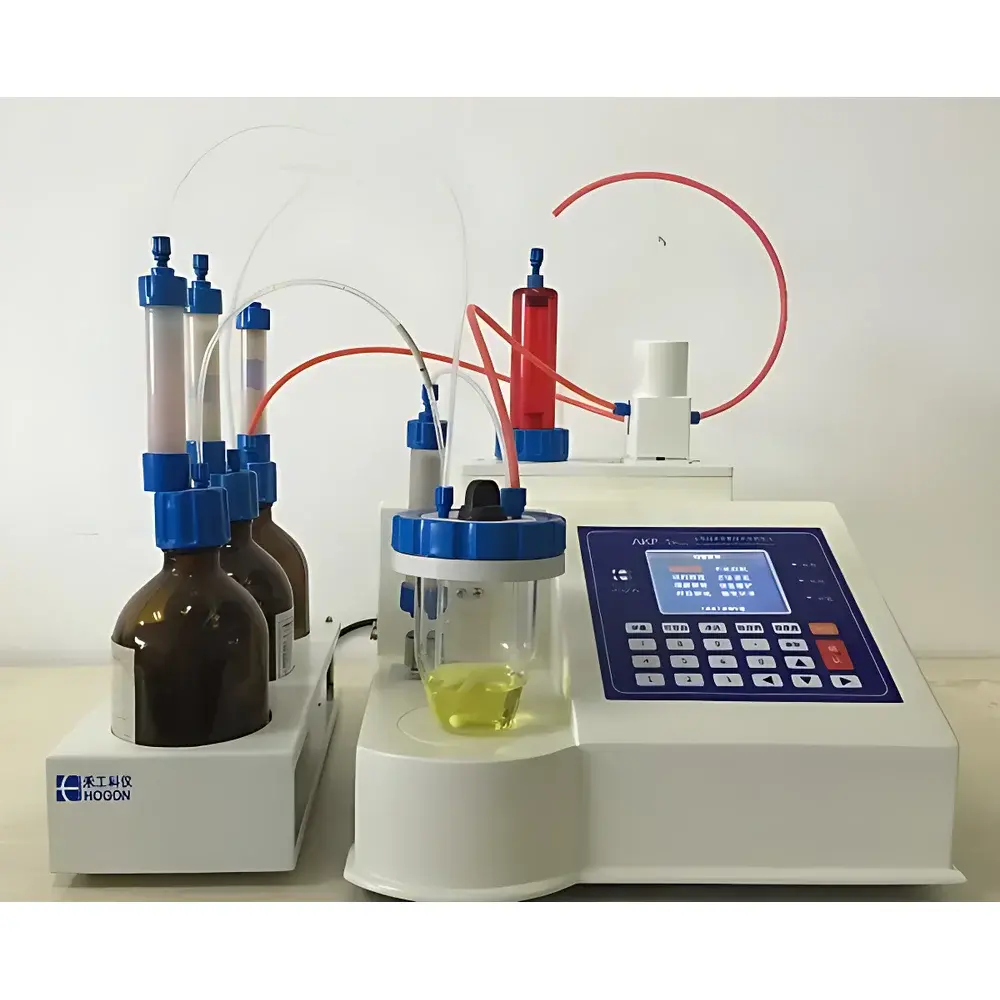
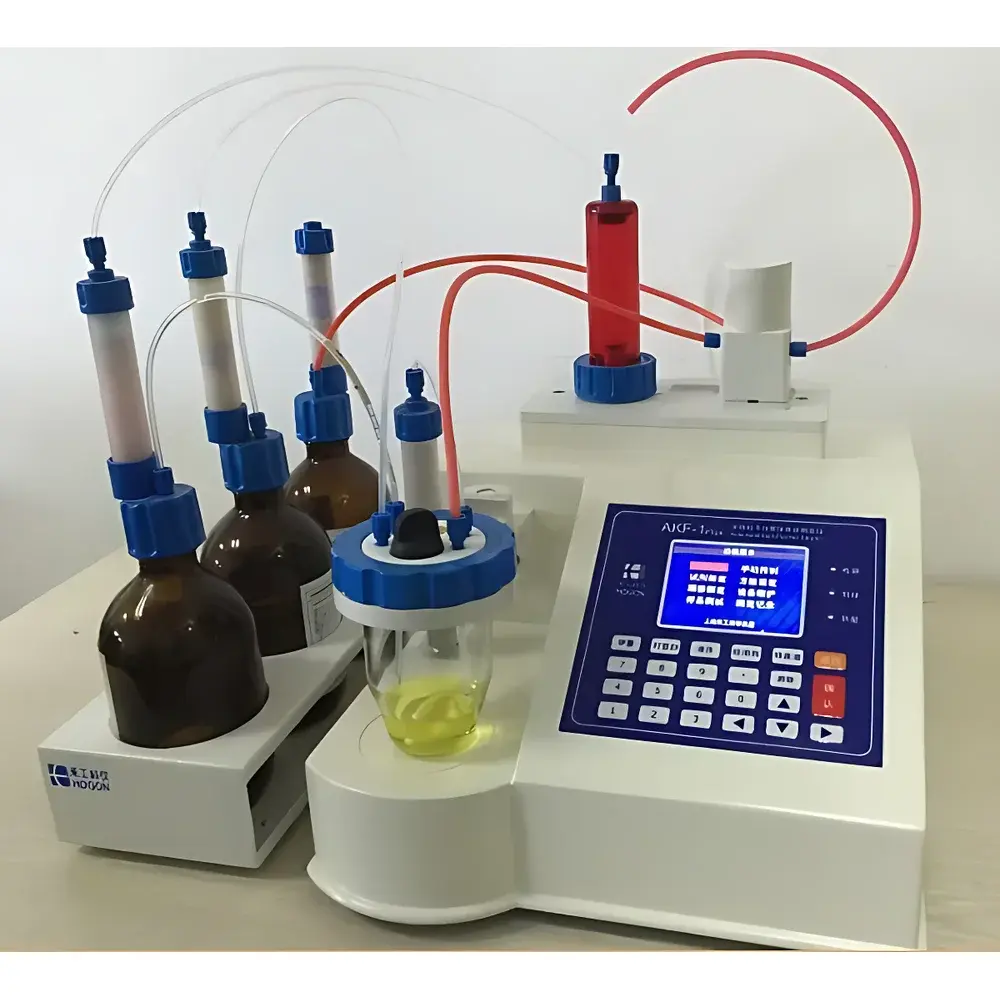
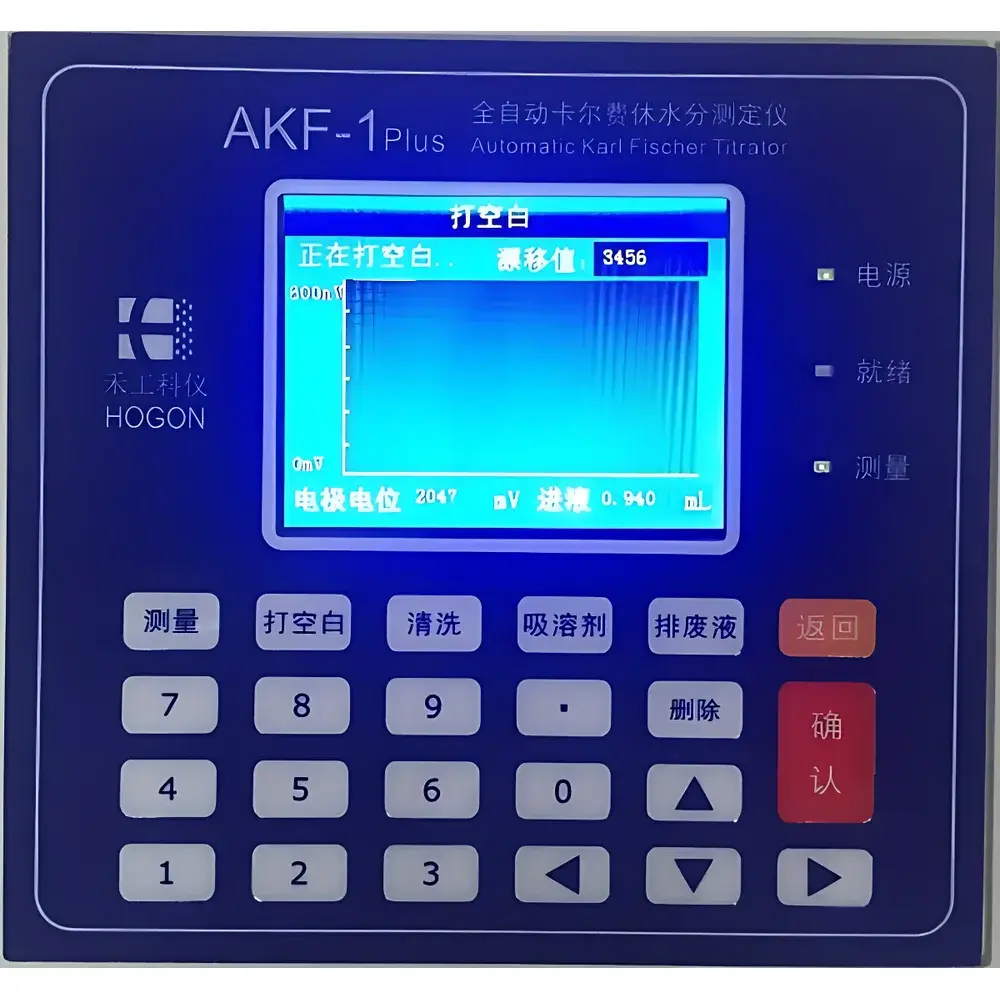
HOGON AKF-1PLUS Fully Automatic Karl Fischer Moisture Titrator
| Brand | HOGON |
|---|---|
| Origin | Shanghai, China |
| Manufacturer Type | Original Equipment Manufacturer (OEM) |
| Model | AKF-1PLUS |
| Titration Method | Fully Automatic Volumetric Coulometric Hybrid Karl Fischer Titrator |
| Measurement Resolution | 1 ppm |
| Moisture Content Range | 0.001–100% w/w |
| Accuracy | ≤0.3% RSD (2 mL reagent) |
| Minimum Dispensing Volume | 0.5 µL (20 mL burette) |
| Titration Control Precision | 1.0 µL |
| Electrode Type | Dual Platinum Electrode |
| Polarization Voltage Range | 0–2000 mV |
| Polarization Current Range | 0–125 µA |
| Drift Compensation | Auto-tracking & subtraction |
| Display | Monochrome LCD with Chinese interface |
| Dimensions (W×D×H) | 380 × 300 × 330 mm |
| Net Weight | 5.6 kg |
| Power Supply | 95–260 V AC, 50 Hz |
| Ambient Humidity Limit | ≤80% RH |
Overview
The HOGON AKF-1PLUS is a fully automated, dual-mode Karl Fischer (KF) moisture titrator engineered for precision volumetric and coulometric moisture analysis in regulated laboratory environments. Based on the electrochemical iodometric principle—where water stoichiometrically reacts with iodine generated *in situ* (coulometric mode) or delivered via standardized KF reagent (volumetric mode)—the instrument delivers trace-level quantification across heterogeneous sample matrices. Its architecture integrates a sealed titration cell, dual platinum indicator electrodes, and a high-fidelity piston-driven burette system to minimize environmental interference and ensure reproducible delivery of titrant. Designed for compliance-critical workflows, the AKF-1PLUS supports both direct titration of soluble samples and indirect analysis via optional external heating ovens or thermoelectric cooling modules—enabling controlled release of bound water from crystalline hydrates, adsorbed moisture, or volatile organic compounds.
Key Features
- Fully enclosed titration cell with integrated solvent exchange and waste evacuation—prevents ambient moisture ingress and eliminates operator exposure to toxic KF reagents (e.g., pyridine-free or imidazole-based solvents).
- Hybrid titration capability: switchable between volumetric and coulometric modes via software configuration—optimized for wide dynamic range (0.001–100% w/w) without hardware modification.
- Piston-type burette with 0.5 µL minimum dispensing volume and ±1.0 µL volumetric control precision—certified per ISO 8655-3 for piston burettes used in analytical titration.
- Adaptive endpoint detection using real-time polarization current monitoring and PID-controlled titrant addition—dynamically adjusts titration speed near equivalence point to suppress overshoot and improve repeatability.
- Auto-drift correction algorithm continuously monitors background current drift during idle periods and subtracts it from final calculation—critical for low-moisture samples (<100 ppm) and high-humidity laboratories.
- Modular hardware design: three-way solenoid valves with chemically resistant PTFE/FFKM seals; tubing compliant with USP Class VI biocompatibility standards; electrode ports compatible with standard ASTM D6304-compliant dual-platinum sensors.
Sample Compatibility & Compliance
The AKF-1PLUS accommodates solids (powders, tablets, polymers), liquids (solvents, oils, APIs), and gases (via gas-tight sampling loop or headspace vial adapter). It meets method validation requirements under USP , EP 2.5.12, and ASTM D6304–23 for KF titration. Data integrity is maintained through GLP/GMP-aligned reporting: each result includes moisture mass (µg), percentage (% w/w), ppm, consumed titrant volume (mL), and timestamped drift correction logs. Audit trail functionality records all parameter changes, method executions, and user logins—fully compliant with FDA 21 CFR Part 11 when paired with validated networked data management software.
Software & Data Management
Embedded firmware provides standalone operation via front-panel keypad and monochrome LCD. All measurement parameters—including titration delay, endpoint hold time, stirring speed (0–1200 rpm, stepless), and drift update interval—are programmable and stored in non-volatile memory. Raw current/voltage traces and endpoint curves are exportable via USB to CSV format. Optional PC software enables method library management, statistical reporting (RSD, mean, SD), calibration curve generation, and electronic signature support for multi-user environments. Data files conform to ASTM E1382-22 metadata conventions for analytical instrument output.
Applications
- Pharmaceutical QC: quantification of residual moisture in lyophilized proteins, excipients, and tablet coatings per ICH Q5C guidelines.
- Petrochemical testing: water content in jet fuel (ASTM D6304), lubricants, and crude oil emulsions.
- Food & agriculture: moisture determination in dairy powders, grains, and dehydrated fruits—aligned with AOAC 955.03 and ISO 712.
- Electronics manufacturing: detection of trace water in lithium battery electrolytes and encapsulation resins (IEC 62621).
- Polymers & composites: measurement of hydrolytic degradation precursors in polyamide, PET, and epoxy prepolymers.
FAQ
What KF reagent types are compatible with the AKF-1PLUS?
The system accepts all commercially available one-component and two-component volumetric KF reagents, including methanol-based, chloroform-free, and aldehyde-stabilized formulations—provided they meet ASTM D6304 viscosity and conductivity specifications.
Can the instrument perform coulometric titration out-of-the-box?
Yes—the AKF-1PLUS includes a built-in generator anode and cathode compartment, enabling coulometric mode without add-on hardware. Volumetric mode requires only installation of the supplied 20 mL burette assembly.
Is GLP-compliant data export supported?
Raw data and summary reports are exportable in timestamped, uneditable CSV format. Full 21 CFR Part 11 compliance (electronic signatures, audit trails, role-based access) requires deployment of the optional HOGON LabManager Suite with server-side validation.
How does the system handle difficult-to-dissolve samples?
Via programmable titration delay and endpoint hold functions—allowing extended reaction time before endpoint recognition—as well as compatibility with external heating ovens (up to 300 °C) for thermal water release prior to titration.
What maintenance intervals are recommended?
Burette piston seal inspection every 6 months; electrode cleaning with ethanol weekly; drying tube desiccant replacement after 200 assays or visible color change; full system performance verification using certified water standards (e.g., Hydranal® 1.00 mg H₂O) quarterly.






