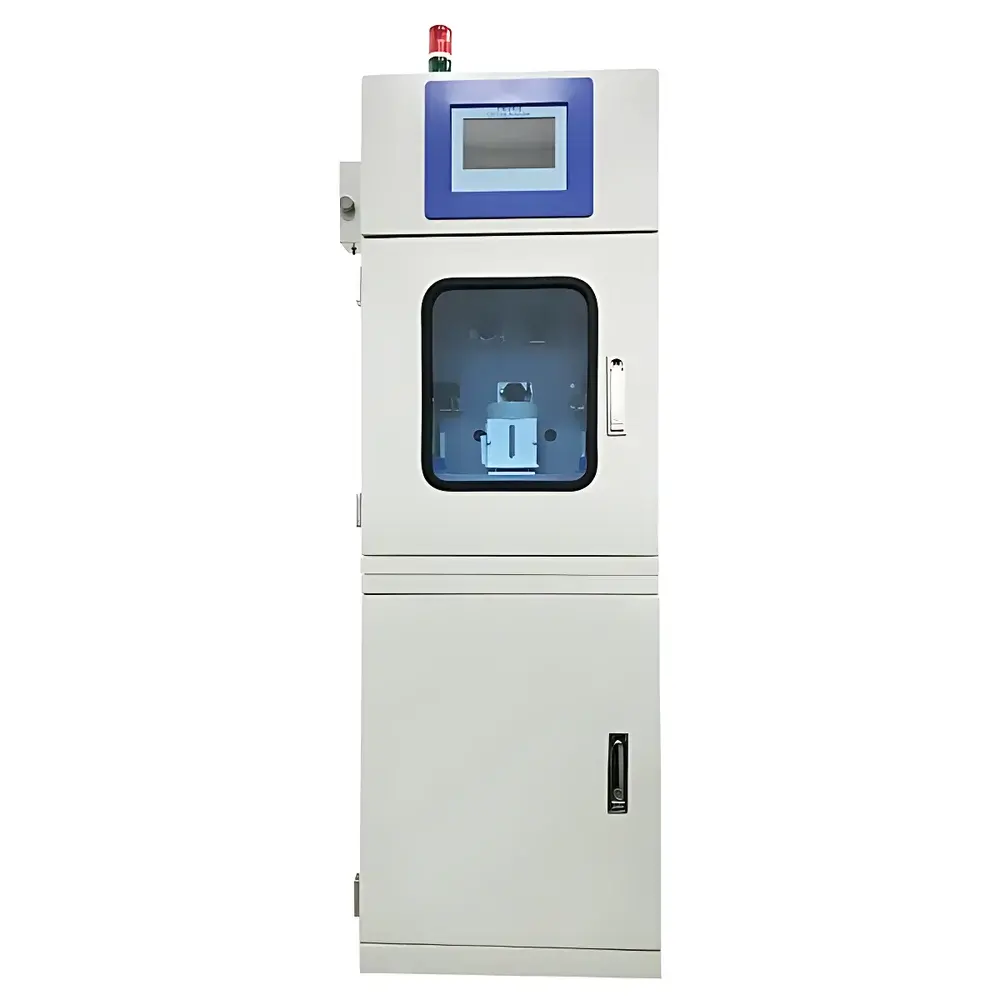
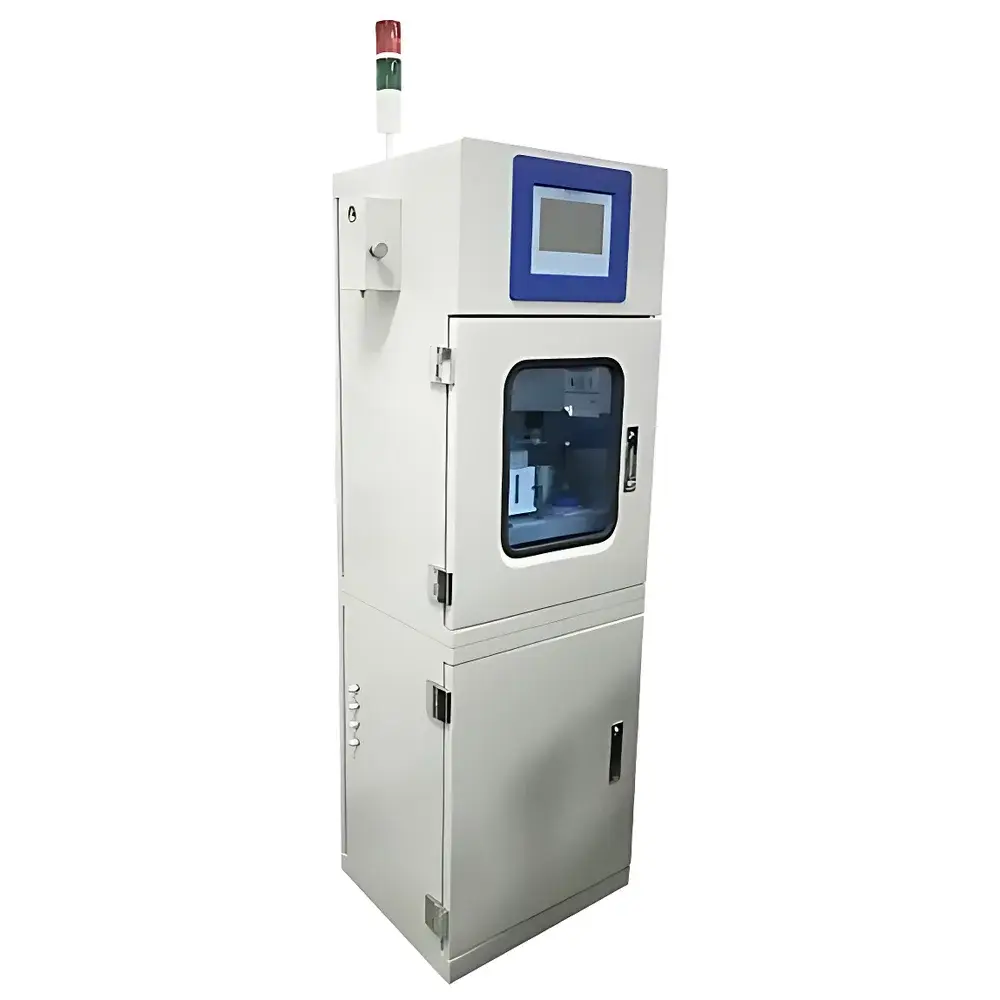
HOGON ALT-SED Industrial Online Precipitation Titration Analyzer
| Brand | HOGON |
|---|---|
| Origin | Shanghai, China |
| Manufacturer Type | Original Equipment Manufacturer (OEM) |
| Country of Origin | China |
| Model | ALT-SED |
| Pricing | Available Upon Request |
Overview
The HOGON ALT-SED Industrial Online Precipitation Titration Analyzer is an engineered solution for real-time, unattended quantitative analysis of ionic species in continuous industrial process streams—specifically designed to replace manual titration in production-critical environments. Operating on the principle of potentiometric and photometric endpoint detection, the ALT-SED performs automated precipitation titrations (e.g., chloride via silver nitrate, sulfate via barium chloride), as well as pH, redox, complexometric, non-aqueous, and colorimetric titrations. Its core architecture integrates a high-precision burette system with electromagnetic switching valves, long-life peristaltic solvent pumps, and a high-resolution color-sensing module capable of detecting subtle chromatic transitions during indicator-based titrations. The instrument employs dual platinum electrodes for robust potentiometric monitoring and supports interchangeable sensor modules to accommodate diverse analyte chemistries across variable matrix conditions. Designed for integration into distributed control systems (DCS) or programmable logic controllers (PLC), the ALT-SED delivers closed-loop feedback by triggering dosing pumps based on real-time analytical results—ensuring process bath composition remains within tightly defined operational windows.
Key Features
- Unattended 24/7 operation with fully automated sample aspiration, reagent delivery, titration execution, endpoint recognition, post-analysis rinsing, and data reporting
- Modular hardware architecture featuring A8 ARM-based embedded controller, 7-inch full-color TFT touchscreen interface with intuitive Chinese/English bilingual HMI
- Dual high-accuracy burettes (±0.1% volumetric accuracy) with integrated electromagnetic valve manifolds for precise reagent metering
- Multi-mode endpoint detection: potentiometric (via dual-platinum electrode), photometric (RGB colorimetric sensor), and pH-based algorithms
- Configurable titration protocols—including custom calculation formulas, dynamic equivalence point algorithms, and adaptive stirring speed control
- Industrial-grade enclosure (IP65-rated) with corrosion-resistant wetted materials suitable for aggressive chemical environments (e.g., acidic plating baths, alkaline cleaning solutions)
- Redundant communication interfaces: RS-232, TCP/IP Ethernet, and MODBUS RTU/TCP for seamless SCADA and MES integration
Sample Compatibility & Compliance
The ALT-SED is validated for use with aqueous and semi-aqueous process liquors commonly encountered in electroplating, metal finishing, wastewater treatment, pulp & paper bleaching, and pharmaceutical intermediate synthesis. It accommodates turbid, colored, or particulate-laden samples through optimized flow-cell design and adaptive signal filtering. While not certified to ISO/IEC 17025 for standalone laboratory accreditation, the system supports GLP-compliant data integrity practices—including user-level access control, electronic audit trails, and timestamped raw signal logs. All firmware and software comply with IEC 61508 functional safety principles for process instrumentation. Data export formats (CSV, XML) are compatible with LIMS and ERP platforms meeting FDA 21 CFR Part 11 requirements when deployed with appropriate IT governance controls.
Software & Data Management
The embedded titration control software enables full lifecycle management of analytical methods: method creation, versioning, parameter locking, and secure storage on internal flash memory. Each analysis generates a structured dataset containing raw electrode potential curves, RGB intensity traces, titrant volume vs. signal derivative plots, and final concentration values—all timestamped and tagged with batch ID, operator ID, and instrument serial number. Results and dosing commands are transmitted via configurable TCP/IP sockets or MODBUS registers to central databases or cloud-based historians. Remote diagnostics, firmware updates, and method deployment are supported over secure SSH or HTTPS connections. Audit trail records capture all user actions—including method edits, calibration events, alarm acknowledgments, and emergency stop activations—retained for ≥18 months per default configuration.
Applications
- Continuous monitoring of Cl⁻, SO₄²⁻, F⁻, and PO₄³⁻ concentrations in electroplating baths (e.g., nickel, zinc, chromium lines)
- Real-time control of coagulant dosing (e.g., Al₂(SO₄)₃, FeCl₃) in municipal and industrial wastewater clarification
- In-line verification of titratable acidity or alkalinity in food-grade cleaning-in-place (CIP) solutions
- Quantification of free cyanide in metal stripping baths using argentometric titration
- Monitoring of chelating agent depletion (e.g., EDTA, DTPA) in passivation and descaling formulations
- Process validation support for ISO 9001 and IATF 16949-certified manufacturing lines requiring documented analytical traceability
FAQ
What types of titration methods does the ALT-SED support?
Potentiometric precipitation, pH, redox, complexometric, non-aqueous, and indicator-based colorimetric titrations—with automatic endpoint selection based on first-derivative maxima or fixed-threshold color shift detection.
Can the ALT-SED interface with existing PLC or DCS systems?
Yes—via native MODBUS RTU/TCP, RS-232 ASCII protocol, or Ethernet TCP socket communication; preconfigured drivers available for Siemens S7, Rockwell ControlLogix, and Yokogawa CENTUM VP.
Is calibration traceable to national standards?
While the instrument itself is not NIST-traceable out-of-box, it accepts certified reference standards (e.g., NIST SRM 3108 for chloride); calibration certificates can be generated internally with user-entered standard lot numbers and expiration dates.
How frequently does the system require maintenance?
Burette calibration verification recommended every 30 days; electrode cleaning and membrane replacement every 90–180 days depending on matrix fouling potential; full system validation annually per internal QA procedures.
Does the ALT-SED support remote troubleshooting?
Yes—engineers can initiate secure remote sessions via encrypted VNC-over-SSH to inspect live sensor outputs, review method configurations, and diagnose communication faults without on-site presence.