
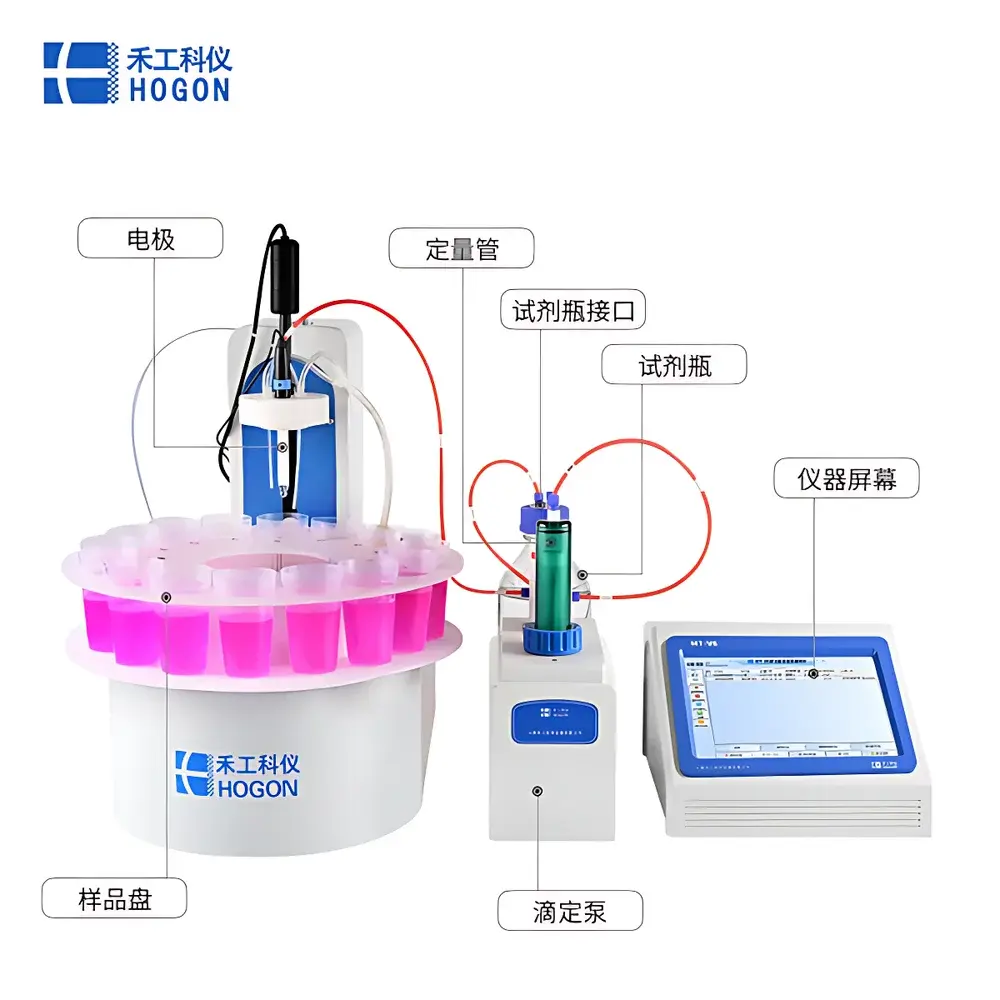
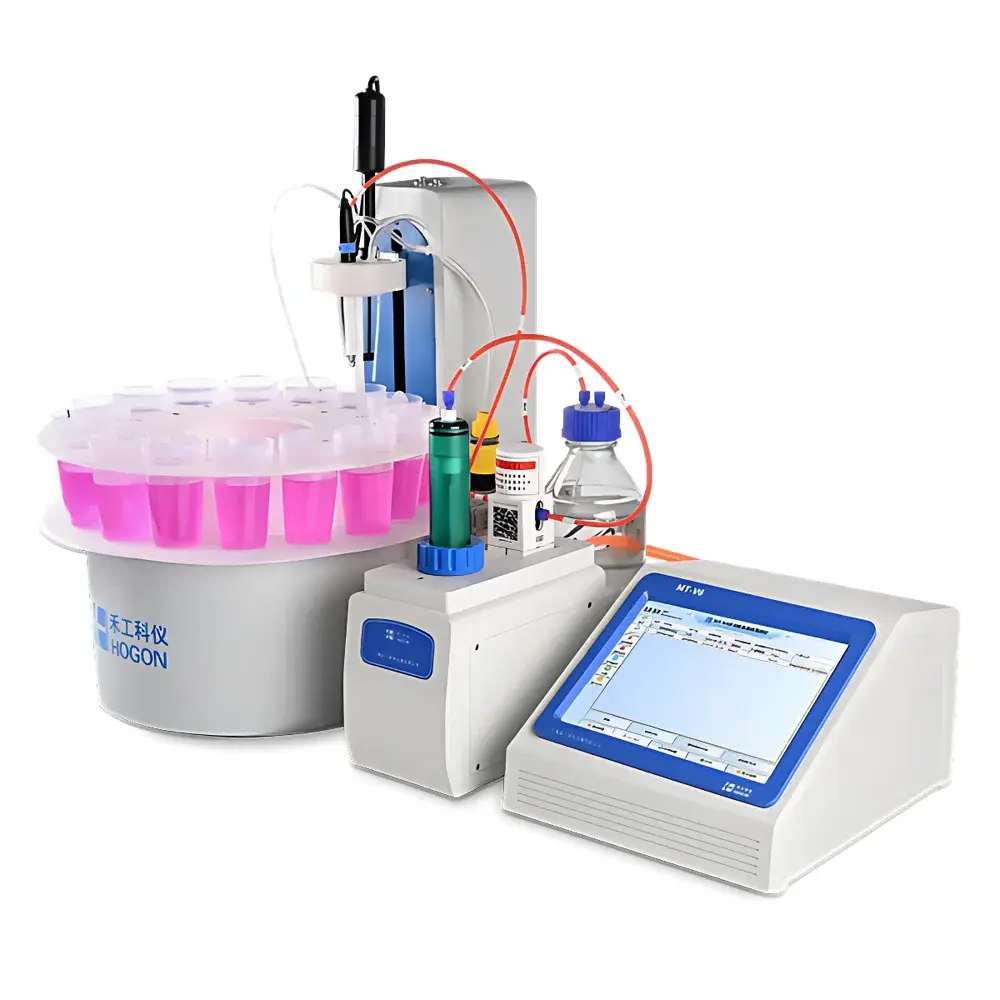
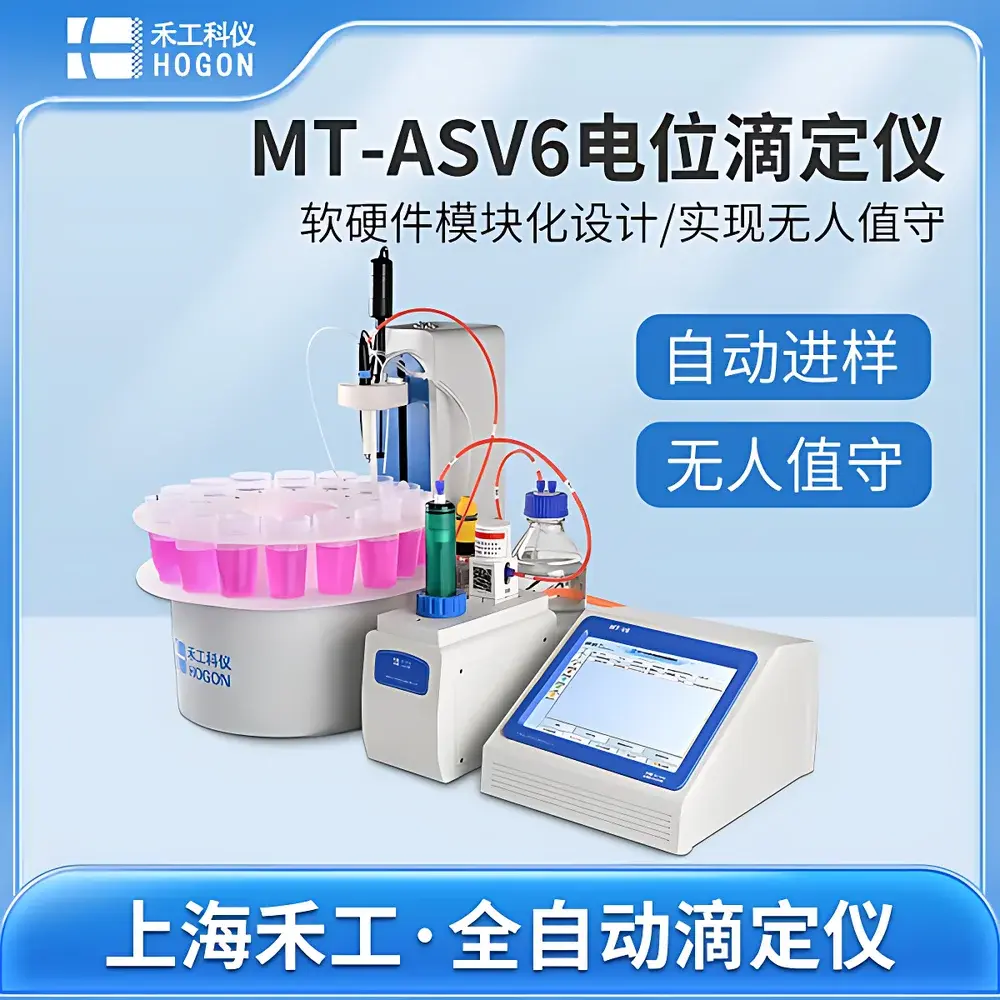
HOGON MT-ASV6 Multi-Station Automatic Potentiometric Titrator
| Brand | HOGON |
|---|---|
| Origin | Shanghai, China |
| Manufacturer Type | Direct Manufacturer |
| Product Category | Domestic |
| Model | MT-ASV6 |
| Instrument Type | General-Purpose Potentiometric Titrator |
| Application Scope | Universal |
| Measurement Range | Potential: −2000 to +2000 mV |
| Color Detection | RGB |
| Photometric Range | 3 AU |
| Meter Accuracy | 0.1 mV ± 0.03% |
| Meter Resolution | 0.1 mV |
| Titration Precision | 1 µL (20 mL burette) |
| Titration Resolution | 1/20000 |
Overview
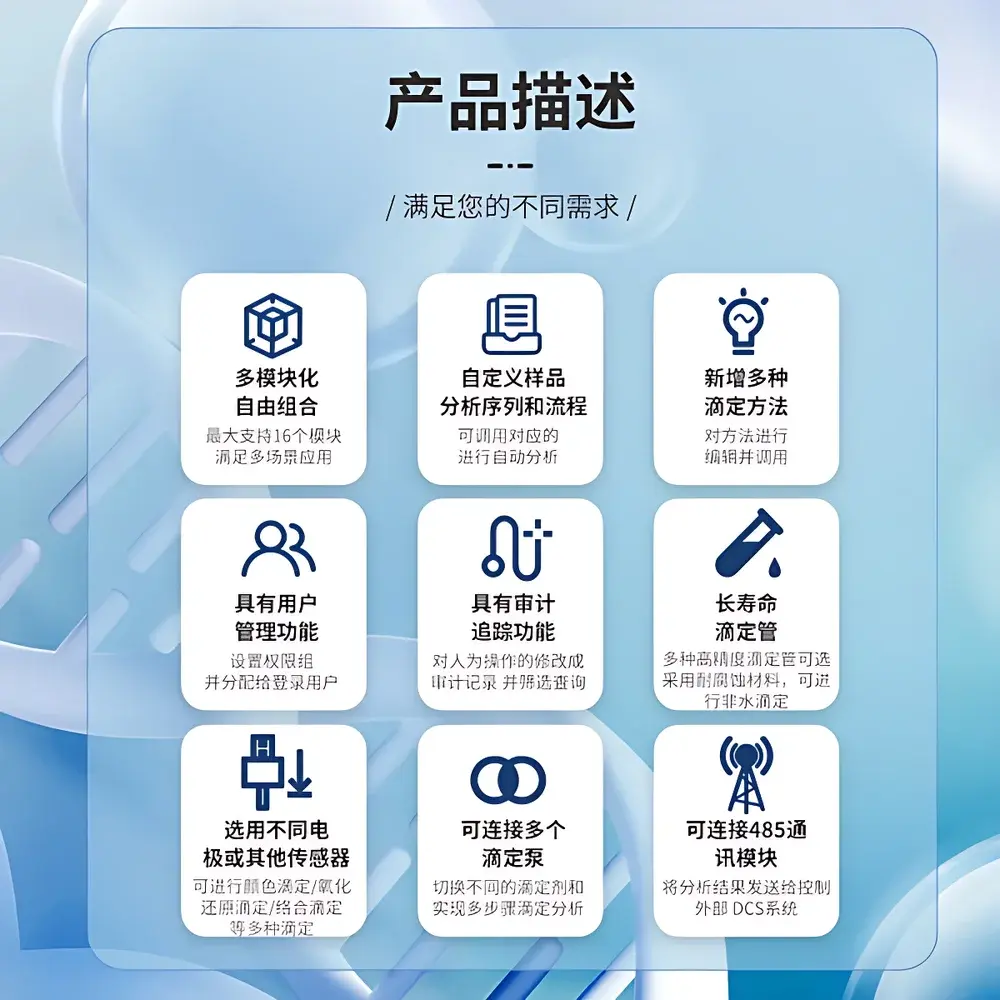
The HOGON MT-ASV6 Multi-Station Automatic Potentiometric Titrator is a modular, high-integrity electrochemical analysis platform engineered for precision, reproducibility, and regulatory compliance in quality control and R&D laboratories. It operates on the fundamental principle of potentiometric titration—measuring potential change across a working/reference electrode pair as titrant is incrementally delivered to determine stoichiometric endpoints. In addition to classical potentiometric mode, the system natively supports colorimetric (RGB-based chromatic endpoint detection), photometric (absorbance up to 3 AU), amperometric (dead-stop), pH-stat, and conductometric titration methods—all within a single unified hardware architecture. Its modular design allows configuration scalability up to 16 functional modules, enabling concurrent or sequential execution of heterogeneous analytical workflows without manual reconfiguration. The instrument is designed for full unattended operation over extended shifts, with integrated safety logic, real-time status monitoring, and fail-safe mechanisms aligned with GLP and GMP operational expectations.
Key Features
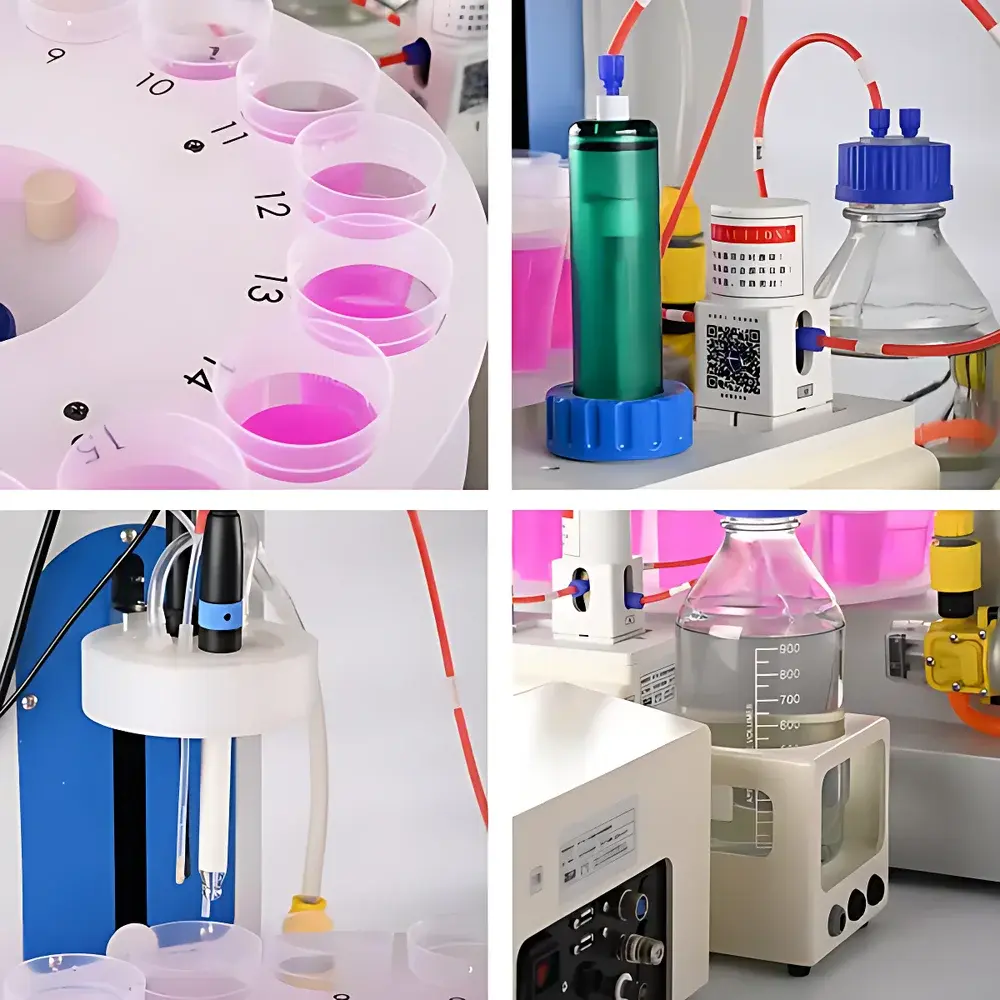
- Modular architecture supporting up to 16 interchangeable functional units—including titration modules (dual-pump capability for multi-reagent or ratio-controlled delivery), automated cleaning & purge modules (electrode, burette, sample probe, and titration cup), liquid level sensing modules (reagent depletion and waste overflow alarms), liquid handling modules (automated dilution, reagent addition, indicator dosing), and volumetric sampling modules (precision pipetting and standardization support)
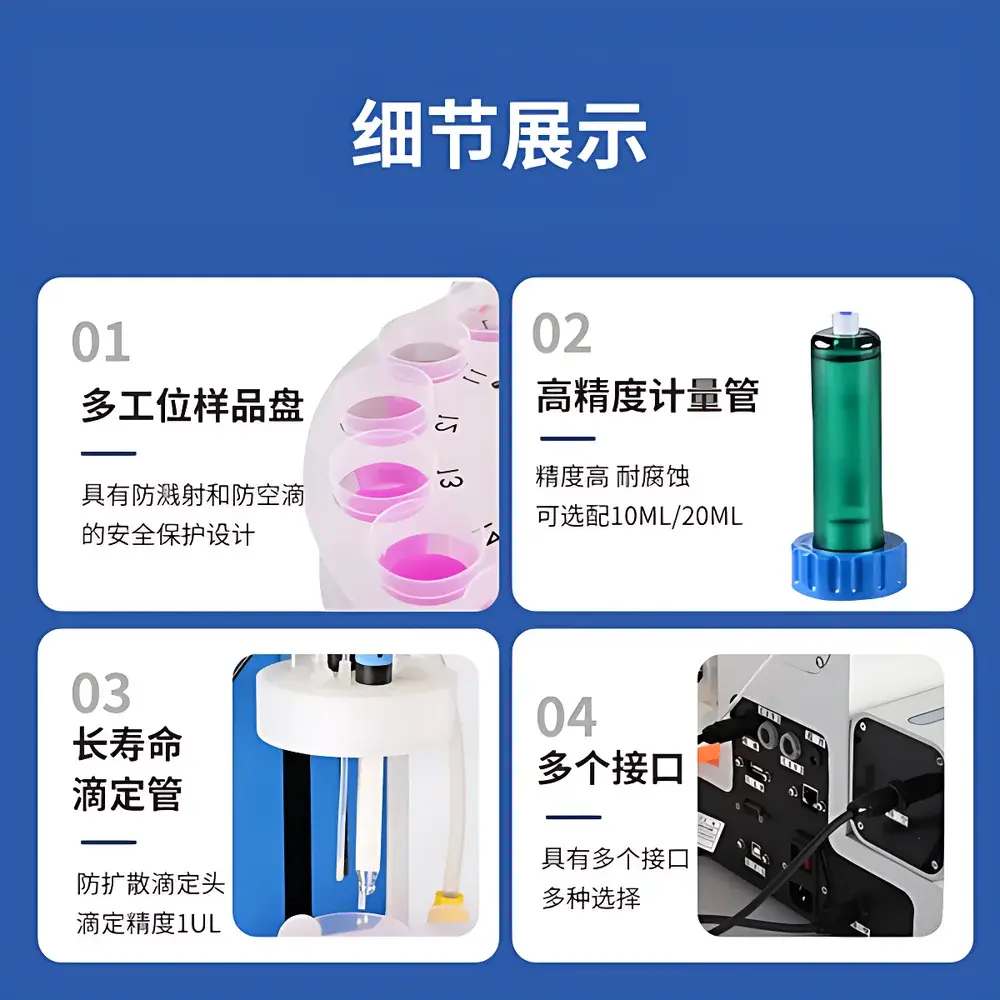
- Configurable sample carousels: choice of 12 × 200 mL or 16 × 100 mL positions, each equipped with splash-resistant shielding and intelligent empty-position detection to prevent air-drawing and cross-contamination
- High-precision titration delivery: 20 mL glass burettes with 1 µL minimum dispensing volume and 1/20,000 resolution; fitted with diffusion-inhibiting titration tips and long-life PTFE piston seals
- Triple-mode detection engine: simultaneous real-time acquisition of electrode potential (−2000 to +2000 mV, ±0.03% accuracy at 0.1 mV resolution), RGB color space values (0.2% FS repeatability), and photometric absorbance (0.0001 AU resolution, 0–3 AU range)
- Integrated safety protocols: automatic stirrer engagement verification, anti-drip valve actuation, real-time electrode impedance monitoring, and audible/visual alerting for out-of-spec results or hardware anomalies
- Windows-based control software with role-based user management, hierarchical permission groups, and full audit trail generation compliant with FDA 21 CFR Part 11 requirements
Sample Compatibility & Compliance
The MT-ASV6 accommodates a broad spectrum of aqueous and non-aqueous matrices—including acids, bases, redox-active species, halides, chelating agents, and weak electrolytes—common in pharmaceutical assay validation, food acidity testing, water hardness determination, and industrial catalyst analysis. Sample vessels are compatible with standard ISO 8573-compliant glassware and disposable polypropylene cups. All titration methods adhere to internationally recognized standards including ASTM E2087 (potentiometric titration), ISO 8655-3 (burette calibration), USP (titrimetric assays), and ICH Q2(R2) guidelines for method validation. System firmware and software logs maintain immutable timestamps, operator IDs, parameter modifications, and result exports—fully traceable for internal audits and regulatory inspections.
Software & Data Management
Control and data acquisition are managed via HOGON’s proprietary Windows-native TitraSoft™ Suite, featuring intuitive workflow builder, drag-and-drop sequence editor, and template-driven method development. Users define custom sample queues—including priority insertion (“queue jumping”), conditional branching, and dynamic method assignment based on sample ID or metadata. All raw sensor data, titration curves, derivative plots, and final reports are stored in encrypted SQLite databases with optional export to CSV, PDF/A-2, or LIMS-compatible XML formats. The system supports bidirectional communication via TCP/IP and CANbus interfaces for integration into centralized DCS or MES environments. Audit trails record every login, parameter edit, calibration event, and report generation—including IP address, timestamp, and action context—with granular filtering and export capabilities.
Applications
- Pharmaceutical QC: assay of active ingredients (e.g., chlorides in antibiotics, sulfates in heparin), residual solvent quantification, and dissolution profile validation
- Food & Beverage: titratable acidity (TA), free fatty acid (FFA) content in oils, sulfur dioxide in wines, and calcium in dairy products
- Environmental Testing: chloride/bromide in wastewater, alkalinity and hardness in drinking water, and cyanide in industrial effluents
- Chemical Manufacturing: concentration verification of caustic soda, hydrochloric acid, and ammonium hydroxide batches; catalyst metal loading analysis
- Academic Research: kinetic endpoint studies, multi-step complexometric titrations, and method development for novel electroactive analytes
FAQ
What titration modes does the MT-ASV6 support?
Potentiometric, colorimetric (RGB), photometric (0–3 AU), amperometric (dead-stop), pH-stat, and conductometric titration—all selectable per method.
Is the system compliant with FDA 21 CFR Part 11?
Yes. TitraSoft™ enforces electronic signature workflows, audit trail immutability, and role-based access control meeting Part 11 technical and procedural requirements.
Can the MT-ASV6 interface with laboratory information management systems (LIMS)?
Yes—via standardized TCP/IP or CANbus protocols; structured data export supports HL7, ASTM E1384, and custom XML schemas.
What maintenance routines are automated?
Scheduled electrode cleaning, burette rinsing, tip purging, stirrer speed calibration, and system self-diagnostic checks—including electrode impedance validation and fluid path integrity tests.
How is sample carryover prevented between analyses?
Through programmable post-run wash cycles (solvent + air-dry), physical barrier shields, position-aware tip washing, and real-time conductivity-based rinse completion verification.



