PMM EP600 / EP601 Isotropic Electric Field Probe
| Brand | PMM |
|---|---|
| Origin | Italy |
| Model | EP600 / EP601 |
| Frequency Range | 100 kHz–9.25 GHz (EP600), 10 kHz–9.25 GHz (EP601) |
| Flatness | ±0.4 dB (typ.), ±0.5 dB (typ.) |
| Dynamic Range | 0.14–140 V/m (60 dB), 0.5–500 V/m (60 dB) |
| Linearity | ±0.4 dB (50 MHz, 0.3–100 V/m |
| Resolution | 0.01 V/m |
| Isotropy | ±0.5 dB (±0.3 dB typical) |
| Overload | 300 V/m (EP600), 1000 V/m (EP601) |
| Sampling Rate | 22 samples/s (max), adjustable down to 0.03 samples/s |
| Digital Filter | Adjustable low-pass, 2.3–28 Hz |
| Power Supply | Rechargeable 3 V Li-Mn battery (capacity: mAh not specified) |
| Operating Time | 80 h |
| Charging | Trickle charge, full capacity in 48 h |
| Temperature Sensor Resolution | 0.1 °C |
| Battery Voltage Sensing Resolution | 10 mV |
| Dimensions | ≤53 mm (probe body: 17 mm, sensor core: 17 mm) |
| Weight | 25 g (including 1 m fiber pigtail) |
| Connector | 20-UNF female |
| Fiber Interface | Duplex optical fiber, standard length 10 m (20/40 m optional) |
| PC Interface | USB via fiber-optic transceiver |
| Compliance | CE, RoHS, IEC 61000-4-3 (radiated immunity test support), ISO/IEC 17025 traceable calibration |
Overview
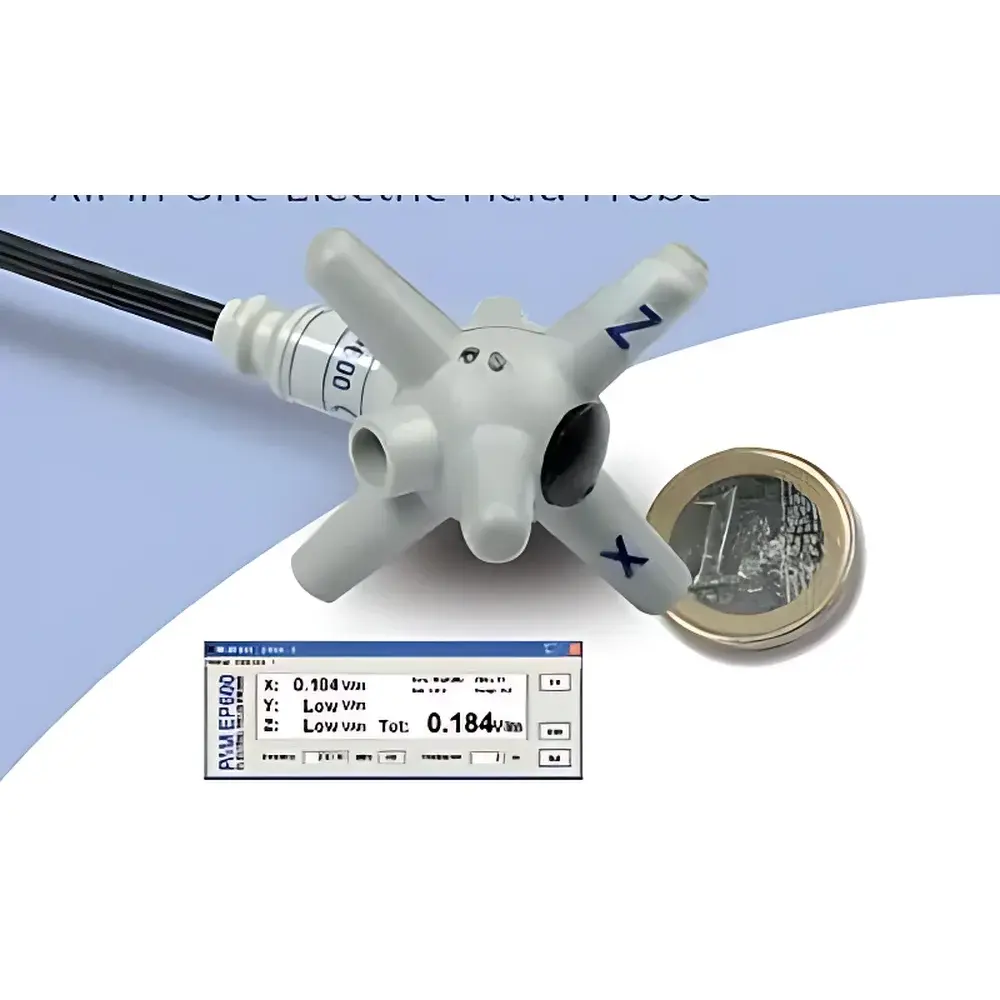
The PMM EP600 and EP601 are isotropic electric field probes engineered for high-fidelity, real-time electromagnetic field characterization in radiated immunity testing, EMC pre-compliance validation, and RF exposure assessment. Based on patented monopole sensor architecture—developed by Narda Safety Test Solutions and exclusively manufactured by PMM—the probes operate on the principle of three orthogonal, matched single-pole sensors, each independently calibrated to ensure true vector magnitude reconstruction (Etotal = √(Ex² + Ey² + Ez²)). Unlike conventional field probes requiring external field meters or analog signal conditioning, the EP600/EP601 integrate signal digitization, temperature compensation, and non-volatile calibration storage directly within the probe head. This eliminates analog cabling artifacts, minimizes field perturbation (<25 g mass, <53 mm maximum envelope), and enables direct USB-connected operation via duplex optical fiber—ensuring galvanic isolation, immunity to ground loops, and zero RF pickup in the data link.
Key Features
- World’s smallest commercially available isotropic E-field probes—optimized for uniform field validation in TEM/GTEM cells and tight-space scanning (e.g., near PCB traces, inside enclosures, or antenna near-fields)
- Fiber-optic interface with integrated USB transceiver: eliminates RF interference, supports up to 40 m separation between probe and host PC without signal degradation
- Onboard temperature sensing (0.1 °C resolution) and real-time thermal drift correction applied during measurement—critical for maintaining accuracy across -10 °C to +50 °C operational range
- Embedded calibration memory stores serial number, frequency-dependent correction factors, firmware version, and sensor-specific linearity coefficients—enabling plug-and-play traceability per ISO/IEC 17025 requirements
- Configurable digital low-pass filtering (2.3–28 Hz) and sampling rate adjustment (0.03–22 samples/s) to match test standards such as IEC 61000-4-3 (modulated RF fields) or ANSI C95.3 (exposure assessment)
- Rechargeable lithium-manganese battery (3 V, trickle-charged over 48 h) delivering 80 hours of continuous operation—ideal for unattended long-duration scans or mobile field surveys
Sample Compatibility & Compliance
The EP600 and EP601 are designed for direct integration into standardized radiated immunity test setups per IEC 61000-4-3, MIL-STD-461 RS103, DO-160 Section 20, and EN 55035. Their sub-53 mm physical profile ensures minimal field distortion—validated via computational EM modeling and inter-laboratory round-robin studies. Each probe is supplied with factory calibration data traceable to national metrology institutes (NMIs), including amplitude flatness, isotropy deviation, and linearity curves across its full frequency span. The embedded temperature compensation algorithm satisfies GLP-relevant stability criteria for measurements conducted under variable ambient conditions. When deployed with the SB10 multi-probe synchronization system, up to 16 EP-series probes can be time-aligned and spatially coordinated for volumetric field mapping—supporting automated uniform area verification per CISPR 16-1-4 Annex D.
Software & Data Management
PMM FieldView software (Windows-based, 64-bit compatible) provides full control and visualization of probe parameters. It displays real-time E-field magnitude (V/m), individual X/Y/Z components, internal temperature, and battery voltage. Users configure filter bandwidth, sampling interval, and averaging mode directly from the GUI. All acquired data—including timestamps, temperature logs, and raw sensor outputs—are saved in ASCII CSV format for post-processing in MATLAB, Python, or Excel. Audit trails record firmware updates, calibration load events, and user-initiated settings changes—meeting FDA 21 CFR Part 11 requirements when operated in validated environments. Optional API access enables integration into custom test automation frameworks (e.g., LabVIEW, Python pyVISA).
Applications
- Radiated immunity test setup verification: rapid uniform field mapping in GTEM cells, anechoic chambers, and open-area test sites (OATS)
- EMC troubleshooting: localized E-field hot-spot identification on PCBs, cables, connectors, and shielding seams
- RF safety and human exposure assessment: compliance evaluation against ICNIRP, IEEE C95.1, or national limits in occupational and public environments
- Antenna pattern characterization: near-field scanning at frequencies up to 9.25 GHz with minimal probe-induced loading
- Wireless device development: validation of SAR-related field distributions in proximity to 5G NR, Wi-Fi 6E, and UWB transmitters
FAQ
Do the EP600 and EP601 require an external field meter or amplifier?
No. Signal conditioning, ADC conversion, temperature compensation, and digital communication are fully integrated within the probe housing.
Can multiple EP600/EP601 probes be synchronized for simultaneous measurements?
Yes—when used with the PMM SB10 synchronization base station, up to 16 probes achieve microsecond-level time alignment for coherent spatial field analysis.
What calibration documentation is provided with each probe?
Each unit ships with a certificate of calibration containing traceable amplitude response data (V/m per digit), isotropy error bands, linearity verification points, and temperature compensation coefficients—all referenced to accredited NMIs.
Is the optical fiber interface compatible with industrial PCs lacking USB-A ports?
Yes. PMM supplies USB-C and USB-B adapter options; the fiber transceiver operates as a standard CDC ACM-class virtual COM port, ensuring OS-level compatibility without proprietary drivers.
How is long-term stability maintained during extended field campaigns?
The Li-Mn battery chemistry exhibits low self-discharge (<2% per month), and the probe’s internal diagnostics continuously monitor voltage decay and thermal drift—triggering warning flags before measurement uncertainty exceeds ±0.1 dB.