
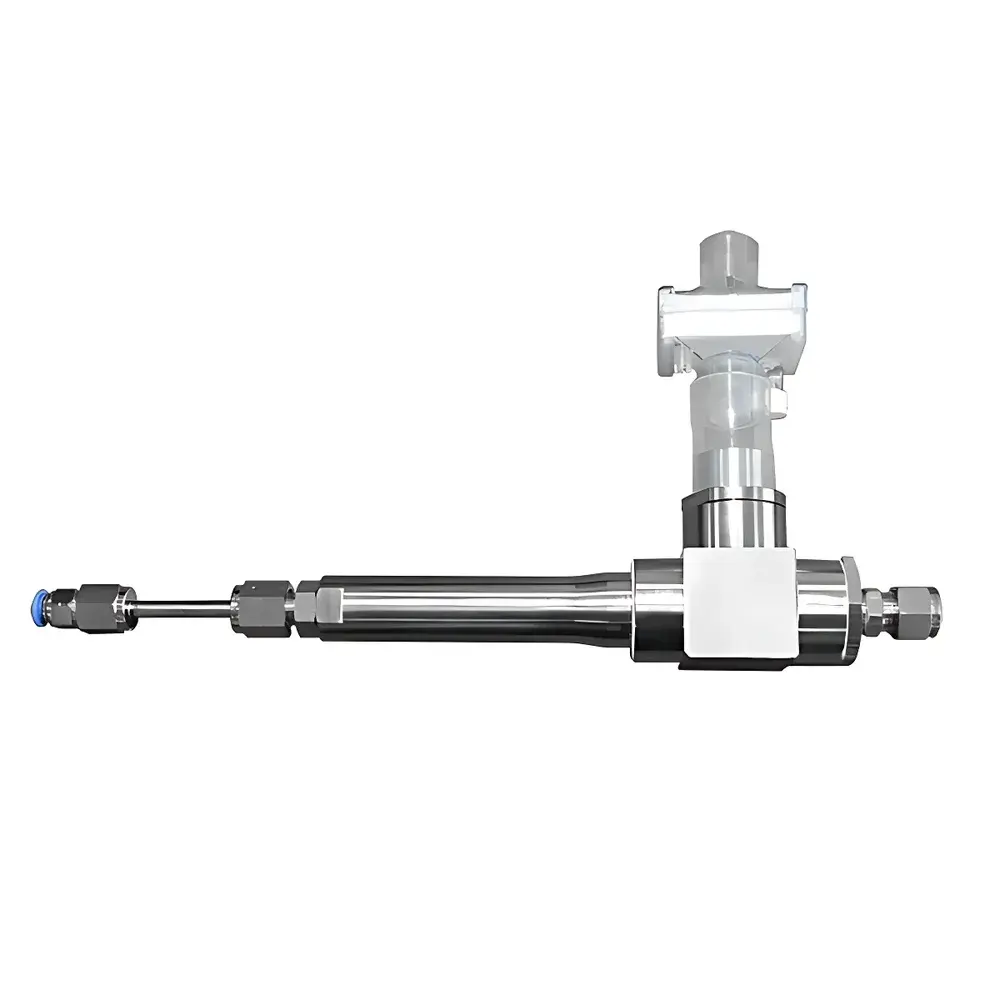
Junray ZR-G08 High-Pressure Diffuser for Particle Counter Protection
| Brand | Junray |
|---|---|
| Origin | Shandong, China |
| Manufacturer Type | Direct Manufacturer |
| Product Category | Domestic |
| Model | ZR-G08 High-Pressure Diffuser |
| Instrument Type | Handheld |
| Flow Range | High Flow |
| Flow Accuracy | ≤ ±5% |
| Configurations | A (100 L/min), B (28.3 L/min) |
Overview
The Junray ZR-G08 High-Pressure Diffuser is an engineered pressure-reduction interface designed specifically for integration into compressed gas supply lines upstream of sensitive airborne particle counting systems. It operates on the principle of controlled laminar expansion and flow impedance, converting high-pressure inlet gas—commonly sourced from cleanroom compressed air networks, nitrogen purge lines, or instrument-grade gas cylinders—into a stabilized, low-pressure, low-velocity output stream compatible with the operational inlet specifications of optical particle counters (OPCs) and condensation particle counters (CPCs). Unlike passive orifice plates or generic pressure regulators, the ZR-G08 incorporates a multi-stage diffusion geometry that minimizes turbulence, suppresses pressure transients, and ensures consistent volumetric delivery across its rated flow range. This design prevents mechanical stress on downstream particle counter sampling inlets, flow sensors, and laser cavities—critical for maintaining measurement integrity and extending instrument service life in ISO Class 3–8 cleanrooms, pharmaceutical manufacturing suites, and microelectronics fabrication environments.
Key Features
- Two calibrated flow configurations: ZR-G08-A delivers 100 L/min at nominal inlet pressures up to 1.0 MPa; ZR-G08-B delivers 28.3 L/min—matching the standard sampling rate of many ISO 21501-4-compliant handheld and portable particle counters.
- High-purity internal wetted path constructed from electropolished stainless steel (316L) and PTFE-sealed components, certified to ISO 14644-1 Class 5 cleanliness prior to packaging—ensuring zero particulate shedding or outgassing during operation.
- Integrated flow stabilization chamber mitigates pulsation and velocity fluctuations, reducing flow-induced measurement variance in real-time particle concentration reporting (typical CV < 2.5% under steady-state conditions).
- Compact, handheld form factor enables rapid deployment between gas source and particle counter without permanent installation—ideal for validation audits, routine calibration checks, and mobile cleanroom qualification campaigns.
- Compatible with non-corrosive, dry, inert gases including compressed air, nitrogen (N₂), argon (Ar), and carbon dioxide (CO₂); not suitable for humid, reactive, or hydrocarbon-laden streams.
Sample Compatibility & Compliance
The ZR-G08 is intended exclusively for use with clean, dry, non-toxic, and chemically inert process gases. It does not perform filtration, drying, or chemical scrubbing—users must ensure upstream gas quality meets ISO 8573-1:2010 Class 2:2:2 (solid particles, water, oil) or equivalent purity requirements prior to diffuser inlet. The device complies with general mechanical safety provisions outlined in GB/T 20801.4–2020 (Industrial Pressure Piping—Part 4: Fabrication and Installation) and conforms to electromagnetic compatibility (EMC) requirements per GB/T 18268.1–2010 for laboratory equipment. While not itself a measuring instrument, its use supports adherence to ISO 21501-4 (calibration of airborne particle counters) and EU GMP Annex 1 (2022) requirements for controlled environment monitoring infrastructure.
Software & Data Management
As a passive mechanical interface, the ZR-G08 requires no firmware, embedded software, or data logging capability. Its performance verification is conducted via external flow calibration using traceable primary standards (e.g., NIST-traceable thermal mass flow meters or critical orifice arrays). For audit readiness, users are advised to document diffuser configuration (A/B), installation date, upstream pressure readings, and post-diffuser flow verification results within their facility’s instrument calibration management system—supporting GLP/GMP traceability and FDA 21 CFR Part 11-compliant record retention when paired with validated electronic data capture tools.
Applications
- Protecting optical particle counters during compressed air line qualification in pharmaceutical aseptic processing areas.
- Stabilizing sample flow for real-time environmental monitoring in semiconductor cleanrooms where pressure spikes may trigger false alarms or sensor saturation.
- Enabling repeatable particle challenge testing using pressurized aerosol generators upstream of HEPA filter integrity testers.
- Serving as a standardized interface in ISO 14644-3 compliance testing protocols requiring consistent flow delivery across multiple test locations.
- Supporting portable particle monitoring during HVAC commissioning, where temporary connections to building compressed air systems necessitate robust overpressure protection.
FAQ
Can the ZR-G08 be used with humidified or oil-lubricated compressed air?
No. The ZR-G08 is strictly limited to clean, dry, and inert gases. Moisture or lubricant carryover may compromise internal surface integrity and induce particle generation.
Does the ZR-G08 require periodic recalibration?
It does not contain active sensing elements and therefore does not require recalibration. However, flow verification against a traceable standard is recommended annually or after any physical impact or exposure to contamination.
Is the ZR-G08 compatible with ISO 21501-4 Class 5 particle counters?
Yes—when configured appropriately (ZR-G08-B for 28.3 L/min instruments; ZR-G08-A for high-flow models), it maintains flow stability within the tolerance bands specified in ISO 21501-4 Annex B for reference flow control devices.
Can multiple ZR-G08 units be connected in parallel?
Not recommended. Parallel configuration introduces uncontrolled flow splitting and potential imbalance—use a single unit sized to match the target instrument’s nominal flow requirement.
What is the maximum allowable inlet pressure?
The rated maximum inlet pressure is 1.0 MPa (10 bar) for both configurations. Exceeding this limit voids warranty and risks structural failure.







