
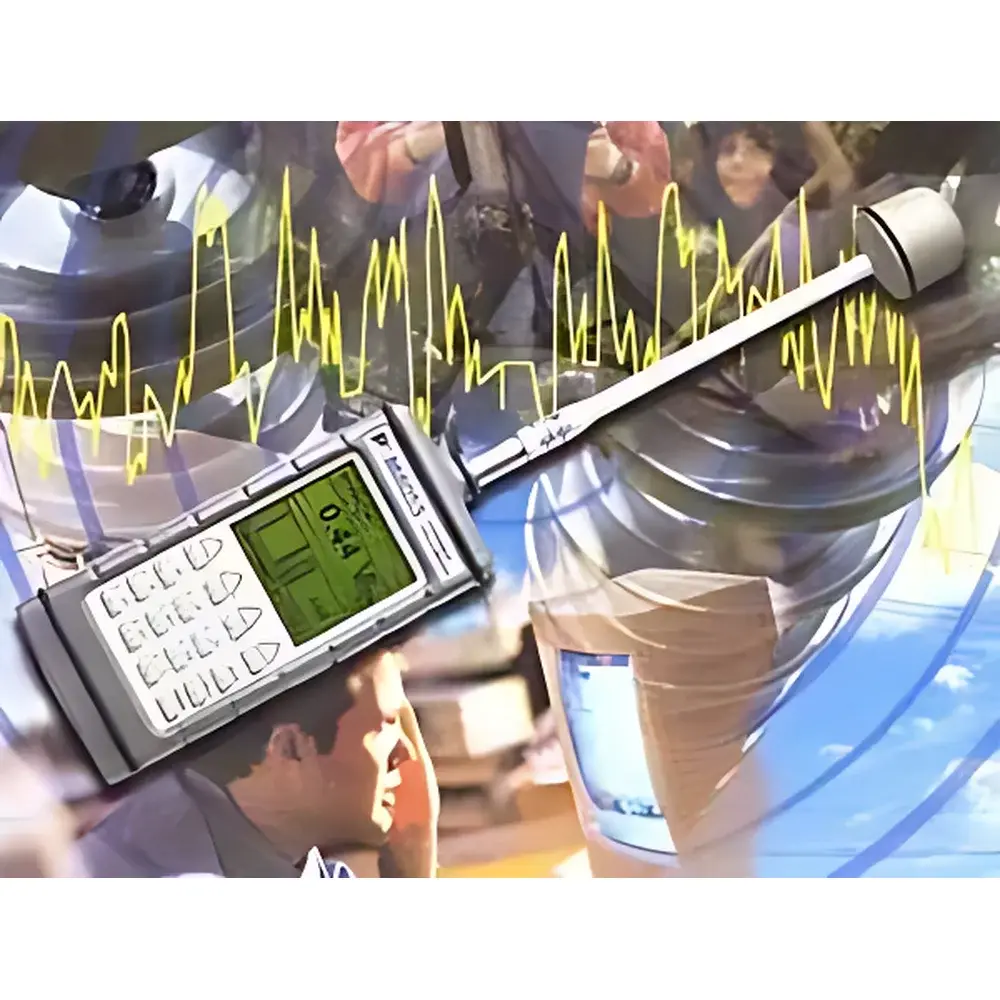
Narda PMM 8053B Electromagnetic Field Analyzer
| Brand | Narda |
|---|---|
| Origin | Germany |
| Model | PMM 8053B |
| Frequency Range | 5 Hz – 40 GHz |
| Low-Frequency Probe | EHP-50C (5 Hz – 100 kHz, E/H-field isotropic, 0.01 V/m – 100 kV/m / 1 nT – 10 mT) |
| RF Probes | EP-105 (100 kHz – 1 GHz), EP-300/EP-330/EP-301 (100 kHz – 3 GHz), EP-183 (1 MHz – 18 GHz), EP-408 (1 MHz – 40 GHz), HP-102 (30 MHz – 1 GHz), HP-032 (100 kHz – 30 MHz) |
| Isotropic Measurement Capability | Yes |
| Spectral Analysis | Real-time FFT with 7 selectable bandwidths (LF), XYZ vector resolution |
| Data Logging | Continuous 24-h recording, internal memory + PC export via RS-232/fiber optic |
| Compliance | IEC 61786-1:2013, IEC 62232:2017, EN 50492:2008, IEEE C95.3-2019 |
| Calibration | Internal reference source, traceable to PTB/NIST |
| Remote Operation | Up to 40 m via fiber optic |
| Multi-probe Expansion | Up to 16 probes (optional) |
Overview
The Narda PMM 8053B Electromagnetic Field Analyzer is a metrologically rigorous, dual-domain measurement platform engineered for full-spectrum electromagnetic field (EMF) assessment across both low-frequency (LF) and radiofrequency (RF) regimes. Unlike segmented or frequency-limited instruments, the PMM 8053B integrates a unified hardware architecture with probe-agnostic signal conditioning, enabling seamless transition from power-frequency magnetic fields (5 Hz) to millimeter-wave emissions (up to 40 GHz). Its core operational principle relies on isotropic triaxial sensor technology coupled with real-time digital signal processing—ensuring accurate spatial averaging and vector magnitude reconstruction per IEC 61786-1:2013 requirements. Designed for regulatory compliance verification, occupational safety evaluation, and site-specific EMF mapping, the system delivers traceable, reproducible measurements in complex mixed-field environments—including substations, broadcast facilities, 5G base station deployments, medical MRI suites, and industrial RF heating installations.
Key Features
- Single-instrument broadband coverage from 5 Hz to 40 GHz via interchangeable, factory-calibrated isotropic probes
- EHP-50C low-frequency probe: simultaneous electric and magnetic field measurement within one physical unit—eliminating spatial misalignment errors inherent in dual-probe setups
- Real-time spectral analysis (FFT) in LF mode with seven user-selectable resolution bandwidths (RBW), supporting harmonic identification and source characterization
- Three averaging modes: instantaneous RMS, time-weighted average (AVG), and spatial average—configurable per EN 50492 and ICNIRP guidelines
- Fiber-optic and RS-232 interfaces for noise-immune data transmission; remote operation up to 40 meters without signal degradation
- Internal reference calibration source ensures long-term stability and eliminates routine external recalibration dependency
- Ruggedized enclosure rated IP54 (dust- and splash-resistant), shock-absorbing housing, and ergonomic handheld design for field deployment
- Expandable architecture supports synchronization of up to 16 distributed probes for area monitoring networks (optional accessory kit)
Sample Compatibility & Compliance
The PMM 8053B accommodates a comprehensive suite of Narda-certified isotropic probes, each individually calibrated and supplied with NIST-traceable certificates. Low-frequency applications include power-line harmonics (50/60 Hz ± interharmonics), traction systems (16.7 Hz), and induction heating (kHz-range). RF probes cover legacy AM/FM broadcasting, cellular bands (700 MHz–3.8 GHz), Wi-Fi (2.4/5/6 GHz), 5G NR (n77/n78/n257/n260), satellite downlinks (C/Ku/Ka-band), and industrial microwave sources (e.g., 2.45 GHz and 5.8 GHz ISM). All probe configurations comply with international exposure limit standards including ICNIRP 2020, IEEE C95.1-2019, EU Council Recommendation 1999/519/EC, and national implementations such as Germany’s 26th BImSchV. The instrument meets EMC immunity requirements per EN 61326-1:2013 and is suitable for GLP-aligned measurement documentation when paired with optional audit-trail software.
Software & Data Management
The PMM 8053B operates with Narda’s proprietary EMF-View software (Windows-based), providing full control, real-time visualization, and post-processing capabilities. Software functions include live spectrum display with marker tracking, XY-plots, time-series logging, and customizable report generation compliant with ISO/IEC 17025 documentation requirements. Raw binary data files (.dat) retain full resolution for third-party analysis. Optional features include automated compliance checking against user-defined limit tables, GPS-tagged measurement georeferencing, and integration into centralized monitoring dashboards via Modbus TCP or OPC UA protocols. All data exports support CSV, PDF, and XML formats—with embedded metadata (probe ID, calibration date, operator ID, timestamp, GPS coordinates) ensuring full traceability under FDA 21 CFR Part 11 and EU Annex 11 requirements.
Applications
- OEM and telecom infrastructure validation: pre-commissioning EMF surveys for macrocell/small-cell sites, DAS installations, and mmWave beamforming arrays
- Occupational health & safety: periodic exposure assessments for utility workers, broadcast engineers, and RF maintenance personnel
- Environmental impact studies: baseline and follow-up monitoring near high-voltage transmission corridors, wind turbine generators, and railway electrification systems
- Medical facility compliance: MRI fringe-field mapping, diathermy equipment leakage testing, and LINAC room shielding verification
- Industrial hygiene: evaluation of dielectric heaters, plasma etchers, and induction furnaces per EN 62311 and EN 62233
- Research & development: antenna pattern validation, material shielding effectiveness testing, and bioelectromagnetics experimental setups
FAQ
Does the PMM 8053B require annual external recalibration?
No—the EHP-50C and all RF probes feature built-in reference sources enabling daily or pre-measurement self-checks. Full traceable recalibration is recommended every 24 months at an accredited lab (e.g., PTB, NIST, or UKAS-registered provider).
Can the system measure pulsed or modulated RF signals accurately?
Yes—peak hold detection, RMS averaging, and burst-mode analysis are supported across all RF probes. The EP-408 and EP-183 models include dedicated pulse demodulation firmware for radar and 5G TDD signal characterization.
Is multi-probe synchronization available for large-area surveys?
Yes—using the optional PMM-DISPATCH module and fiber-optic hub, up to 16 probes can be time-synchronized to ±10 ns, enabling coherent field mapping and gradient analysis.
How is measurement uncertainty quantified for reporting?
Uncertainty budgets are automatically generated in EMF-View based on probe-specific calibration certificates, environmental conditions (temperature/humidity), and measurement duration—aligned with GUM (JCGM 100:2008) methodology.
Does the instrument support custom limit definitions for country-specific regulations?
Yes—users may import or define arbitrary exposure limits (electric/magnetic field, power density) by frequency band, with automatic pass/fail flagging and graphical overlay on spectra and time plots.







