
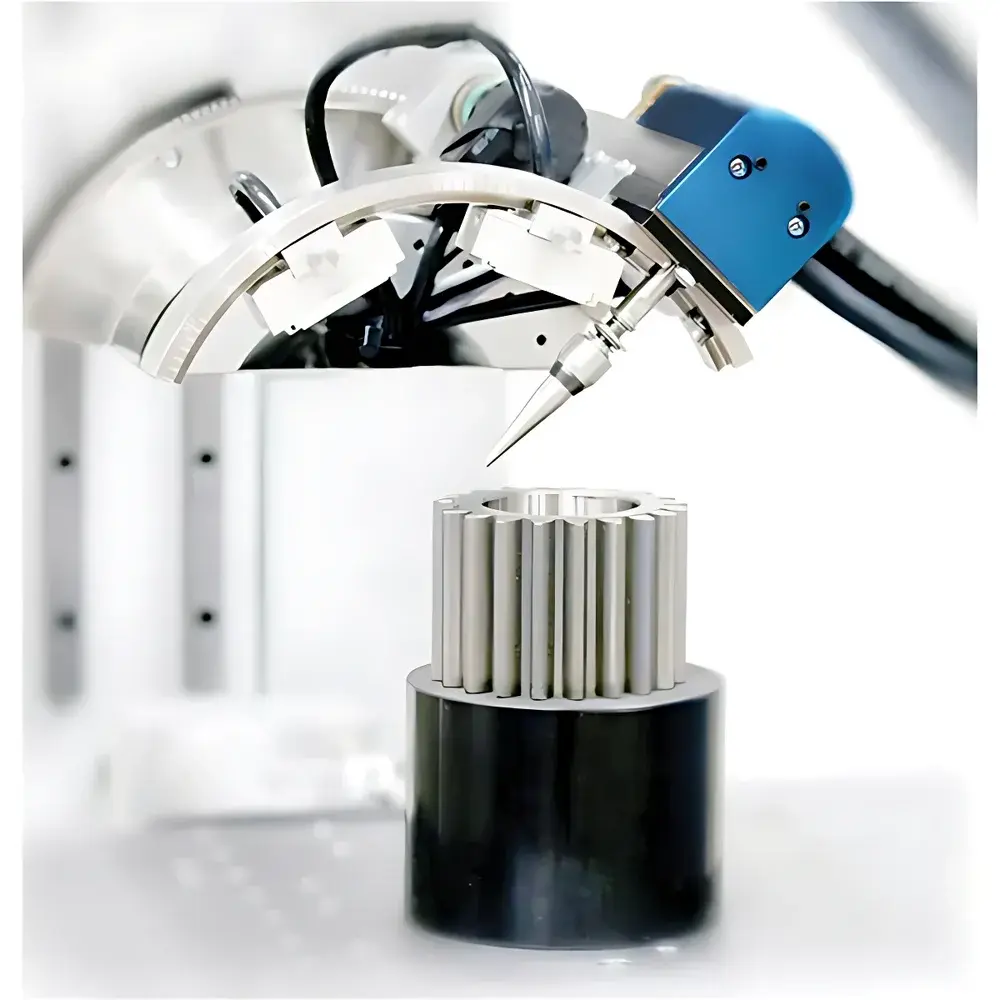
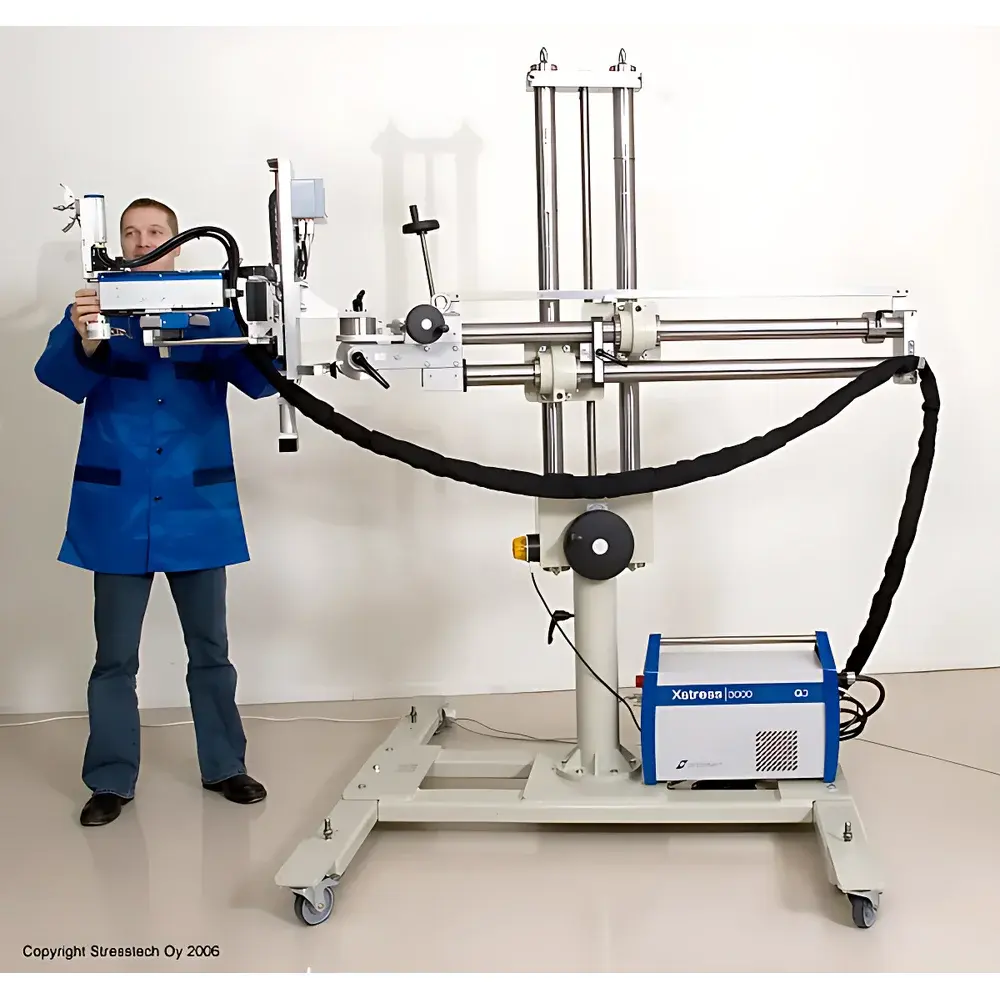
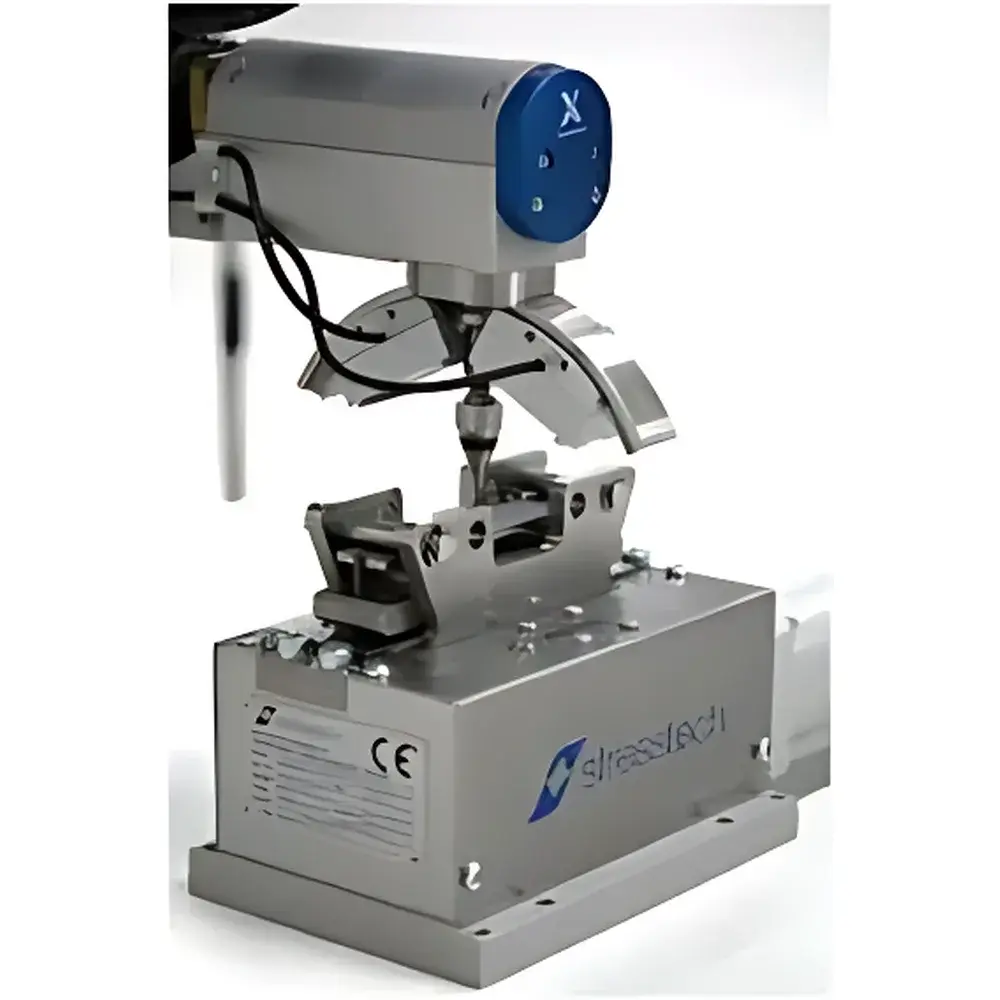
Stresstech Xstress 3000 Portable X-ray Residual Stress Analyzer
| Brand | Stresstech Oy |
|---|---|
| Origin | Finland |
| Model | Xstress 3000 |
| Application Scope | Polycrystalline materials including ferrous alloys, ceramics, nickel-based superalloys, and titanium alloys |
| Measurement Principle | Sin²ψ method via X-ray diffraction (XRD) |
| Portability | Field-deployable, tripod-mounted, self-contained unit |
| Angular positioning | Motorized ψ-tilt and φ-rotation goniometer |
| X-ray tube options | Cr, Co, Fe, Cu, Mo anodes with integrated water cooling |
| Compliance | Designed to support ISO 21432:2020, ASTM E915-22, and EN 15305:2021 requirements |
Overview
The Stresstech Xstress 3000 is a portable, high-precision X-ray residual stress analyzer engineered for non-destructive evaluation of macroscopic residual stresses in polycrystalline engineering materials. Based on the well-established sin²ψ method, it utilizes monochromatic X-ray diffraction to determine lattice strain from peak shift analysis of selected crystallographic reflections (e.g., α-Fe {211}, Ni {200}, Al {311}). The instrument operates at ambient pressure and temperature, requiring no vacuum chamber or sample preparation beyond surface cleaning—enabling direct measurement on finished components, welds, heat-treated parts, and additive-manufactured structures. Its modular architecture integrates a microfocus X-ray tube, high-resolution silicon strip detector, motorized goniometer with independent ψ-tilt and φ-rotation axes, and real-time diffraction data acquisition firmware—all housed in a rugged, field-ready enclosure weighing under 25 kg.
Key Features
- True field portability: Operates on standard AC power or optional battery pack; tripod-mounted setup completed by a single technician in ≤10 minutes without specialized tools.
- Dual-axis goniometer: Precision motorized ψ-tilt (±70°) and continuous φ-rotation (0–360°) eliminate sample repositioning errors and enhance signal-to-noise ratio—particularly critical for coarse-grained or textured materials where peak broadening limits intensity.
- Multi-anode X-ray source compatibility: Interchangeable Cr, Co, Fe, Cu, and Mo targets allow optimal Kα wavelength selection per material system (e.g., Cr for ferritic steels, Co for austenitic stainless steels), maximizing diffraction angle separation and minimizing absorption effects.
- Integrated thermal management: Each X-ray tube assembly includes dedicated water-cooling circuitry with quick-connect fittings; tube swaps require <5 minutes and no calibration recalibration.
- Robust mechanical design: IP54-rated enclosure, shock-absorbing transport case, and vibration-damped optical bench ensure metrological stability across workshop, foundry, and outdoor environments.
Sample Compatibility & Compliance
The Xstress 3000 accommodates components of arbitrary geometry and dimension—from turbine blades and rail axles to large welded pressure vessels—without size constraints or fixturing requirements. Surface access only is needed; measurements are performed directly on as-received surfaces, including curved, inclined, or confined locations (minimum radius of curvature: 15 mm). It supports quantitative residual stress mapping (via manual or motorized XY stage integration), retained austenite quantification (per ASTM E975), and near-surface stress profiling using variable penetration depth via incidence angle control. The system is designed to facilitate compliance with international standards including ISO 21432:2020 (non-destructive testing — X-ray diffraction methods for residual stress measurement), ASTM E915-22 (standard test method for verifying the alignment of X-ray diffraction instrumentation for residual stress measurement), and EN 15305:2021 (non-destructive testing — test method for residual stress analysis by X-ray diffraction). Audit trails, user access logs, and report templates align with GLP and GMP documentation expectations.
Software & Data Management
Xstress Studio software provides full control of acquisition parameters (voltage, current, exposure time, step size, ψ/φ angles), real-time diffraction pattern visualization, automated peak search and fitting (Pseudo-Voigt profile), stress tensor calculation (with elastic constants database for >120 materials), and uncertainty estimation per ISO/IEC Guide 98-3. Raw data (.xrdml, .csv) and processed reports (.pdf, .xlsx) are timestamped and digitally signed. Optional 21 CFR Part 11-compliant configuration includes electronic signatures, role-based permissions, and immutable audit logs for regulated industries.
Applications
- Verification of shot peening, laser shock peening, and ultrasonic impact treatment efficacy on aerospace landing gear and engine disks.
- Weld residual stress assessment in offshore pipeline girth welds and nuclear reactor vessel nozzles.
- Heat treatment validation for gear teeth, bearing races, and forged crankshafts.
- Residual stress monitoring during additive manufacturing build cycles and post-process HIP treatments.
- Retained austenite quantification in carburized and induction-hardened steel components.
- Failure analysis root cause investigation in fatigue-critical components exhibiting premature cracking.
FAQ
Does the Xstress 3000 require a vacuum environment for operation?
No. It operates in air at atmospheric pressure, eliminating need for evacuation cycles or vacuum pumps.
Can it measure residual stress through coatings or surface treatments?
Yes—within practical penetration depth limits (typically 5–30 µm depending on material density and X-ray energy); thin PVD/CVD coatings may require Cr or Co radiation for sufficient transmission.
Is calibration traceable to national metrology institutes?
Yes. Factory calibration uses NIST-traceable reference specimens (e.g., stressed silicon wafers and certified steel standards); on-site verification kits are available.
What training and technical support does Stresstech provide?
Stresstech offers certified operator training courses (on-site or virtual), application-specific consulting, annual performance verification, and firmware updates included under extended service agreements.
How is data integrity ensured during field use?
All measurements include embedded metadata (operator ID, GPS coordinates if enabled, environmental temperature/humidity, instrument serial number), and raw diffraction patterns are stored unprocessed to enable retrospective reanalysis.




