
Stresstech Camscan X-Ray Residual Stress Analyzer for Camshaft Grinding Burn Detection
| Brand | Stresstech Oy |
|---|---|
| Origin | Finland |
| Model | Camscan |
| Application | Non-Destructive Grinding Burn and Heat Treatment Defect Detection on Rotating Symmetric Components |
| Measurement Principle | X-Ray Diffraction (XRD) Based Residual Stress & Microstructural Change Analysis |
| Compliance | ASTM E915, ISO 21943, EN 15305 |
| Automation Level | Semi-Automatic with Motorized Self-Aligning Sensor Arm |
| Sample Handling | Benchtop or Near-Line Integration for In-Process QC |
Overview
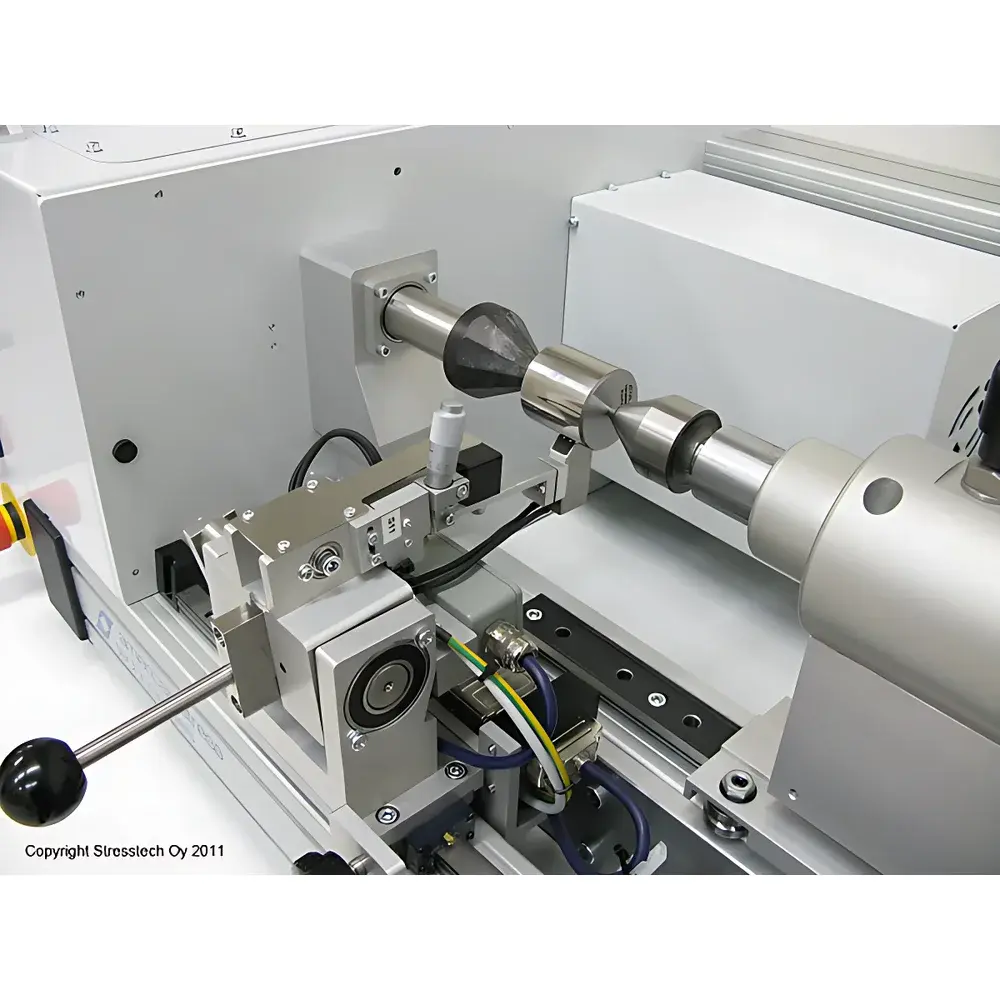
The Stresstech Camscan X-Ray Residual Stress Analyzer is a purpose-built, semi-automatic non-destructive testing (NDT) system engineered for the detection of grinding burn and heat treatment–induced microstructural defects on camshafts and other rotationally symmetric cylindrical components. Unlike conventional acid etching—a destructive, labor-intensive, and environmentally regulated method—the Camscan utilizes high-resolution X-ray diffraction (XRD) to quantitatively assess near-surface residual stress gradients, lattice distortion, and phase transformations (e.g., untempered martensite formation) associated with thermal damage during grinding. The system operates on Bragg’s law principles, employing a monochromatic Cu-Kα X-ray source and a position-sensitive detector to acquire diffraction patterns from depths ranging from 10–100 µm, depending on material composition and surface condition. Designed for low-to-medium volume production environments—including engine manufacturing facilities, Tier-1 automotive suppliers, and R&D laboratories—the Camscan delivers repeatable, traceable, and auditable data without part alteration or chemical exposure.
Key Features
- Semi-automatic operation with motorized, self-aligning sensor arm—eliminates manual positioning errors and ensures consistent beam incidence angle across multiple operators and shifts.
- Integrated rotating stage with precision servo control, enabling full-circumferential scanning of cam lobes and journal surfaces at programmable angular increments (0.1° resolution) and variable rotational speeds (0.5–10 rpm).
- Dedicated camshaft fixture kit with adjustable centering collets and quick-change adapters for shaft diameters from Ø25 mm to Ø120 mm.
- Industrial-grade X-ray tube (Cu anode, 30 kV/1 mA) with collimated beam (0.5 mm × 0.5 mm spot size) optimized for ferrous alloys including hardened steels (e.g., 100Cr6, 52100, EN-GJS-700).
- Real-time diffraction pattern acquisition and on-board peak fitting algorithm (based on pseudo-Voigt profile deconvolution) for rapid identification of stress-induced peak shifts and broadening.
- Emergency stop circuitry compliant with ISO 13850; CE-marked electrical cabinet with status-indicating LED panel (power, rotation, standby, emergency).
Sample Compatibility & Compliance
The Camscan is validated for use on ground and hardened camshafts used in gasoline and diesel internal combustion engines, as well as crankshafts, valve stems, and bearing journals within the Ø25–Ø120 mm diameter range and up to 600 mm in length. It supports both ferritic and austenitic steel substrates and accommodates surface roughness values up to Ra 0.8 µm without signal degradation. All measurement protocols adhere to ASTM E915 (“Standard Test Method for Verifying the Alignment of X-Ray Diffraction Instrumentation for Residual Stress Measurement”) and ISO 21943 (“Non-destructive testing — X-ray diffraction methods for residual stress analysis”). Data output meets GLP/GMP documentation requirements, with full audit trail capability for FDA 21 CFR Part 11–compliant software configurations (optional).
Software & Data Management
The system runs on Stresstech’s proprietary GRINDSCAN™ software v5.2, a Windows-based application offering guided workflow navigation, automated report generation (PDF/CSV), and multi-layer stress depth profiling. Raw diffraction data is stored in vendor-neutral .xye format; processed results include residual stress magnitude (MPa), full-width-at-half-maximum (FWHM) of (211) α-Fe peak, and qualitative burn classification (Class A–D per DIN 50144). Software supports user-defined acceptance thresholds, batch comparison tools, and SPC chart integration via OPC UA interface. All calibration records, operator logs, and instrument performance verifications are time-stamped and exportable for internal audits or third-party certification.
Applications
- Final quality verification of ground cam lobes prior to engine assembly—replacing acid etch per OEM specifications (e.g., Ford WSS-M2P106-C, GM 6095M).
- In-process parameter optimization: correlating wheel dressing frequency, coolant flow rate, and feed rate with subsurface stress signatures to reduce rework.
- Root cause analysis of premature cam follower wear or spalling linked to undetected thermal damage.
- Material research on alternative hardening processes (e.g., induction vs. carburizing) using comparative stress-depth profiles.
- Supplier qualification testing under AIAG CQI-9 guidelines for heat-treat process validation.
FAQ
Does the Camscan require radioactive sources or regulatory licensing?**
No. It employs a sealed-tube X-ray generator operating below 30 kV—classified as a “radiation-generating device” under local occupational safety regulations (e.g., OSHA 1926.53, EU Directive 2013/59/Euratom), but does not require nuclear licensing.
Can it detect subsurface burn beyond the first 20 µm?**
Yes—by varying incident angle (ψ-scan mode) and applying sin²ψ analysis, the system resolves stress states down to ~100 µm in hardened steel, subject to surface finish and grain size.
Is training provided for operators and maintenance personnel?**
Stresstech offers certified 3-day on-site training covering safety protocols, measurement setup, result interpretation, and routine calibration verification—aligned with ISO/IEC 17025 competence requirements.
How frequently must the X-ray tube be replaced?**
Under typical QC lab usage (≤4 hrs/day), the tube service life exceeds 8,000 hours; preventive replacement is recommended every 24 months or per manufacturer’s tube health diagnostics.
Does the system support integration into a factory MES or QMS?**
Yes—via Ethernet-connected REST API and configurable SQL database export, enabling direct linkage to Siemens Opcenter, PTC ThingWorx, or ETQ Reliance for real-time SPC dashboards.
Related Products







