
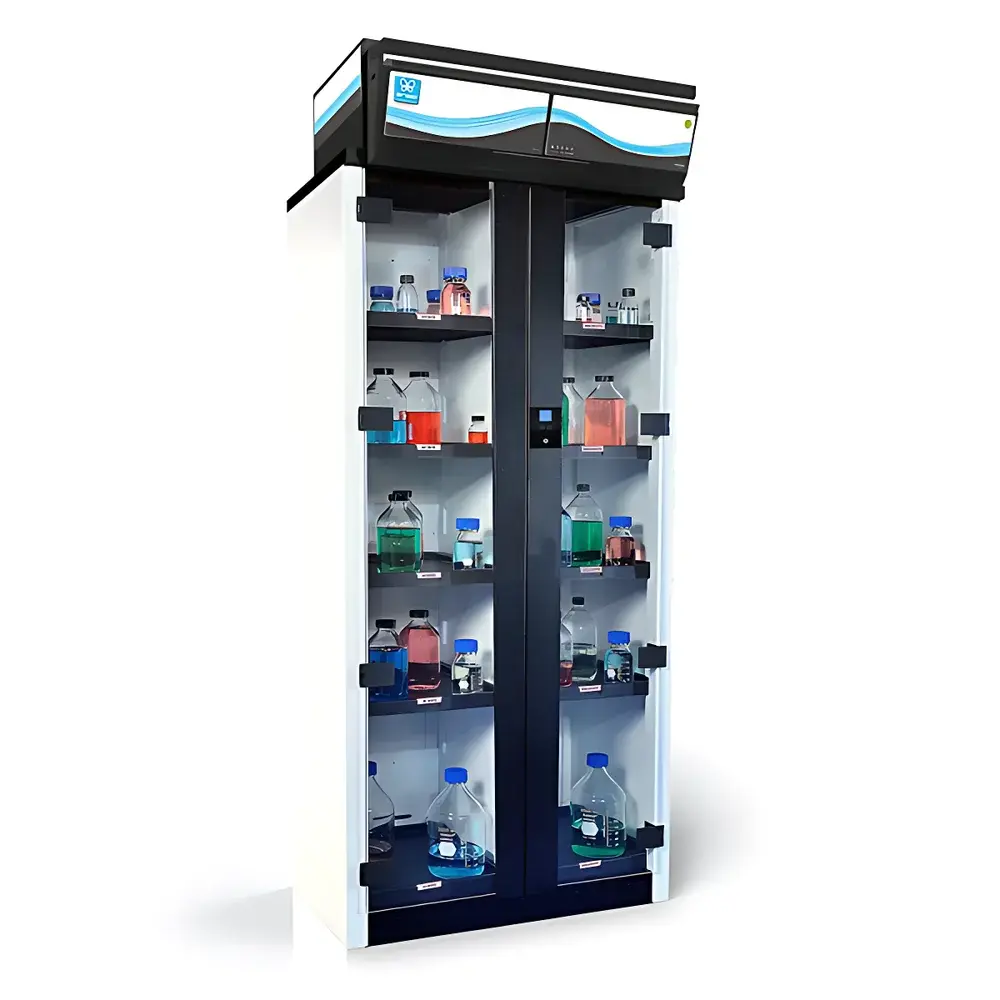
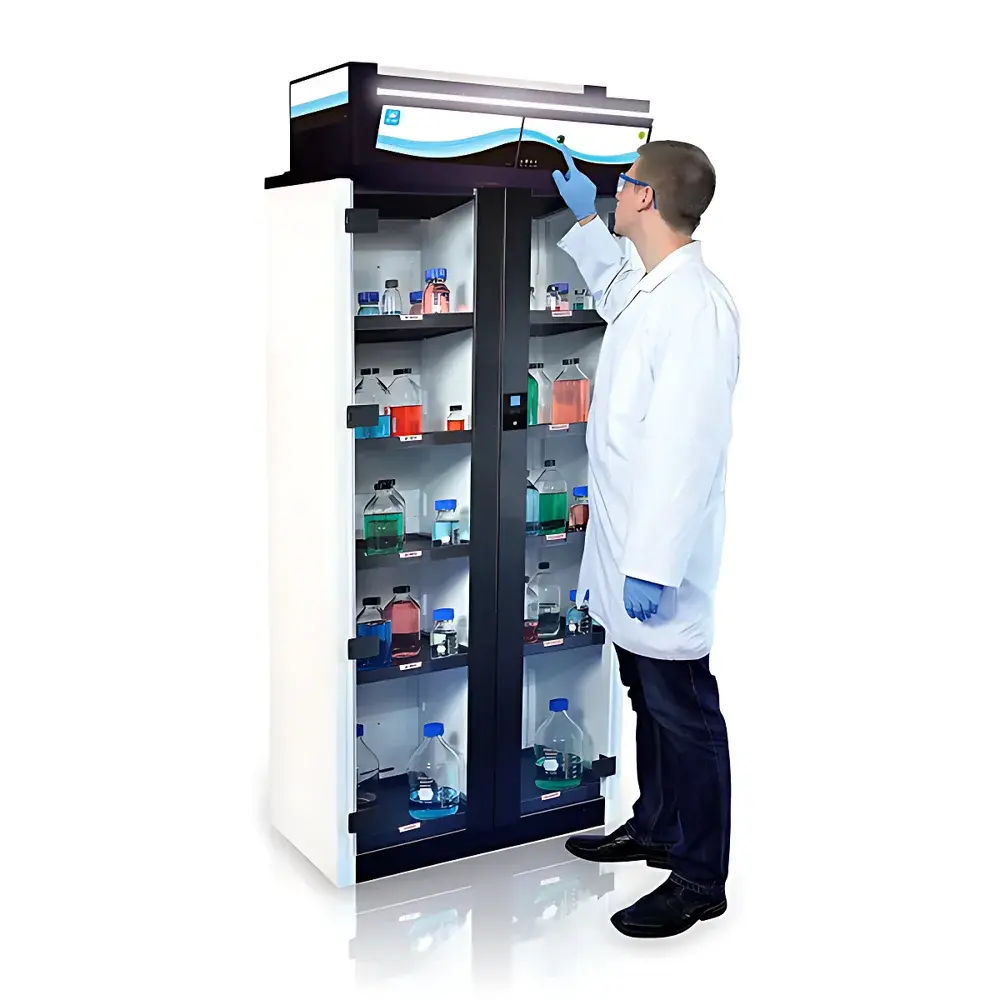
Erlab Captair 834 Smart Ductless Chemical Storage Cabinet
| Brand | Erlab |
|---|---|
| Model | Captair 834 Smart |
| Airflow Rate | 220 m³/h |
| Power Supply | 80–220 V / 50–60 Hz |
| Power Consumption | 45 W (Max. Current: 0.45 A) |
| Cabinet Material | Electrogalvanized Steel with Acid-Resistant Polymer Coating |
| Door Material | Chemically Resistant Acrylic (Transparent) |
| Filter Frame Material | Polypropylene (PP) |
| Filtration Compliance | JG/T 385–2012 (CN), AFNOR NF X 15-211:2009 (FR), BS 7989 (UK), DIN 12927 (DE), EN 1822:1998 (HEPA H14 & ULPA U17), CE Marked |
| Storage Capacity | ~160 × 500 mL Bottles |
| Safety Certification | Erlab ESP (Equipment Safety Protocol) with Traceability, Applicability Assessment & Usage Certificate |
| Filter Monitoring | Real-time Detection of Organic Solvents, Inorganic Acids, and Formaldehyde Saturation |
| Noise Level | <45 dB(A) |
| Dimensions (W×D×H) | 834 × 550 × 2000 mm (Typical for 834 Series) |
Overview
The Erlab Captair 834 Smart is a ductless chemical storage cabinet engineered for continuous, localized air purification in laboratories where permanent ventilation infrastructure is impractical or cost-prohibitive. Unlike conventional fume hoods or plumbed storage cabinets, the Captair 834 Smart operates on a closed-loop recirculation principle: ambient laboratory air is drawn through a multi-stage filtration system—comprising pre-filters, activated carbon beds optimized for broad-spectrum organic vapors, and optional acid gas or formaldehyde-specific chemisorbent layers—then returned to the room at ISO Class 5–7 cleanliness levels. This design eliminates ductwork installation, reduces HVAC load, and maintains thermal integrity without compromising containment integrity. The cabinet meets stringent performance benchmarks defined in JG/T 385–2012 (China), AFNOR NF X 15-211:2009 (France), BS 7989 (UK), and DIN 12927 (Germany), and carries CE marking under the EU Machinery Directive and Low Voltage Directive. Its core function is not passive storage but active hazard mitigation—ensuring operator exposure to volatile chemicals remains below occupational exposure limits (OELs) during routine access, long-term storage, and incidental door openings.
Key Features
- Smart Status Communication System: Dual-mode feedback via color-coded LED light band (green = normal operation; amber = filter saturation warning; red = critical fault) and audible pulse coding (e.g., three beeps = door left open >30 s; five beeps = main filter exhaustion).
- Real-Time Filter Saturation Monitoring: Integrated electrochemical and photoionization sensors continuously assess breakthrough risk for organic solvents (e.g., acetone, ethanol, toluene), inorganic acids (e.g., HCl, HNO₃), and formaldehyde—triggering stage-specific alerts before adsorption capacity is exhausted.
- Erlab Equipment Safety Protocol (ESP): A documented safety framework including pre-installation applicability assessment, user certification, and digital usage log—supporting GLP/GMP-aligned audit trails and regulatory readiness.
- Chemical-Resistant Construction: Electrogalvanized steel chassis with acid-resistant polymer coating; 12 mm thick chemically tempered acrylic door offering full visual inventory monitoring while resisting etching from common reagents.
- Energy-Efficient Operation: Ultra-low power draw (45 W max) enables 24/7 operation without significant impact on lab energy budgets; airflow stability maintained across voltage fluctuations (80–220 V, 50–60 Hz).
Sample Compatibility & Compliance
The Captair 834 Smart is validated for safe storage of IARC Group 3 and 4 chemicals, including flammable liquids (Class I–IIIA per NFPA 30), corrosives (pH 12), and low-volatility organics. It is not rated for pyrophoric substances, peroxides, or high-hazard toxics requiring dedicated inert-atmosphere storage. All filtration media are tested per EN 1822:1998 for particulate retention (HEPA H14 and ULPA U17 options available); carbon beds comply with ASTM D5228 for iodine number and BET surface area. The unit satisfies local regulatory requirements for ductless containment in academic, pharmaceutical QC, and industrial R&D labs—including alignment with China’s GB/T 385–2012 verification protocol and European workplace exposure limit (WEL) compliance frameworks.
Software & Data Management
While the Captair 834 Smart operates as a standalone device, its ESP-enabled firmware supports optional integration with Erlab’s LabManager Cloud platform via Ethernet or Wi-Fi (add-on module). This enables remote monitoring of real-time status flags (door position, fan RPM, filter remaining life %), automated alert dispatch (email/SMS), and exportable CSV logs for internal safety audits. All data events—including door open duration, filter replacement timestamps, and alarm history—are time-stamped and cryptographically signed to meet FDA 21 CFR Part 11 requirements for electronic records and signatures when deployed in regulated environments.
Applications
- Academic Teaching Labs: Secure, low-cost storage for undergraduate chemistry stock solutions without facility retrofitting.
- Pharmaceutical Quality Control: Isolation of reference standards and assay reagents subject to USP analytical instrument qualification guidelines.
- Industrial R&D Facilities: Modular chemical staging adjacent to benchtop instrumentation (e.g., HPLC, GC-MS) where space and duct routing constraints exist.
- Hospital Core Labs: Segregated storage of histology solvents (xylene, ethanol) and fixatives (formalin) with trace-level formaldehyde detection.
- Environmental Testing Labs: Containment of EPA Method 8081/8270 target analytes during sample preparation workflows.
FAQ
Does the Captair 834 Smart require external ducting or make-up air systems?
No. It is fully ductless and recirculates filtered air into the laboratory environment—eliminating civil engineering modifications.
How often must filters be replaced?
Filter service intervals depend on chemical loading profile and usage frequency; typical range is 6–12 months. The Smart sensor system provides ≥72 hours advance warning prior to saturation.
Can it store perchloric acid or hydrofluoric acid?
No. Perchloric acid requires wash-down hoods; hydrofluoric acid demands specialized fluoropolymer-lined filtration—neither is supported by standard Captair configurations.
Is remote monitoring mandatory for compliance?
No. ESP documentation and local status indicators satisfy baseline regulatory expectations; cloud connectivity is optional for enhanced traceability in GxP settings.
What maintenance certifications are required for technicians?
Erlab-certified field service engineers must perform annual performance verification per JG/T 385–2012 Annex C, including face velocity mapping, filter leakage testing, and alarm response validation.



