
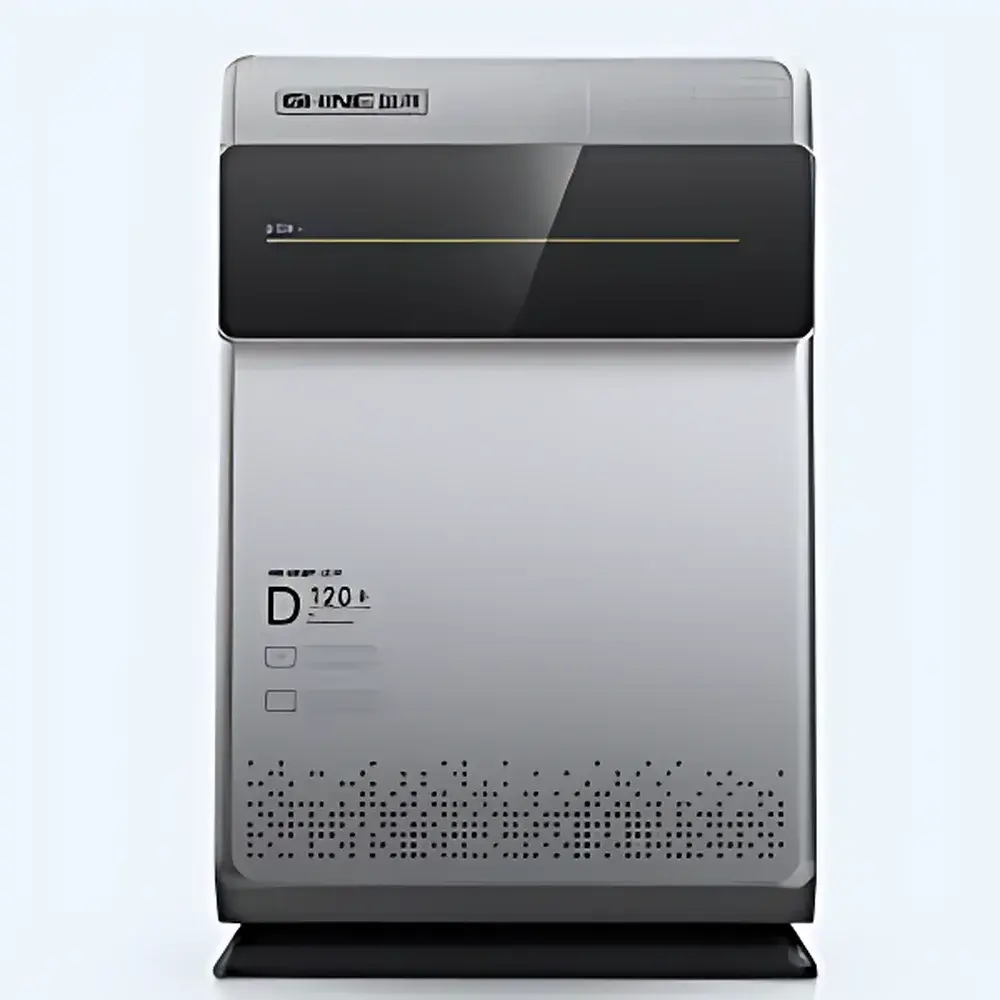
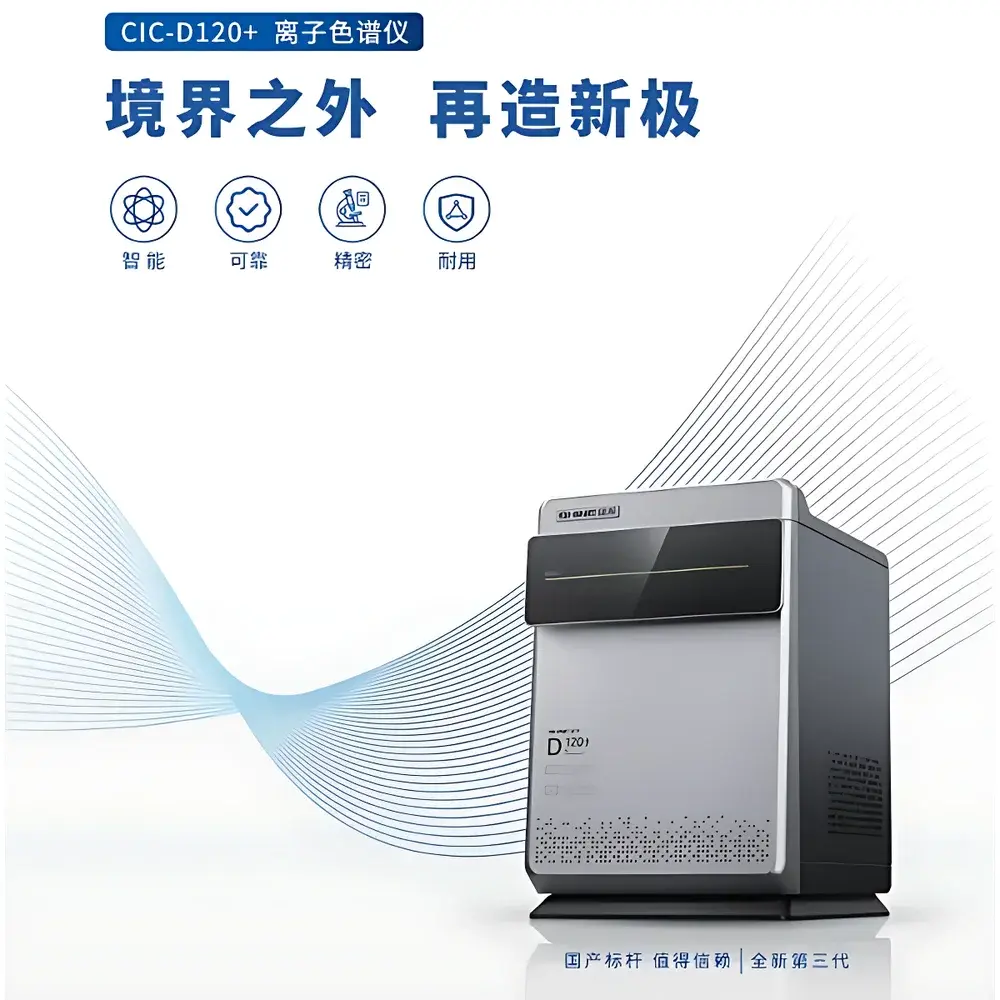
Shine CIC-D120+ Ion Chromatograph
| Brand | Shine |
|---|---|
| Origin | Shandong, China |
| Manufacturer Type | Direct Manufacturer |
| Regional Classification | Domestic (China) |
| Model | CIC-D120+ |
| Instrument Type | Laboratory Benchtop |
| Application Scope | General-Purpose Ion Analysis |
| Pump Maximum Pressure | 42 MPa |
| Flow Rate Range | 0.001–9.999 mL/min |
| System Operating Pressure Limit | 10 MPa |
Overview
The Shine CIC-D120+ Ion Chromatograph is a high-performance, laboratory-grade benchtop instrument engineered for precise, reproducible separation and quantification of inorganic anions and cations in diverse aqueous matrices. Based on suppressed conductivity detection coupled with high-efficiency ion exchange chromatography, the system delivers robust analytical performance across environmental, pharmaceutical, food safety, and industrial quality control applications. Its modular architecture integrates a PEEK-fluidic path, electrochemical suppression, and temperature-stabilized column compartment—ensuring minimal analyte adsorption, low baseline noise, and long-term signal stability. Designed to meet routine and method-development requirements, the CIC-D120+ supports both isocratic and gradient elution modes using hydroxide- or carbonate-based eluents, and is compatible with standard and microbore column formats (2.1 mm and 3.0 mm i.d.).
Key Features
- Full-PEEK fluidic pathway—including pump head, injection valve, column, detector cell, and tubing—ensures exceptional chemical resistance to strong acids, bases, and oxidizing reagents, while minimizing metal ion leaching and background conductivity drift.
- Auto-ranging digital conductivity detector eliminates manual gain switching; dynamically adjusts sensitivity across four orders of magnitude (ppb to ppm), enabling simultaneous quantification of trace and major ions in a single injection.
- Circulating 3D thermostatic column oven employs variable-frequency fan-assisted convection heating with PID-controlled ramp/soak programming—achieving ±0.1 °C temperature stability and rapid thermal equilibration without overshoot.
- Integrated degassing module with gas–liquid separator removes dissolved CO₂ and O₂ from eluent streams, reducing baseline fluctuations and improving retention time reproducibility.
- Intelligent consumables monitoring system tracks column usage, suppressor life, and eluent depletion in real time via embedded sensors and firmware logic—triggering alerts prior to performance degradation.
- Standard 120-position autosampler with programmable vial cooling (4–40 °C) enables unattended batch analysis, supporting GLP-compliant sequence logging and audit trail generation.
Sample Compatibility & Compliance
The CIC-D120+ accommodates a broad range of sample types—including drinking water, wastewater, soil extracts, biological fluids, pharmaceutical excipients, and food leachates—following appropriate pre-treatment (e.g., filtration, dilution, matrix elimination). It supports validated methods aligned with ISO 10304-1 (water quality), ASTM D4327 (anion analysis), USP (conductivity of purified water), and EPA Methods 300.0, 300.1, and 317.0. The instrument’s hardware design and software architecture facilitate compliance with FDA 21 CFR Part 11 requirements when configured with electronic signatures, audit trails, and role-based access control.
Software & Data Management
The proprietary IC Control Suite provides intuitive method setup, real-time chromatogram visualization, peak integration with customizable baselines, and automated calibration curve generation. All raw data files are stored in vendor-neutral, timestamped binary format with embedded metadata (instrument ID, operator, sequence ID, acquisition parameters). Data export options include CSV, PDF reports, and XML-compatible structures for LIMS integration. Software logs all user actions—including method edits, calibration events, and instrument status changes—with immutable timestamps—supporting full traceability under GLP/GMP frameworks.
Applications
- Environmental monitoring: Quantification of F⁻, Cl⁻, NO₂⁻, Br⁻, NO₃⁻, PO₄³⁻, SO₄²⁻, and AsO₄³⁻ in surface and groundwater per EPA protocols.
- Pharmaceutical QC: Testing for residual acetate, chloride, nitrate, and sulfate in APIs and parenteral formulations per ICH Q5C and USP monographs.
- Food & beverage safety: Detection of preservative anions (benzoate, sorbate), iodide in dairy, cyanide in almond extracts, and small organic acids (lactate, citrate, malate).
- Industrial process control: Monitoring of Cl⁻ and SO₄²⁻ in boiler feedwater, OH⁻ and CO₃²⁻ in caustic scrubber solutions, and heavy metal complexes (e.g., [CuCl₄]²⁻) in plating baths.
- Research applications: Method development for multi-analyte profiling using fast-separation columns (<6 min for 7-anion screening) and low-volume microbore configurations (2.1 mm i.d.) for limited sample availability.
FAQ
What eluent systems are supported by the CIC-D120+?
The instrument is fully compatible with potassium hydroxide (KOH) gradient elution via electrolytic eluent generation, as well as isocratic carbonate/bicarbonate and methanesulfonic acid (MSA) systems.
Does the system support regulatory-compliant data integrity?
Yes—when deployed with IC Control Suite’s audit trail module and network-authenticated user accounts, it satisfies core ALCOA+ principles and meets technical prerequisites for 21 CFR Part 11 compliance.
Can the CIC-D120+ be used for cation analysis?
Yes—equipped with optional cation-exchange columns and MSA-based eluents, the system enables simultaneous or sequential analysis of Li⁺, Na⁺, NH₄⁺, K⁺, Mg²⁺, and Ca²⁺.
Is column temperature control mandatory for quantitative accuracy?
While not strictly mandatory, column oven stabilization is strongly recommended: retention time shifts of >0.5% per °C are typical for ion exchange separations, directly impacting precision and method transferability.
What maintenance intervals are recommended for the suppressor and guard column?
Suppressor lifetime is typically 2,000–3,000 injections under normal use; guard column replacement is advised every 100–200 injections depending on sample cleanliness—both monitored automatically and logged in the software.





