
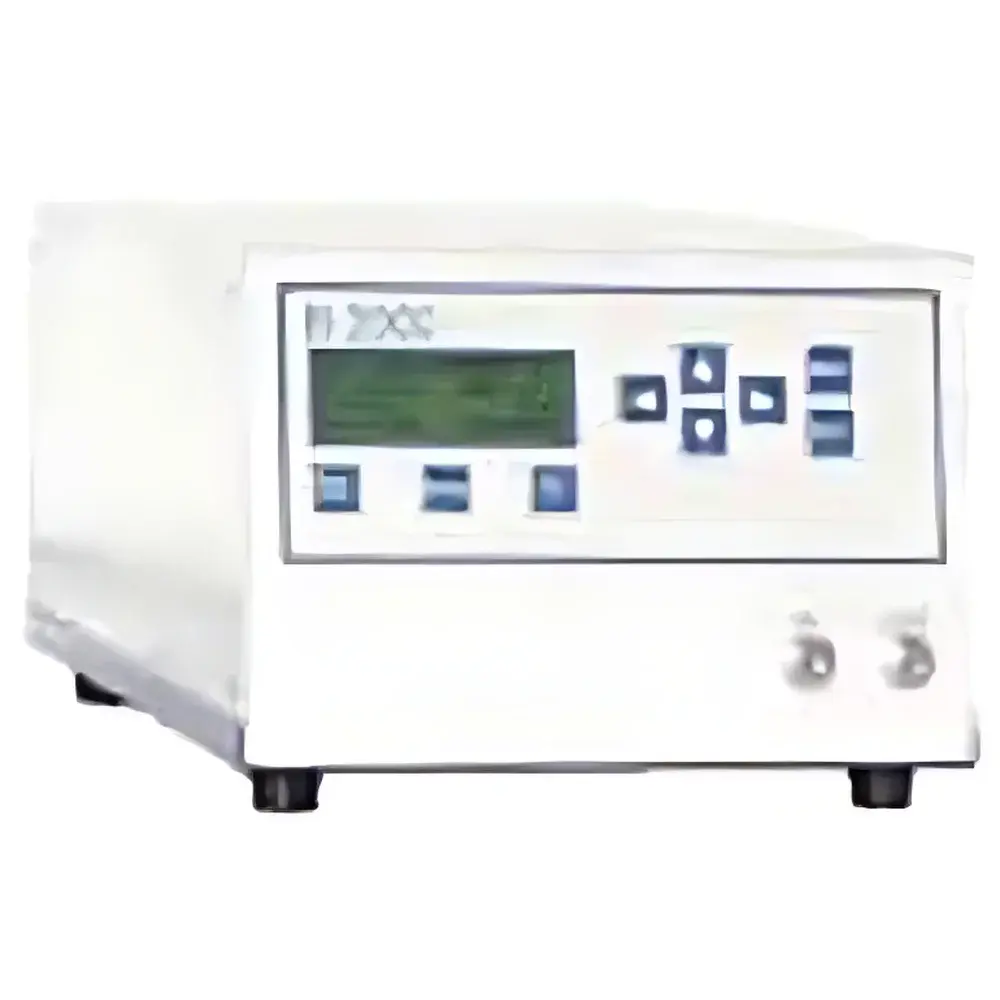
Agela RI-100 Refractive Index Detector
| Brand | Agela |
|---|---|
| Origin | Tianjin, China |
| Instrument Type | Refractive Index Detector (RID) |
| Flow Rate Range | 1–50 mL/min |
| Flow Cell Volume | 7 µL |
| Temperature Control Range | 35–55 °C (adjustable in 1 °C increments |
| Flow Cell Pressure Rating | 6 kg/cm² |
| Internal Cell Dead Volume | 88 µL or 353 µL (selectable) |
| Linear Range | 0–2000 µRIU |
| Noise Level | ≤10 × 10⁻⁸ RIU |
| Drift (Full-Scale) | <1 mV/hour with 1 mL/min H₂O flow |
| Auto-Zero Function | Yes |
| Integrated Flush Valve | Yes |
| Digital Interface | RS-232 (bidirectional parameter transmission) |
Overview
The Agela RI-100 Refractive Index Detector is a precision optical detector engineered for universal solute detection in liquid chromatography systems—particularly where analytes lack strong UV absorbance or native fluorescence. Operating on the principle of differential refractometry, the RI-100 measures minute changes in the refractive index of the mobile phase as eluting compounds pass through a thermally stabilized flow cell. This physical detection method provides consistent, concentration-dependent response across a broad range of non-volatile and semi-volatile organic compounds—including sugars, polymers, lipids, alcohols, and ionic species—without requiring chromophores or derivatization. Designed for integration with HPLC, GPC/SEC, and preparative chromatography platforms, the RI-100 delivers high baseline stability and reproducible quantitation under isocratic and gradient conditions, provided mobile phase composition remains constant.
Key Features
- Thermally controlled flow cell with precise temperature regulation from 35 °C to 55 °C (1 °C resolution), extendable to 75 °C for short-term thermal equilibration
- Low-volume, dual-option flow cell design (7 µL optical path volume) with selectable internal dead volumes of 88 µL or 353 µL to optimize sensitivity vs. peak dispersion trade-offs
- High-pressure compatibility up to 6 kg/cm² (≈0.6 MPa), supporting robust operation in standard HPLC workflows
- Low-noise optical system achieving ≤10 × 10⁻⁸ RIU noise level—enabling reliable detection of subtle refractive index shifts
- Integrated auto-zero function with real-time baseline correction, reducing manual intervention and improving long-run stability
- Built-in flush valve for rapid cell cleaning and solvent exchange, minimizing carryover between runs
- RS-232 serial interface supporting bidirectional communication for remote parameter configuration, status monitoring, and synchronization with chromatography data systems (CDS)
Sample Compatibility & Compliance
The RI-100 is compatible with common HPLC-grade solvents (e.g., THF, chloroform, acetonitrile, methanol, water, and aqueous buffers) and exhibits minimal drift when used with stable, low-volatility mobile phases. It complies with fundamental performance expectations outlined in ASTM D5296 (for polymer molecular weight distribution by SEC) and ISO 16014-4 (plastics—determination of average molecular weights by size-exclusion chromatography). While refractive index detection is inherently non-destructive and universally responsive, users must maintain strict mobile phase consistency during gradient elution, as RI signal responds directly to solvent composition changes. For regulated environments, the detector supports audit-ready operation when paired with CDS software compliant with FDA 21 CFR Part 11 requirements—including electronic signatures, user access control, and full parameter change logging.
Software & Data Management
The RI-100 communicates via RS-232 using a standardized ASCII protocol, enabling seamless integration with third-party chromatography data systems such as Waters Empower, Thermo Chromeleon, Shimadzu LabSolutions, and open-source platforms like OpenChrom. All operational parameters—including temperature setpoint, zero offset, gain, and flush valve status—are remotely configurable and queryable. The detector transmits analog voltage output (typically ±1 V or 0–10 V) synchronized with digital status flags, allowing time-aligned signal acquisition and metadata tagging. When deployed in GLP/GMP laboratories, the combination of hardware-level auto-zero repeatability, temperature-stabilized optics, and traceable RS-232 command logs satisfies core instrument qualification criteria for Installation Qualification (IQ) and Operational Qualification (OQ).
Applications
- Gel permeation chromatography (GPC) and size-exclusion chromatography (SEC) for polymer characterization (Mn, Mw, PDI)
- Carbohydrate analysis in food, beverage, and pharmaceutical excipient QC (e.g., sucrose, lactose, dextran)
- Quality control of surfactants, glycols, and polyethylene glycols (PEGs)
- Process monitoring of fermentation broths and biopolymer synthesis streams
- Method development support for UV-silent compounds where alternative detection modalities are unavailable
FAQ
Can the RI-100 be used with gradient elution methods?
No—refractive index detection is highly sensitive to mobile phase composition. Gradient elution induces large baseline shifts that obscure analyte signals. Isocratic or step-gradient methods with matched mobile phase composition in reference and sample channels are required.
What is the recommended maintenance interval for the flow cell?
Daily flushing with appropriate solvent post-run is advised. Quarterly inspection of optical windows for residue buildup and annual calibration verification against certified RI standards (e.g., sucrose solutions) are recommended for routine QC labs.
Does the detector support analog output for legacy data acquisition systems?
Yes—the RI-100 provides a standard analog voltage output (±1 V or 0–10 V, user-selectable) fully synchronized with digital status reporting via RS-232.
Is temperature stabilization critical for quantitative accuracy?
Yes. Refractive index is temperature-dependent (typically ~1 × 10⁻⁴ RIU/°C). The 0.1 °C thermal stability specification ensures measurement repeatability within ±0.5 µRIU over extended runs.
How does the dual dead-volume option affect method transferability?
The 88 µL configuration minimizes band broadening for high-resolution SEC applications, while the 353 µL variant improves signal-to-noise ratio in preparative or low-concentration assays—both retain identical optical path length and calibration linearity.





