
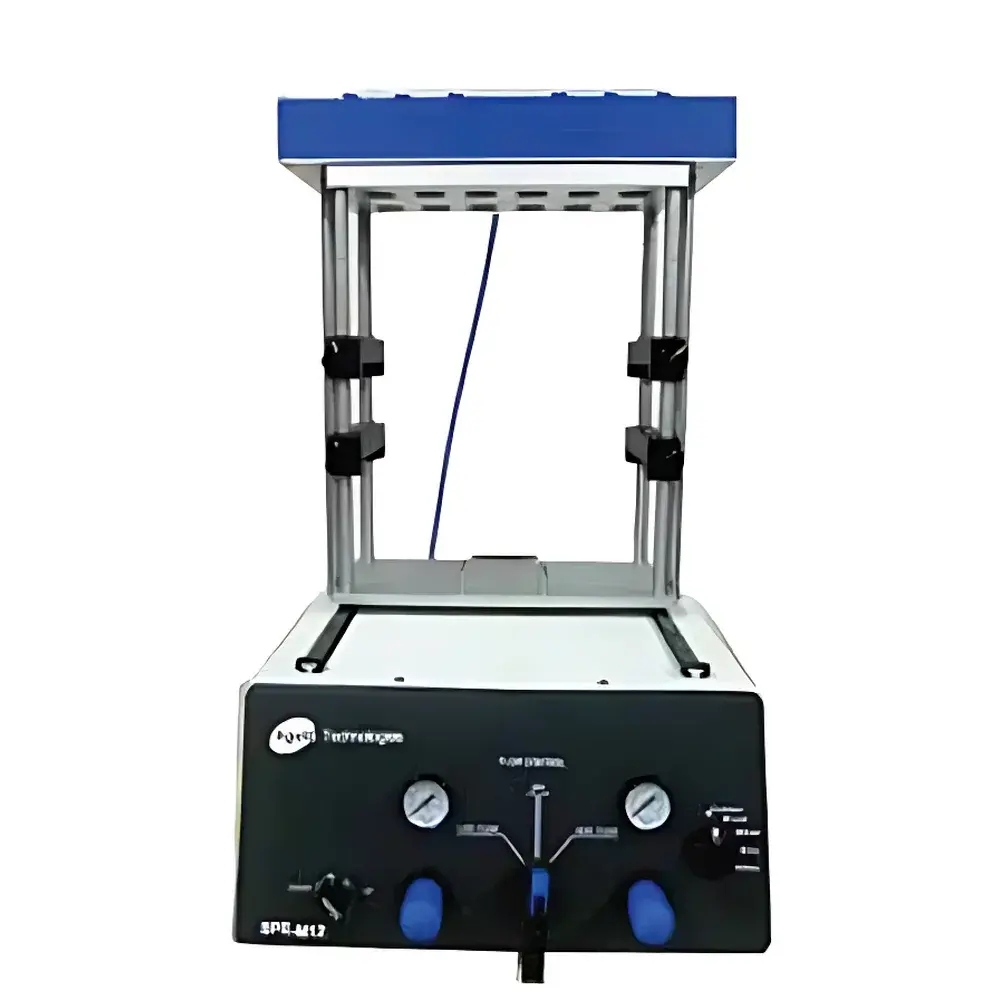
Agela SPE-M12 Positive-Pressure Multi-Channel Solid Phase Extraction System
| Brand | Agela |
|---|---|
| Origin | Tianjin, China |
| Model | SPE-M12 |
| Automation Level | Semi-Automatic |
| Channel Count | 12 Independent Channels |
| Extraction Format | Cartridge-Based SPE |
| Flow Control Method | Pneumatic Pressure Regulation |
| Solvent Types Supported | ≥5 Distinct Eluents |
| Sample Capacity | 1–12 Samples per Run |
| Sample Loading Volume | Up to 25 mL per Cartridge |
| Wetted Materials | PTFE (Polytetrafluoroethylene) |
| Valve Configuration | 12 Individually Adjustable Pneumatic Valves |
| Dual-Gas Path Architecture | One for Precise Flow Modulation, One for Post-Elution Drying/Desolvation |
Overview
The Agela SPE-M12 Positive-Pressure Multi-Channel Solid Phase Extraction System is an engineered solution for high-throughput, reproducible sample preparation in analytical laboratories. It operates on the principle of positive-pressure-driven solvent delivery—applying regulated inert gas (typically nitrogen or compressed air) to uniformly push liquid phases through solid-phase extraction cartridges. Unlike vacuum-based SPE manifolds, this system eliminates channel-to-channel flow variability caused by differential vacuum decay, clogging, or cartridge bed collapse. The SPE-M12 delivers consistent, operator-independent flow rates across all 12 positions, enabling precise control over loading, washing, and elution steps critical for method robustness in regulated environments such as environmental testing, food safety analysis, pharmaceutical QC, and clinical toxicology.
Key Features
- 12 independently controllable pneumatic valves—each actuating a dedicated SPE cartridge port—allow simultaneous yet individually optimized protocols across different sample matrices or analyte classes.
- Dual-gas-path architecture: Primary path regulates eluent flow velocity with fine pressure resolution (0.01–0.3 MPa range typical); secondary path supplies drying gas post-elution to remove residual solvents prior to evaporation or instrumental analysis.
- PTFE-wetted fluidic pathway ensures chemical compatibility with aggressive solvents including acetonitrile, methanol, dichloromethane, ethyl acetate, and acidic/basic aqueous buffers—minimizing leachables and adsorptive losses.
- Modular cartridge holder accepts standard 1 mL, 3 mL, 6 mL, and 12 mL SPE columns from major vendors (e.g., Agela, Waters, Thermo Fisher, Phenomenex), supporting C18, SCX, SAX, Florisil, HLB, and mixed-mode chemistries.
- Semi-automatic operation integrates seamlessly into laboratory workflows: users manually load samples and cartridges, while the system executes timed, pressure-regulated steps—reducing manual intervention without requiring full software integration.
Sample Compatibility & Compliance
The SPE-M12 accommodates diverse sample types—including aqueous environmental extracts (e.g., wastewater, surface water), biological fluids (urine, plasma, serum), food homogenates, and plant tissue digests—provided they are pre-filtered to ≤0.45 µm. Its PTFE construction meets USP Class VI biocompatibility requirements and resists corrosion under prolonged exposure to halogenated solvents and strong acids/bases. While the instrument itself does not carry CE or UL certification as a standalone unit (it is intended for use within certified lab infrastructure), its design supports compliance with ISO/IEC 17025:2017 (General Requirements for the Competence of Testing and Calibration Laboratories) and FDA 21 CFR Part 11 when operated within validated SOPs that include audit-trail documentation of pressure settings, timing, and operator identity.
Software & Data Management
The SPE-M12 operates via front-panel tactile controls and LED status indicators—no embedded software or computer interface is required. However, it is fully compatible with laboratory information management systems (LIMS) and electronic lab notebooks (ELN) through documented procedural controls. Users may record pressure setpoints, dwell times, and valve activation sequences in standardized templates aligned with GLP/GMP documentation practices. For labs pursuing full digital traceability, optional external pressure loggers (e.g., calibrated digital manometers with USB output) can be integrated to generate time-stamped pressure profiles compliant with audit requirements under ISO 17025 Clause 7.7 and ICH M7 guidelines.
Applications
- Pre-concentration and cleanup of trace-level pesticides in drinking water per EPA Method 525.3 and ISO 17799.
- Isolation of mycotoxins (e.g., aflatoxin B1, ochratoxin A) from cereal extracts prior to LC-MS/MS quantification.
- Removal of phospholipids and proteins from plasma samples in bioanalytical method development (FDA Bioanalytical Method Validation Guidance).
- Extraction of polycyclic aromatic hydrocarbons (PAHs) from soil leachates using silica or Florisil cartridges.
- Multi-residue analysis of veterinary drugs in milk using mixed-mode cation-exchange (MCX) and reversed-phase dual-cartridge configurations.
FAQ
What pressure range is supported for optimal flow control?
Typical operating pressure spans 0.01–0.3 MPa (1–30 psi), adjustable per channel via calibrated needle valves; recommended range depends on cartridge packing density and solvent viscosity.
Can the system handle viscous or particulate-laden samples?
Pre-filtration (≤0.45 µm) is mandatory; for high-viscosity matrices (e.g., honey, syrup), dilution or centrifugation prior to SPE is advised to prevent column clogging.
Is validation support documentation available?
Agela provides a Factory Acceptance Test (FAT) report covering pressure linearity, valve response time, and leak integrity—intended as a foundation for user-defined IQ/OQ protocols.
How often do the PTFE seals require replacement?
Under normal usage (≤500 cycles/year), PTFE components exhibit no measurable degradation; routine visual inspection during maintenance is sufficient per manufacturer’s preventive maintenance schedule.
Does the system comply with ISO 8573-1 for compressed air quality?
The unit assumes inlet air meets Class 2:2:2 (solid particles ≤0.1 µm, dew point −40°C, oil content ≤0.1 mg/m³); external filtration/drying is recommended if lab air supply is unconditioned.



