
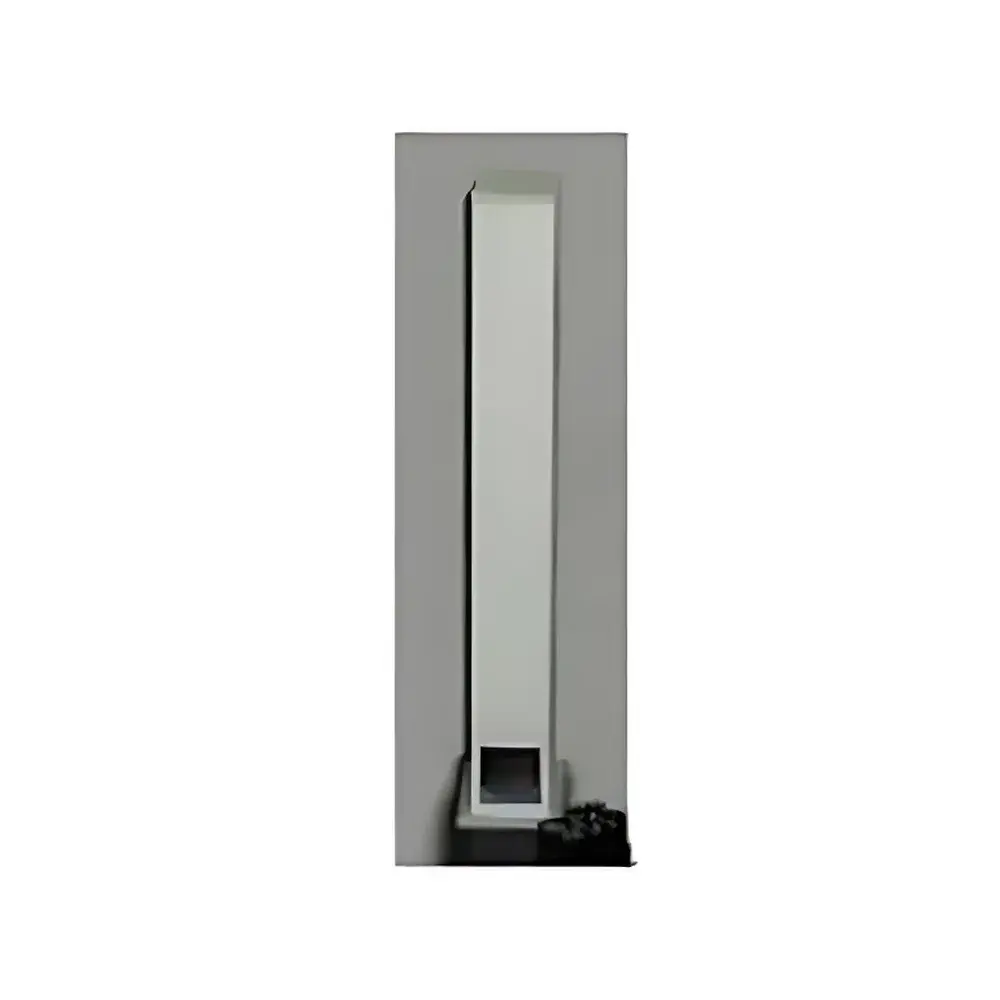
Agela CC-100 Analytical Column Oven
| Brand | Agela |
|---|---|
| Model | CC-100 |
| Origin | Tianjin, China |
| Temperature Range | Ambient +5°C to 100°C |
| Temperature Stability | ±0.1°C |
| Temperature Uniformity | ±0.3°C (across chamber) |
| Control Method | PID digital control with touch keypad |
| Display | LED digital display |
| Safety Features | Over-temperature protection cutoff |
| Chamber Design | Vertical upright configuration with magnetic-latch dual-layer lid (outer magnetic cover + insulated inner cover) |
| Power Supply | AC 220 V, 50 Hz |
| Dimensions (W×D×H) | 260 × 320 × 380 mm |
| Net Weight | 8.5 kg |
| Cooling | None (heating-only operation) |
Overview
The Agela CC-100 Analytical Column Oven is a precision-engineered thermal management system designed specifically for high-performance liquid chromatography (HPLC), ultra-high-performance liquid chromatography (UHPLC), and gas chromatography (GC) applications. It operates on the fundamental principle that consistent, precisely controlled column temperature directly governs retention time reproducibility, peak shape symmetry, resolution of closely eluting analytes, and mobile phase viscosity—critical parameters in quantitative and qualitative chromatographic analysis. Unlike ambient-temperature operation, which introduces drift due to laboratory fluctuations, the CC-100 maintains thermal equilibrium across the entire chromatographic column length via uniform convective air circulation and high-fidelity PID feedback control. Its heating-only architecture (ambient +5°C to 100°C) is optimized for routine QC labs, method development workflows, and regulatory-compliant environments where refrigeration is unnecessary or cost-prohibitive.
Key Features
- PID-based digital temperature control system utilizing an industrial-grade microprocessor for long-term stability and minimal setpoint overshoot;
- High-sensitivity platinum resistance temperature sensor (PT100) mounted in direct thermal contact with the column bed, enabling real-time, closed-loop monitoring synchronized with column thermal mass;
- LED digital display with intuitive touch-key interface—no mechanical dials or calibration drift concerns;
- Dual-layer lid design: outer magnetic-latch cover ensures rapid access while the insulated inner lid minimizes thermal loss and improves energy efficiency;
- Vertical upright chamber geometry reduces dead volume and eliminates column sagging, preserving optimal flow path integrity and minimizing extra-column band broadening;
- Independent over-temperature safety cutoff circuit (hardware-based, non-software dependent) triggers automatic heater deactivation at 110°C, meeting IEC 61010-1 Class II electrical safety requirements;
- Compact footprint (260 × 320 × 380 mm) accommodates standard benchtop HPLC configurations without obstructing detector or autosampler access.
Sample Compatibility & Compliance
The CC-100 supports all standard 1/16″ OD stainless steel, PEEK, and fused-silica capillary columns used in analytical-scale HPLC and GC systems—including reversed-phase C18, HILIC, ion-exchange, and chiral stationary phases. Its chamber accommodates up to two 250 mm × 4.6 mm columns side-by-side or one 150 mm × 2.1 mm UHPLC column with integrated column switching valves. The device complies with ISO 9001 manufacturing protocols and conforms to electromagnetic compatibility (EMC) standards per EN 61326-1 for laboratory equipment. While not intrinsically rated for hazardous locations, its Class II insulation and grounded chassis support safe integration into GLP/GMP-regulated laboratories when deployed as part of a validated chromatographic method (e.g., USP , ICH Q2(R2), or ASTM D7213 for fuel analysis).
Software & Data Management
The CC-100 operates as a standalone hardware module with no embedded firmware or network connectivity—intentionally designed to eliminate cybersecurity risks and software validation overhead in regulated environments. All operational parameters (setpoint, actual temperature, status flags) are locally displayed but not logged internally. For audit-trail compliance under FDA 21 CFR Part 11, temperature data must be acquired externally via analog output (0–5 V DC proportional to temperature) connected to a validated data acquisition system or chromatography data system (CDS) such as Waters Empower, Thermo Chromeleon, or Agilent OpenLab. Optional RS-232 interface (available upon request) enables remote setpoint adjustment and status polling in automated workflows.
Applications
- Routine pharmaceutical QC testing requiring strict retention time repeatability (RSD < 0.2% over 24 h);
- Method development for gradient elution optimization where temperature gradients complement solvent gradients;
- Stability-indicating assays where thermal stress on column chemistry must remain constant across batches;
- Environmental analysis (EPA Methods 8081, 8270) involving thermally labile pesticides or PAHs;
- Food safety testing (AOAC 2007.01) where matrix-dependent retention shifts are mitigated by fixed column temperature;
- Academic research labs performing kinetic studies or thermodynamic parameter estimation (e.g., van’t Hoff plots).
FAQ
Does the CC-100 support sub-ambient temperature control?
No. The CC-100 is a heating-only column oven. Its operational range begins at ambient +5°C and extends to 100°C. Refrigerated column ovens require separate compressor-based systems.
Can it be integrated with third-party HPLC systems?
Yes. It accepts standard 1/16″ tubing and fits industry-standard column holders. No proprietary adapters or drivers are required.
Is temperature calibration traceable to NIST standards?
The factory calibration uses PT100 sensors certified to ISO/IEC 17025-accredited reference standards. End-user calibration verification is performed using an external NIST-traceable thermometer probe inserted into the column path.
What maintenance is required?
Annual inspection of thermal insulation integrity and verification of magnetic latch force. No consumables or scheduled servicing intervals apply.
How does vertical orientation improve chromatographic performance?
By eliminating column bending and minimizing gravitational effects on packed bed integrity, the upright design preserves linear velocity profiles and reduces axial dispersion—directly improving plate count (N) and peak capacity.
Related Products






