
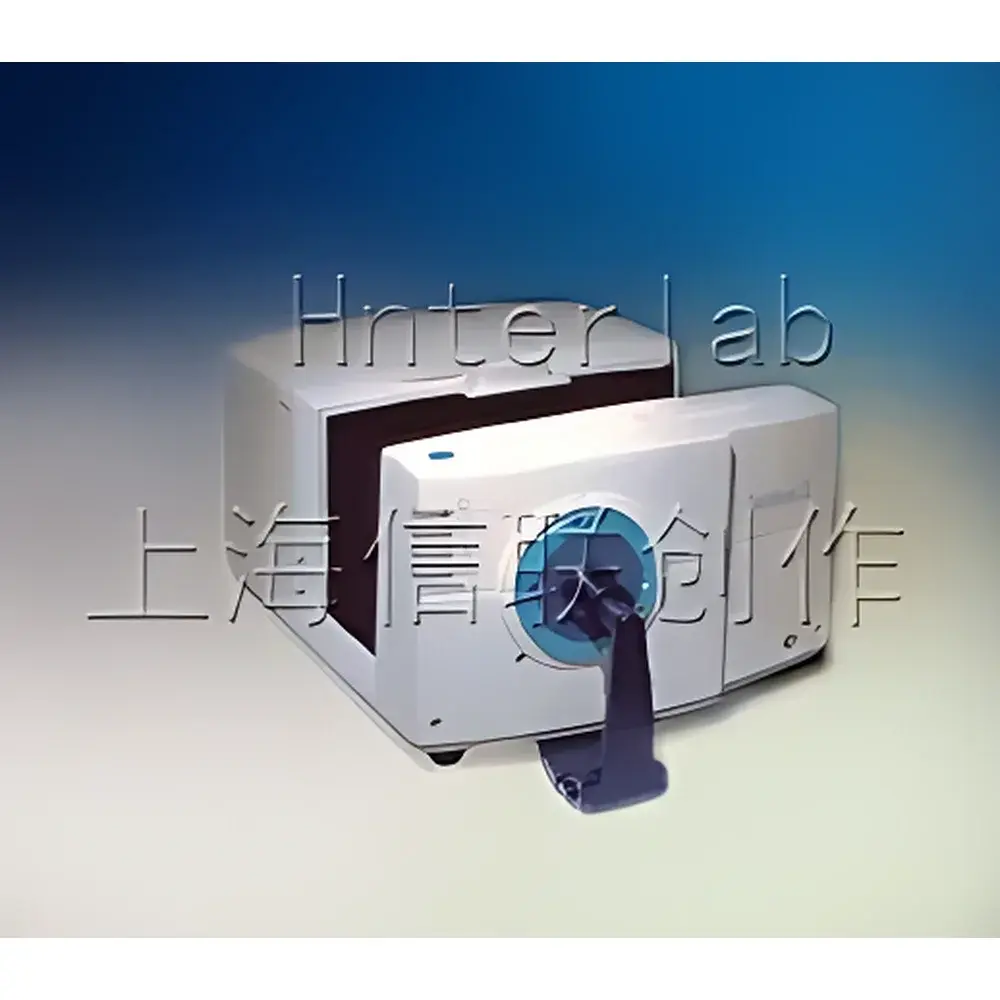
HunterLab ColorQuest XE Benchtop Spectrophotometer
| Brand | HunterLab |
|---|---|
| Origin | USA |
| Model | CQXE |
| Product Type | Spectrophotometric Colorimeter |
| Instrument Type | Benchtop |
| Optical Geometry | d/8° Integrating Sphere |
| Light Source | Pulsed Xenon Lamp |
| Spectral Range | 400–700 nm |
| Repeatability | ΔE*ab ≤ 0.03 (for white tile, 10 readings) |
| Wavelength Resolution | < 3 nm |
| Wavelength Accuracy | ±0.1 nm |
| Effective Bandwidth | 10 nm (triangular) |
| Photometric Range | 0–200% |
| Photometric Resolution | 0.003% (reported as 0.01%) |
| Measurement Time | < 1 s |
| Minimum Interval Between Measurements | 3 s |
| Transmission Modes | Direct and Total |
| Integrating Sphere Diameter | 152 mm |
| Sphere Coating | Spectraflect® |
| Viewing Apertures | LAV (25.4 mm illum. / 19.0 mm meas.), SAV (9.5 mm illum. / 6.3 mm meas.), MAV (4 mm meas.) |
| Specular Component | Automatic Include/Exclude |
| Lamp Lifetime | > 1,000,000 flashes |
Overview
The HunterLab ColorQuest XE is a benchtop spectrophotometric colorimeter engineered for precision, reproducibility, and operational robustness in both quality control laboratories and production-floor environments. Built upon a dual-beam spectral photometry architecture, it employs a 256-element diode array detector coupled with a high-resolution concave holographic grating to deliver stable, high-fidelity spectral data across the visible spectrum (400–700 nm). Its d/8° optical geometry—compliant with ISO 7724-1, ASTM E308, and CIE No. 15—ensures consistent illumination and collection of diffuse reflectance and transmittance, accommodating specular component inclusion or exclusion via motorized baffle control. The instrument utilizes a pulsed xenon lamp filtered to simulate CIE Standard Illuminant D65, eliminating thermal drift and enabling rapid, flash-based measurements (98% across 400–700 nm), the system maintains exceptional signal-to-noise ratio and long-term photometric stability—critical for GLP-compliant color validation and inter-laboratory method transfer.
Key Features
- Dual-beam optical design with real-time reference compensation for enhanced baseline stability and reduced sensitivity to lamp aging or ambient fluctuations.
- Automated aperture switching between Large Area View (LAV), Small Area View (SAV), and Micro Area View (MAV) configurations—enabling seamless adaptation to heterogeneous surfaces, small parts, or localized defects without manual recalibration.
- Motorized specular component control ensures repeatable compliance with ASTM D2244 (gloss-inclusive) and ASTM E308 (gloss-excluded) measurement protocols.
- Pulsed xenon light source delivers D65-simulated illumination with >1,000,000 flash lifetime; lamp modules are field-replaceable with no optical realignment required.
- Integrated transmission chamber with three-sided open design supports liquid cells, films, and rigid transparent substrates under both direct and total transmission geometries.
- Robust mechanical architecture with temperature-stabilized optics and sealed optical path minimizes calibration drift—typical drift <0.01 ΔE*ab/8 hours under controlled lab conditions.
Sample Compatibility & Compliance
The ColorQuest XE accommodates opaque, translucent, and transparent solids and liquids—including powders, granules, gels, solutions, coatings, plastics, textiles, paper, glass, and ceramics. Its modular sample compartment accepts standard 10-mm, 20-mm, and 50-mm pathlength cuvettes, as well as custom fixtures for irregular geometries. The system meets regulatory requirements for color measurement in regulated industries: it supports audit-trail-enabled data capture compliant with FDA 21 CFR Part 11 when used with Vision software v5.0+, and its measurement algorithms align with ISO 11664 (CIE colorimetry), ASTM D6290 (plastics), ASTM D313 (paper and textiles), and ISO 27677 (APHA/YI/Whiteness). All factory calibrations are traceable to NIST SRM 930e and SRM 2035.
Software & Data Management
Vision software (v5.0+) provides full instrument control, spectral analysis, and statistical reporting. It enables creation of multi-parameter color specifications (e.g., L*a*b*, ΔE*ab, Yellowness Index ASTM E313, Whiteness Index CIE/ISO, APHA/Pt-Co, Hazen, Gardner, and Turbidity NTU), with pass/fail logic based on user-defined tolerances. Data export supports CSV, XML, and PDF formats; raw spectral data (10-nm intervals) is stored alongside metadata (operator ID, timestamp, instrument serial, calibration history). The software supports role-based access control, electronic signatures, and full audit trail logging—including parameter changes, result edits, and calibration events—to satisfy GMP/GLP documentation requirements.
Applications
The ColorQuest XE serves as a primary color verification tool across industrial sectors requiring quantitative, traceable color assessment. In chemical manufacturing, it validates batch-to-batch consistency of dyes and pigments; in pharmaceuticals, it monitors excipient color stability per USP ; in food packaging, it verifies ink hue and opacity on flexible laminates; in automotive coatings, it quantifies metamerism under multiple illuminants (D65, A, F2); and in pulp & paper, it measures brightness (ISO 2470-1), yellowness, and opacity (ISO 2471). Its transmission capability supports beverage clarity testing (e.g., fruit juice haze per AOAC 973.41) and polymer film clarity evaluation per ASTM D1003.
FAQ
What is the difference between LAV and SAV measurement modes?
LAV (Large Area View) uses a 25.4-mm illumination area and 19.0-mm measurement area for averaging over heterogeneous or textured surfaces. SAV (Small Area View) reduces both to 9.5 mm and 6.3 mm respectively, improving spatial resolution for small features or localized color variation.
Can the ColorQuest XE measure APHA and turbidity values directly?
Yes—the instrument calculates APHA (Pt-Co) and turbidity (NTU) from raw spectral transmittance data using embedded algorithms compliant with ASTM D1209 and ASTM D6505, eliminating need for separate dedicated instruments.
Is the xenon lamp user-replaceable?
Yes—lamp replacement requires no optical alignment or service technician; the module is designed for field swap in under five minutes using standard tools.
Does the system support GLP-compliant data archiving?
When operated with Vision software v5.0+ and configured with appropriate network permissions and audit settings, all measurements, calibrations, and user actions are logged with timestamps, operator IDs, and digital signatures—fully satisfying GLP record retention requirements.
How often is calibration verification required?
HunterLab recommends daily verification using supplied ceramic tiles (LAV/SAV), with full calibration every 30 days or after lamp replacement—per internal SOPs aligned with ISO/IEC 17025 Clause 6.5.2.




