
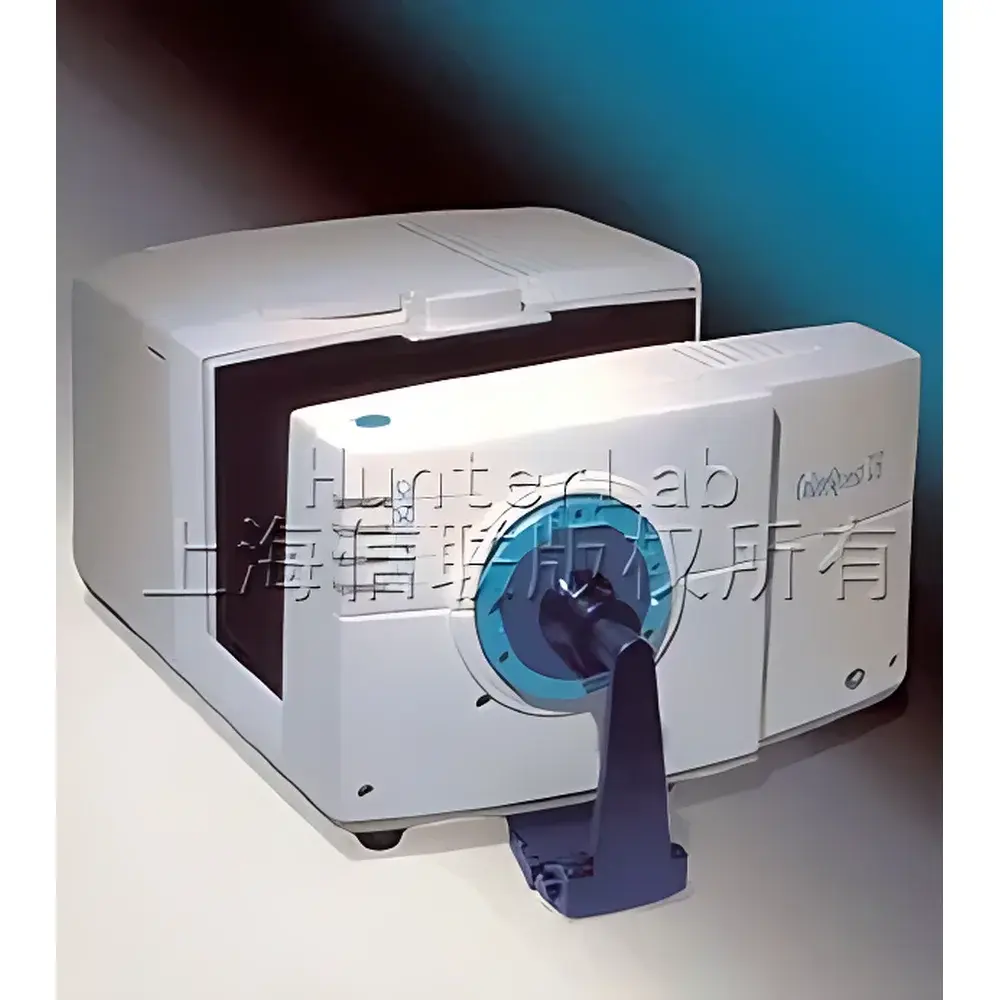
HunterLab ColorQuest XE Benchtop Spectrophotometer
| Brand | HunterLab |
|---|---|
| Origin | USA |
| Model | ColorQuest XE |
| Product Type | Spectrophotometric Color Difference Meter |
| Instrument Type | Benchtop |
| Optical Geometry | d/8° Integrating Sphere |
| Light Source | Pulsed Xenon Lamp |
| Spectral Range | 400–700 nm |
| Repeatability | ΔE*ab ≤ 0.03 |
| Detector | 256-element Diode Array |
| Grating | High-Resolution Concave Holographic |
| Integrating Sphere Diameter | 15.2 cm (6″) |
| Sphere Coating | Spectraflect® |
| Viewing Apertures | LAV (25.4 mm illum. / 19.0 mm meas.), SAV (9.5 mm illum. / 6.3 mm meas.), MAV (4 mm meas.) |
| Mirror Finish Compensation | Automated Inclusion/Exclusion |
| Measurement Time | < 1 s |
| Minimum Interval Between Measurements | 3 s |
| Transmission Modes | Direct (Directional) and Total Transmission |
| Transmission Chamber | Three-Sided Open |
Overview
The HunterLab ColorQuest XE is a high-precision benchtop spectrophotometer engineered for objective, repeatable color measurement in demanding industrial environments—particularly photovoltaic (PV) module manufacturing, encapsulant film production (e.g., EVA, POE), and solar-grade polymer development. It operates on the principle of double-beam spectral photometry, utilizing a pulsed xenon lamp and a 256-element diode array detector coupled with a high-resolution concave holographic grating to deliver full-spectrum reflectance and transmittance data from 400 nm to 700 nm at 10 nm intervals. Its d/8° integrating sphere geometry conforms to CIE No. 15, ASTM E308, ISO 7724-1, and DIN 5033 standards, ensuring metrological traceability and inter-laboratory comparability. Designed for long-term stability in quality control laboratories, the instrument achieves instrumental repeatability of ΔE*ab ≤ 0.03 under controlled conditions—critical for detecting subtle batch-to-batch variations in PV film yellowness index (YI), haze, transmission uniformity, and spectral shift due to UV degradation or thermal aging.
Key Features
- Automated dual-aperture system supporting Large Area View (LAV), Small Area View (SAV), and Micro Area View (MAV) configurations—enabling consistent measurement across heterogeneous film surfaces, textured backsheets, and narrow-width laminates.
- Self-calibrating optical path with real-time reference monitoring; no manual white tile recalibration required between measurements.
- Pulsed xenon light source rated for >1,000,000 flashes, eliminating warm-up drift and enabling stable spectral output across extended QC shifts.
- Spectraflect®-coated 15.2 cm integrating sphere ensures near-Lambertian diffusion and minimal inter-reflection error, essential for accurate measurement of low-gloss, semi-transparent, or diffusely scattering PV materials.
- Integrated specular component compensation (SPIN/SPINEX) allows rapid switching between total reflectance (including surface reflection) and diffuse-only reflectance—vital for evaluating anti-reflective coatings and front-glass optical performance.
- Three-sided open transmission chamber accommodates rigid substrates, flexible films, and multi-layer laminates up to 25 mm thick without disassembly.
Sample Compatibility & Compliance
The ColorQuest XE is routinely deployed in ISO/IEC 17025-accredited PV material testing labs and supports compliance-driven workflows aligned with IEC 61215-2 (photovoltaic module qualification), ASTM D1003 (haze and luminous transmittance), ASTM E313 (yellowness index), and UL 1703 (solar panel safety). Its modular aperture system enables precise characterization of EVA encapsulants, PET backsheet films, glass substrates, and AR-coated front sheets—even when samples exhibit non-uniform thickness, micro-roughness, or edge effects. All hardware and firmware comply with CE, FCC Part 15, and RoHS directives. Data integrity meets FDA 21 CFR Part 11 requirements when used with optional compliant software modules featuring electronic signatures, audit trails, and role-based access control.
Software & Data Management
Instrument operation and data analysis are managed via EasyMatch QC software (v5.0+), which provides GMP/GLP-compliant reporting templates, statistical process control (SPC) charting, tolerance zone mapping (ΔL*, Δa*, Δb*, ΔE*ab), and spectral difference overlays. Raw spectral data (.csv and .spc formats) are exportable for secondary analysis in MATLAB, Python (NumPy/SciPy), or custom QA dashboards. The software supports automated pass/fail decision logic based on user-defined color tolerances, batch deviation thresholds, and time-series trend alerts—enabling seamless integration into MES and LIMS platforms via OPC UA or RESTful API interfaces.
Applications
- Quantification of yellowing index (YI) and b* value drift in ethylene-vinyl acetate (EVA) encapsulants after damp heat (DH1000) or UV exposure testing.
- Batch release verification of spectral transmittance uniformity across solar glass and anti-reflective coated substrates.
- Color consistency validation of black backsheet films, white reflective tapes, and frame anodization finishes.
- Correlation of color shift with PID (potential-induced degradation) susceptibility in module-level accelerated stress tests.
- Supporting R&D of next-generation encapsulants by tracking spectral absorption changes in UV-curable resins and silicone-based alternatives.
FAQ
What spectral resolution does the ColorQuest XE provide?
The instrument acquires data at 10 nm intervals across the visible spectrum (400–700 nm), with effective optical resolution determined by the concave holographic grating and 256-channel diode array.
Can it measure both reflectance and transmittance in a single setup?
Yes—switching between reflectance and transmission modes requires only repositioning the sample holder; no hardware modification is needed.
Is the instrument suitable for measuring curved or textured PV module surfaces?
For non-flat surfaces, the LAV aperture (25.4 mm illumination) provides spatial averaging sufficient for representative readings on lightly textured backsheets and tempered glass; SAV/MAV options support localized defect analysis.
How is calibration traceability maintained?
Each unit ships with NIST-traceable ceramic calibration tiles; annual verification against certified standards is recommended per ISO/IEC 17025 clause 6.5.
Does it support measurement of haze and clarity per ASTM D1003?
Yes—when configured with the optional haze measurement kit and calibrated using certified haze standards, the ColorQuest XE calculates % haze and % clarity in accordance with ASTM D1003-22 Annex A1.



