
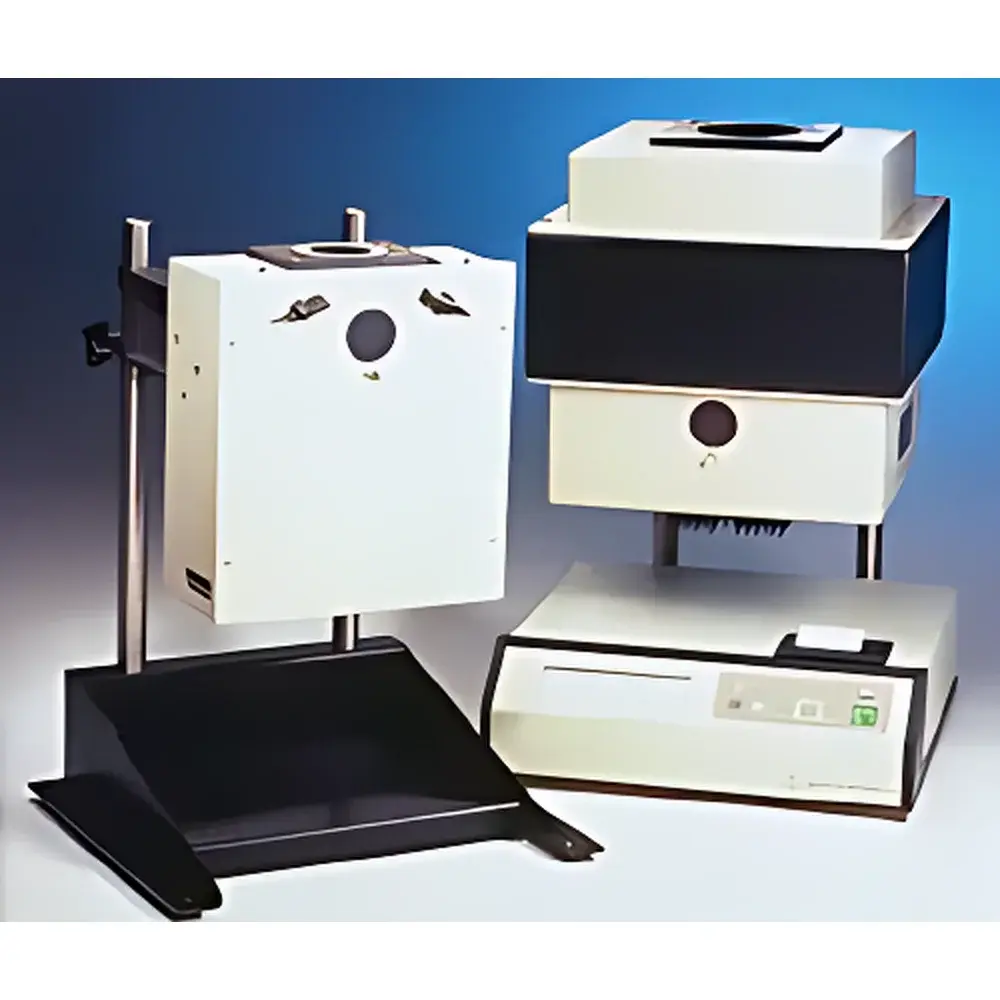
HunterLab D25L-DP9000 (D25L) Colorimeter and Color Difference Meter
| Brand | HunterLab |
|---|---|
| Origin | USA |
| Manufacturer Type | Authorized Distributor |
| Origin Category | Imported |
| Model | HunterLab D25L-DP9000 (D25L) Colorimeter and Color Difference Meter |
| Pricing | Upon Request |
Overview
The HunterLab D25L-DP9000 (D25L) is a precision benchtop color measurement system engineered for rigorous industrial quality control environments. It operates on the principle of spectrophotometric colorimetry—capturing reflected light from a sample under standardized geometric and illuminant conditions—and converting spectral data into internationally recognized color spaces (e.g., CIE L*a*b*, XYZ, Yxy) and industry-specific indices (e.g., WI E313, YI D1925, TAPPI Brightness). Designed for high reproducibility in production settings, the D25L employs a 45° circumferential illumination geometry with 0° viewing—mimicking human visual assessment while minimizing directional bias from surface texture or gloss. Its large 95.3 mm (3.75″) measurement aperture accommodates heterogeneous, textured, or irregular surfaces common in food, textiles, and building materials; an optional aperture reducer allows downscaling to 50.8 mm (2″) for higher spatial resolution where required. The system integrates a stabilized tungsten-halogen source with UV-filtered and UV-inclusive modes, enabling both standard color evaluation and fluorescence-compensated analysis per ASTM E308 and ISO/CIE standards.
Key Features
- 45°/0° optical geometry compliant with CIE No. 15 and ASTM D2244, optimized for diffuse, non-directional surface evaluation
- Dual-aperture capability: switchable 95.3 mm (3.75″) and 50.8 mm (2″) measurement areas via mechanical reducer
- Stabilized tungsten-halogen lamp with selectable UV filter—supports both UV-excluded (standard) and UV-included (fluorescent) measurement modes
- Integrated color processor with image-key membrane keypad and backlit 40×8 character LCD display
- Multi-language interface (English, Spanish, German, French, Italian) supporting global manufacturing operations
- Battery-backed memory stores up to 300 sample readings and 99 product configurations for offline use
- Onboard thermal printer (40-column) with ASCII, DIF, and WK1 output formats for immediate documentation
- RS-232C bidirectional serial port for real-time integration with LIMS, MES, or SPC software platforms
Sample Compatibility & Compliance
The D25L-DP9000 excels in measuring non-uniform, textured, or low-gloss substrates—including baked goods, carpets, woven fabrics, paperboard, plastics, and ceramic glazes—where traditional 8mm or 10mm aperture instruments yield inconsistent results. Its large-area optics reduce sampling variance caused by local heterogeneity, aligning closely with ASTM D6290 (color measurement of granular or textured materials) and ISO 2813 (gloss-independent color assessment). All color calculations adhere to CIE 1931 2° standard observer and CIE Illuminant C unless otherwise specified. The instrument supports FDA 21 CFR Part 11–ready data logging when paired with compliant host software, and its calibration traceability conforms to NIST-traceable standards via HunterLab’s certified calibration tiles (e.g., white ceramic, green glass). Routine verification meets ISO/IEC 17025 laboratory accreditation requirements for color measurement uncertainty management.
Software & Data Management
While the D25L-DP9000 operates autonomously via its embedded processor, it fully interoperates with HunterLab’s Universal Software Suite (version 7.0+), enabling advanced statistical process control (SPC), trend analysis, batch reporting, and audit-trail generation. Raw XYZ, L*a*b*, and index values are exportable in CSV, Excel-compatible DIF, or legacy WK1 formats. The RS-232 interface supports command-line protocol for automated triggering in inline QC workflows. All stored measurements retain timestamp, operator ID (user-defined), and configuration metadata—critical for GLP/GMP traceability. Statistical outputs include mean, standard deviation, min/max, range, and ΔE*cmc (2:1) tolerance evaluation per ISO 11664-4 and CMC(l:c) guidelines. Data integrity is preserved through battery-backed RAM with write-cycle protection and configurable auto-save intervals.
Applications
- Food & Beverage: Quantitative color grading of roasted coffee beans, baked bread crusts, dried fruits, and dairy powders per USDA and AOAC protocols
- Textiles & Carpet: Batch-to-batch consistency verification for dyed yarns, cut pile carpets, and nonwovens under controlled lighting conditions
- Paper & Packaging: TAPPI brightness (ISO 2470), yellowness index (ASTM E313), and opacity measurement across coated/uncoated grades
- Plastics & Polymers: Pigment dispersion uniformity, weathering stability (ΔE tracking), and regulatory compliance (e.g., FDA colorant limits)
- Paints & Coatings: Metallic flake orientation compensation, gloss-independent hue matching, and Rf/Rd separation for effect pigments
FAQ
What color spaces and indices does the D25L support?
It calculates XYZ, Yxy, Hunter Lab, CIE L*a*b*, CIE L*C*h°, FMC-2, WI E313, YI E313, YI D1925, Opacity, TAPPI Brightness, Z%, Tomato Color Grade, and multiple ΔE formulations (ΔE*ab, ΔE*cmc, ΔE*94, ΔE*00).
Is the instrument suitable for measuring fluorescent or optically brightened samples?
Yes—by engaging the UV-inclusive mode using the built-in UV filter wheel, the D25L enables accurate measurement of fluorescent whitening agents (FWAs) per ISO 11475 and ASTM D6587.
How is calibration and verification performed?
Users perform daily verification using NIST-traceable calibration tiles; full recalibration is conducted annually by HunterLab-certified service engineers using factory-standard reference materials and software.
Can the D25L integrate with enterprise quality systems?
Yes—its RS-232 port supports custom scripting for integration with SAP QM, Siemens Opcenter Quality, or proprietary SPC dashboards via ASCII command protocol.
What is the short-term repeatability specification?
Based on 20 consecutive measurements of a stable white tile, XYZ repeatability is ≤0.02 standard deviation; total measurement time per reading is <1 second.




