
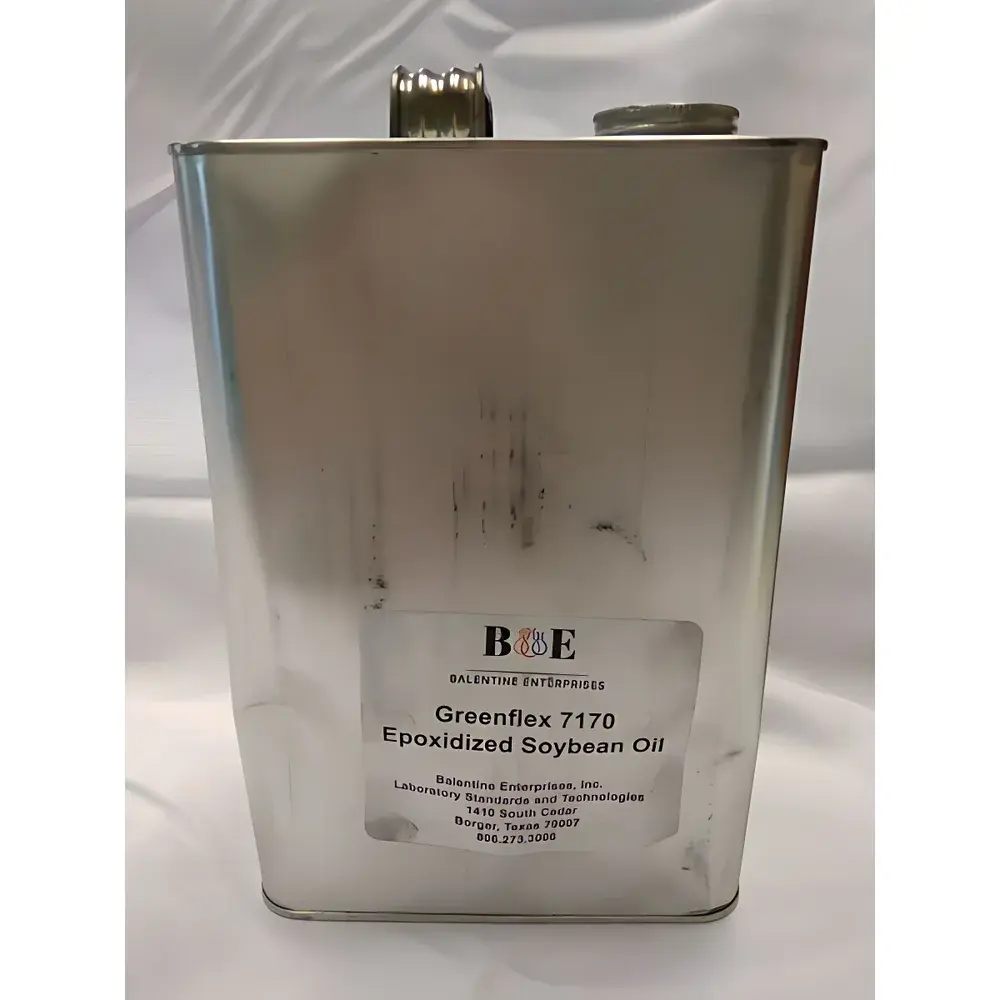
GreenChem Paralex G-62 Epoxidized Soybean Oil (ASTM D3265 Reference Standard for Carbon Black Tinting Strength)
| Brand | GreenChem |
|---|---|
| Origin | USA |
| Product Type | ASTM D3265 Reference Material |
| Compliance | ASTM D3265-22 |
| Form | Liquid epoxy ester |
| CAS No. | 68307-94-6 |
| Packaging | Sealed amber glass bottle (100 g, 500 g, or 1 kg) |
| Storage | Store at 2–8 °C, protected from light and moisture |
| Shelf Life | 24 months from date of manufacture |
Overview
GreenChem Paralex G-62 Epoxidized Soybean Oil is a rigorously characterized reference material specifically formulated and certified for use in ASTM D3265 – Standard Test Method for Tinting Strength of Carbon Black. This test method quantifies the ability of carbon black to reduce the reflectance of a white pigment dispersion—typically titanium dioxide—in a standardized vehicle. Paralex G-62 serves as the prescribed binder/diluent matrix in the preparation of tinting strength pastes, where its consistent epoxide content, viscosity, and non-volatile fraction ensure reproducible dispersion behavior and optical response across laboratories.
The material functions as a critical metrological anchor in quality control workflows for carbon black producers, rubber compounders, and pigment formulators. Its chemical stability, low volatility, and uniform rheological profile enable precise paste preparation under controlled shear conditions—essential for achieving repeatable drawdown films on Leneta charts or equivalent substrates. Unlike generic epoxidized soybean oils, Paralex G-62 is batch-certified against traceable reference standards and undergoes full QC screening (including iodine value, oxirane oxygen content, acid number, and Gardner color) per ASTM D1652, D1653, and D1544.
Key Features
- Manufactured in an ISO 9001-certified facility in the United States with full traceability to raw material lots and process parameters
- Batch-specific Certificate of Analysis (CoA) provided, including oxirane oxygen content (≥6.0% w/w), iodine value (≤5.0 g I₂/100 g), and Gardner color (≤3)
- Consistent viscosity (250–350 cP at 25 °C) ensures uniform paste homogeneity and blade-coating repeatability
- Low volatility (<0.5% weight loss at 105 °C, 2 h) minimizes film shrinkage and reflectance drift during drying
- Free of added plasticizers, antioxidants, or surfactants that could interfere with carbon black dispersion or photometric measurement
- Compatible with standard laboratory equipment: planetary mixers, three-roll mills, and drawdown applicators (e.g., Bird or Sheen)
Sample Compatibility & Compliance
Paralex G-62 is validated for use with all commercially available carbon black grades covered by ASTM D3265, including N110, N220, N330, N550, and specialty blacks. It meets the compositional and performance requirements specified in Section 6.1 of ASTM D3265-22 for “epoxidized soybean oil conforming to Paralex G-62 specifications.” The material is also referenced in ISO 3856-2 (paints and varnishes – determination of tinting strength) and cited in internal quality manuals of major tire and rubber manufacturers operating under AIAG and VDA audit frameworks.
All batches are produced under documented manufacturing controls aligned with GLP principles. Full analytical data packages support regulatory submissions requiring evidence of reference material qualification per ICH Q5D and USP . Documentation includes residual solvent analysis (GC-FID), heavy metals profiling (ICP-MS), and peroxide value testing to confirm oxidative stability.
Software & Data Management
While Paralex G-62 itself is a physical reference standard, its use is integral to digital quality management systems compliant with FDA 21 CFR Part 11. Laboratories employing LIMS platforms (e.g., LabWare, Thermo Fisher SampleManager, or Agilent OpenLab) can assign unique batch IDs, link CoAs to instrument-generated reflectance data (from HunterLab UltraScan PRO or Datacolor 600), and maintain full audit trails for ASTM D3265 test records. GreenChem provides machine-readable CoA files (PDF/A-2b and CSV) with embedded digital signatures for seamless integration into electronic lab notebooks (ELNs) and compliance reporting modules.
Applications
- Primary reference material for ASTM D3265 tinting strength determinations in carbon black production QA/QC labs
- Benchmark vehicle for evaluating dispersion efficiency of new carbon black surface treatments or functionalization chemistries
- Calibration medium in interlaboratory round-robin studies coordinated by ASTM Committee D24 on Carbon Black
- Matrix for preparing certified reference materials (CRMs) used in proficiency testing programs (e.g., NIST SRM 1861, IRMM-802)
- Control formulation component in R&D studies assessing pigment interaction with bio-based binders in sustainable coatings and elastomers
FAQ
Is Paralex G-62 interchangeable with other epoxidized soybean oils?
No. Only Paralex G-62 meets the exact specification limits defined in ASTM D3265 Annex A1. Substitution with generic or alternate-brand epoxidized soybean oils introduces variability in oxirane content and impurity profiles, leading to non-compliant reflectance values and failed method validation.
What is the recommended storage condition to preserve reactivity?
Store unopened containers at 2–8 °C in the dark. Avoid repeated freeze-thaw cycles. Once opened, purge with nitrogen and reseal tightly; use within 30 days under refrigerated conditions.
Does GreenChem provide technical support for ASTM D3265 method implementation?
Yes. Application engineers offer protocol review, troubleshooting for inconsistent drawdown films or reflectance drift, and guidance on instrument calibration verification per ASTM E308 and CIE 15:2018.
Can Paralex G-62 be used for methods beyond ASTM D3265?
It is validated for ASTM D3265 only. Use in other standards (e.g., ASTM D2805 or ISO 787-16) requires independent qualification per ISO/IEC 17025 clause 5.4.2 and documented uncertainty assessment.
How is batch-to-batch consistency verified?
Each lot undergoes orthogonal testing: titrimetric oxirane oxygen assay, FTIR spectral fingerprinting against master reference, and comparative tinting strength testing using NIST-traceable carbon black SRMs.





