
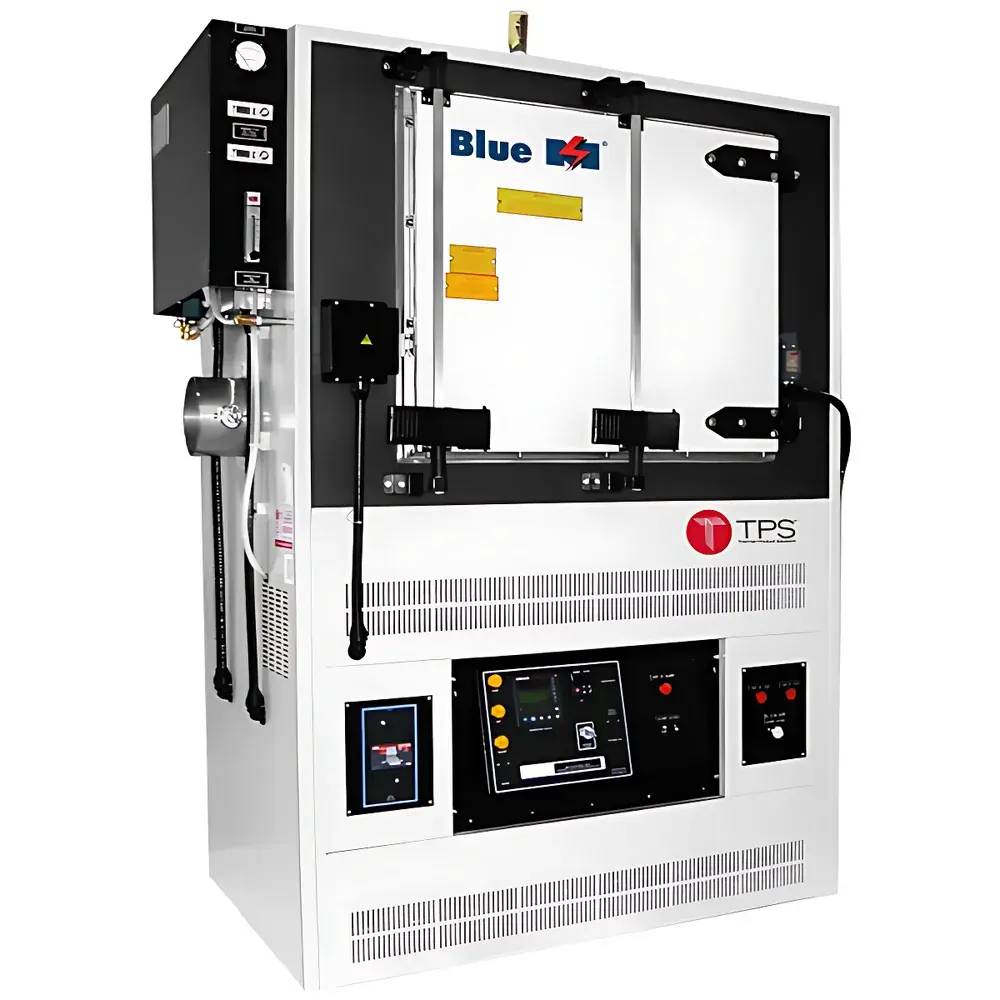
Blue M IGF-7780 Inert Atmosphere High-Temperature Forced-Air Oven
| Brand | Blue M |
|---|---|
| Origin | USA |
| Model | IGF-7780 |
| Type | Benchtop/Industrial Box-Type Furnace |
| Max Temperature | 593°C |
| Temperature Uniformity | ±2% of setpoint |
| Control Accuracy | ±0.5°C |
| Resolution | ±0.1°C |
| Heating Method | Forced-air convection with heavy-duty NiCr heating elements |
| Internal Dimensions (W×D×H) | 64 × 51 × 51 cm |
| Power Rating | 30.0 kW @ 240 VAC 3-phase |
| Insulation | 152 mm (6") mineral wool |
| Gas Compatibility | N₂, Ar, He, CO₂, and forming gas (4% H₂ / 96% N₂) |
| Safety Certifications | NFPA 86 Class B compliant |
| Door Type | Water-cooled (on IGF-8880/9980 models), standard insulated door on IGF-7780 |
| Exhaust & Purge System | Integrated blow-down timer, pressure monitoring, vent valve, and relief valve |
Overview
The Blue M IGF-7780 is a precision-engineered inert atmosphere high-temperature forced-air oven designed for thermal processing under oxygen-free conditions. It operates on the principle of convective heat transfer within a sealed, welded stainless steel chamber, enabling stable, repeatable thermal profiles across its working temperature range of ambient +15°C to 593°C (1099°F). Unlike standard laboratory ovens, the IGF-7780 integrates structural and safety features essential for inert-gas applications—particularly in metallurgical annealing, ceramic sintering, catalyst activation, and advanced materials research where oxidation must be rigorously excluded. Its NFPA 86 Class B certification confirms compliance with stringent industrial safety standards for heated chambers operating with flammable or reactive atmospheres. The unit employs a dual-wall cavity design that isolates the inert process zone from external thermal and mechanical stressors, while maintaining precise thermal uniformity (±2% of setpoint) through balanced horizontal airflow distribution.
Key Features
- Hermetically welded 304 stainless steel inner chamber prevents gas leakage and eliminates pathways for ambient air ingress or insulative material contamination.
- Heavy-duty open-coil NiCr heating elements mounted externally to the chamber walls ensure rapid thermal response and extended service life under continuous high-temperature operation.
- Integrated gas flow meter, chamber pressure transducer, and adjustable purge valve enable real-time monitoring and fine-tuned control of inert gas dynamics during ramp-hold-cool cycles.
- Automated safety interlocks: door switch disables heater and blower upon opening; pressure loss detection triggers audible/visual alarm and automatic heater shutdown.
- 6-inch-thick mineral wool insulation (152 mm) minimizes thermal bridging and supports energy-efficient operation at sustained elevated temperatures.
- Front-access glass-fiber door gasket ensures reliable sealing integrity up to 593°C without outgassing or degradation.
- Dual-zone airflow system delivers uniform horizontal circulation—critical for consistent thermal exposure across large or stacked sample loads.
Sample Compatibility & Compliance
The IGF-7780 accommodates a broad spectrum of sample geometries and material classes—including metal alloys, powder compacts, ceramic green bodies, battery electrode coatings, and semiconductor precursors—provided they remain chemically stable under the selected inert gas environment. It is fully compatible with nitrogen, argon, helium, carbon dioxide, and forming gas (4% H₂ / 96% N₂), all of which may be introduced via standardized 3/8″ NPT inlet ports. The chamber’s construction and control architecture meet NFPA 86 requirements for Class B ovens, ensuring safe operation in environments where combustible atmospheres may develop unintentionally. While not inherently GLP/GMP validated, the system supports audit-ready documentation when integrated with third-party data loggers compliant with FDA 21 CFR Part 11 requirements for electronic records and signatures.
Software & Data Management
The IGF-7780 utilizes a dedicated analog/digital hybrid controller with front-panel interface for manual operation, including independent setpoint adjustment, ramp rate definition, dwell time programming, and purge cycle initiation. Although it does not feature embedded Ethernet or USB connectivity, its analog outputs (0–5 V or 4–20 mA) allow integration into centralized SCADA or LIMS platforms for remote temperature logging and alarm notification. Optional third-party dataloggers—configured for NIST-traceable calibration and timestamped event recording—can capture full thermal profiles with audit trails suitable for ISO 17025-accredited laboratories. All operational parameters (temperature, gas pressure, elapsed time, purge status) are displayed in real time on the LED interface, with non-volatile memory retaining last-used settings after power interruption.
Applications
- Controlled-atmosphere annealing of stainless steel, titanium, and nickel-based superalloys to prevent surface scaling and intergranular oxidation.
- Sintering of oxide and non-oxide ceramics under nitrogen or argon to inhibit decomposition or phase segregation.
- Thermal debinding of metal injection molded (MIM) parts using low-oxygen forming gas environments.
- Pre-oxidation treatment of battery cathode materials prior to lithiation, requiring strict oxygen partial pressure control.
- Heat treatment of optical fiber preforms and specialty glass components where trace oxygen induces defect formation.
- Calibration and stability testing of high-temperature sensors and reference materials under reproducible inert conditions.
FAQ
What inert gases are certified for use with the IGF-7780?
Nitrogen (N₂), argon (Ar), helium (He), carbon dioxide (CO₂), and forming gas (4% H₂ / 96% N₂) are all approved per NFPA 86 and Blue M engineering specifications.
Is the IGF-7780 suitable for vacuum operation?
No—this model is designed exclusively for positive-pressure inert gas environments and lacks vacuum-rated seals or structural reinforcement for sub-atmospheric use.
Can the oven be integrated into an automated production line?
Yes, via analog control signals (4–20 mA temperature feedback, relay outputs for heater enable/status) and optional dry-contact interfaces for PLC coordination.
What maintenance is required for long-term reliability?
Annual verification of door gasket compression, thermocouple calibration against NIST-traceable standards, and inspection of gas line fittings and relief valve function are recommended.
Does Blue M provide installation support or commissioning services?
Factory-trained field service engineers are available globally for startup assistance, safety validation, and operator training—subject to regional service agreements.



