
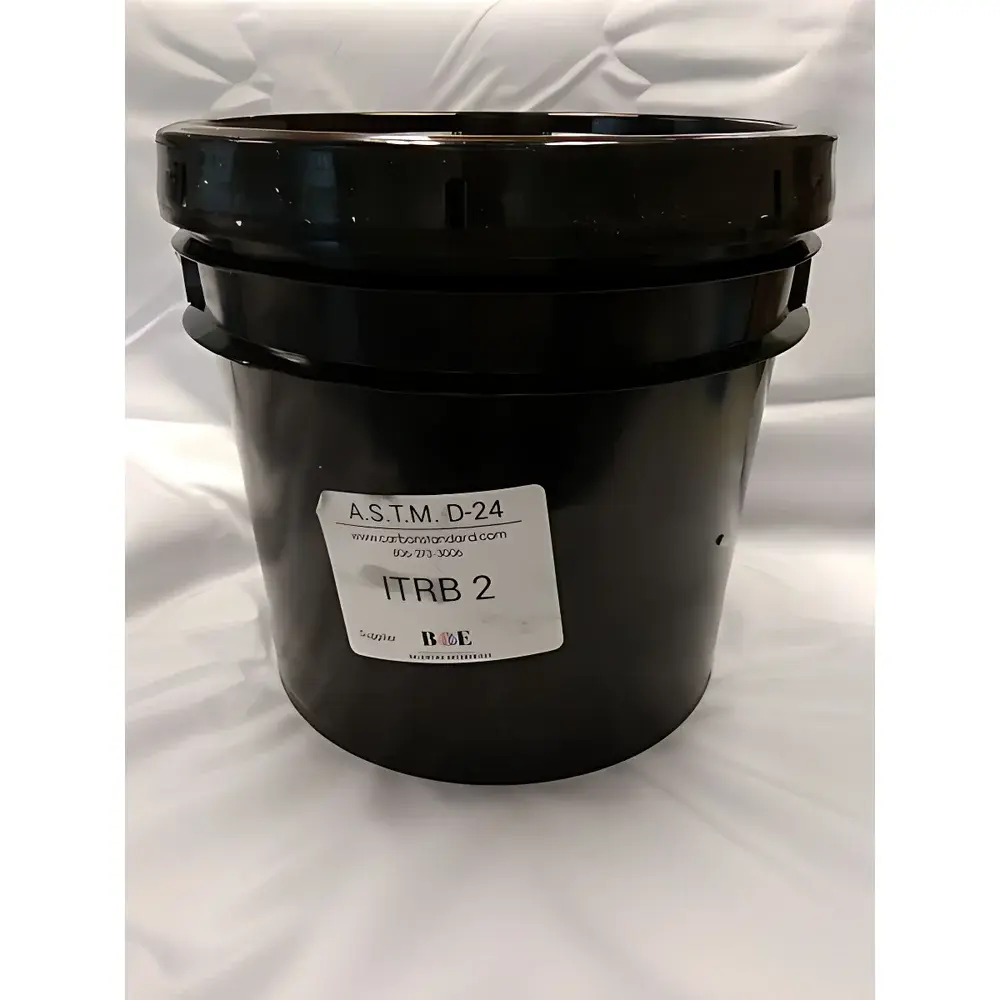
ASTM IRB9 Industrial Reference Carbon Black (Balentine Enterprises)
| Origin | USA |
|---|---|
| Manufacturer Type | Authorized Distributor |
| Origin Category | Imported |
| Model | ASTM IRB9 |
| Pricing | Available Upon Request |
Overview
ASTM IRB9 Industrial Reference Carbon Black is a certified reference material (CRM) manufactured and distributed by Balentine Enterprises under strict adherence to ASTM International standards. Designed specifically for calibration, method validation, and interlaboratory performance assessment in rubber compounding and carbon black quality control laboratories, IRB9 serves as the current industry benchmark for evaluating the reinforcing performance of carbon black in elastomeric systems. It operates on the principle of comparative physical property benchmarking—its precisely characterized mechanical response in standardized rubber formulations (SBR and NR) enables traceable quantification of test method reproducibility and operator competency. As the ninth generation in the ASTM Industry Reference Black series, IRB9 supersedes IRB8 and is fully compliant with ASTM D3182 (Standard Practice for Rubber—Materials—Carbon Black), D3191 (Test Method for Rubber Property—Tensile Strength and Elongation of Carbon Black–Rubber Compounds), and D3192 (Test Method for Rubber Property—Tensile Strength and Elongation of Carbon Black–Natural Rubber Compounds).
Key Features
- Traceable certification to ASTM specifications with documented homogeneity and long-term stability data
- Validated performance across multiple ASTM test methods: D3191 (SBR-based compounds) and D3192 (NR-based compounds)
- Quantified differential mechanical properties relative to IRB#7, enabling precise inter-series correlation and historical trend analysis
- Supplied in sealed, moisture-resistant packaging to preserve surface activity and dispersion integrity
- Batch-specific Certificate of Analysis (CoA) including full ASTM-compliant test results for tensile strength, 300% modulus, and ultimate elongation
- Engineered for use in GLP- and GMP-aligned QC environments requiring audit-ready reference material documentation
Sample Compatibility & Compliance
IRB9 is formulated for direct incorporation into standardized rubber compound recipes per ASTM D3182. It exhibits consistent dispersion behavior in both styrene-butadiene rubber (SBR) and natural rubber (NR) matrices when processed using standard two-roll mill or internal mixer protocols. Each batch undergoes rigorous lot-to-lot verification against ASTM D1506 (Carbon Black—Sampling), D1507 (Carbon Black—Determination of pH), and D3849 (Carbon Black—Determination of Oil Absorption Number). The material complies with ISO/IEC 17034:2016 (General requirements for producers of reference materials) and supports laboratory accreditation to ISO/IEC 17025:2017 through documented metrological traceability.
Software & Data Management
While IRB9 itself is a physical reference standard, its integration into laboratory data workflows aligns with FDA 21 CFR Part 11-compliant LIMS and ELN platforms. Batch-specific CoAs are provided in PDF/A-1 format with embedded digital signatures and cryptographic hash verification. Laboratories may import IRB9 performance deltas (e.g., −0.33 MPa tensile difference vs. IRB#7 per D3191 Method B) directly into statistical process control (SPC) dashboards for real-time monitoring of testing system drift. Full traceability records—including raw ASTM test reports, uncertainty budgets, and storage condition logs—are retained for minimum 10 years per ASTM E2554 (Practice for Statistical Analysis of Quality Control Data).
Applications
- Validation and periodic verification of tensile testing systems (ASTM D412) used in rubber product development
- Assessment of interlaboratory precision in carbon black qualification programs (e.g., supplier acceptance testing)
- Calibration of masterbatch formulation models where reinforcement efficiency is modeled as a function of reference black response
- Root cause analysis of nonconforming rubber compound batches via deviation mapping against IRB9 baseline profiles
- Training and proficiency testing for rubber technologists performing ASTM D3191/D3192 evaluations
- Supporting regulatory submissions requiring documented use of certified reference materials (e.g., medical device elastomer certifications)
FAQ
What distinguishes IRB9 from IRB8?
IRB9 introduces updated mechanical property differentials relative to IRB#7 across all ASTM D3191 and D3192 test configurations, reflecting evolved consensus on optimal reinforcement benchmarks. Notably, IRB9 exhibits tighter tolerances in 300% modulus consistency in NR compounds (±0.09 MPa vs. IRB#7) and improved elongation predictability in SBR systems.
Is IRB9 suitable for ISO 1798 testing?
Yes—while ISO 1798 specifies general tensile test parameters for flexible cellular polymeric materials, IRB9’s characterization in vulcanized rubber compounds supports method equivalence assessments when adapted per ISO 1798 Annex B (reference material usage guidelines).
How should IRB9 be stored to maintain integrity?
Store unopened containers at 23 ± 2°C and 50 ± 5% RH in original sealed packaging. Avoid exposure to UV light, ozone, or high-humidity environments. Once opened, use within 30 days under inert gas purge if possible.
Does Balentine Enterprises provide technical support for IRB9 implementation?
Yes—application engineering support includes ASTM method interpretation guidance, CoA data integration protocols, and assistance with uncertainty budgeting per GUM (JCGM 100:2008).
Can IRB9 be used for calibrating particle size analyzers?
No—IRB9 is not a particle size standard. Its certification pertains exclusively to bulk mechanical performance in compounded rubber; it is not characterized for primary particle size distribution (e.g., TEM or BET surface area) and must not be substituted for SRM 1860 or NIST-traceable size standards.






