
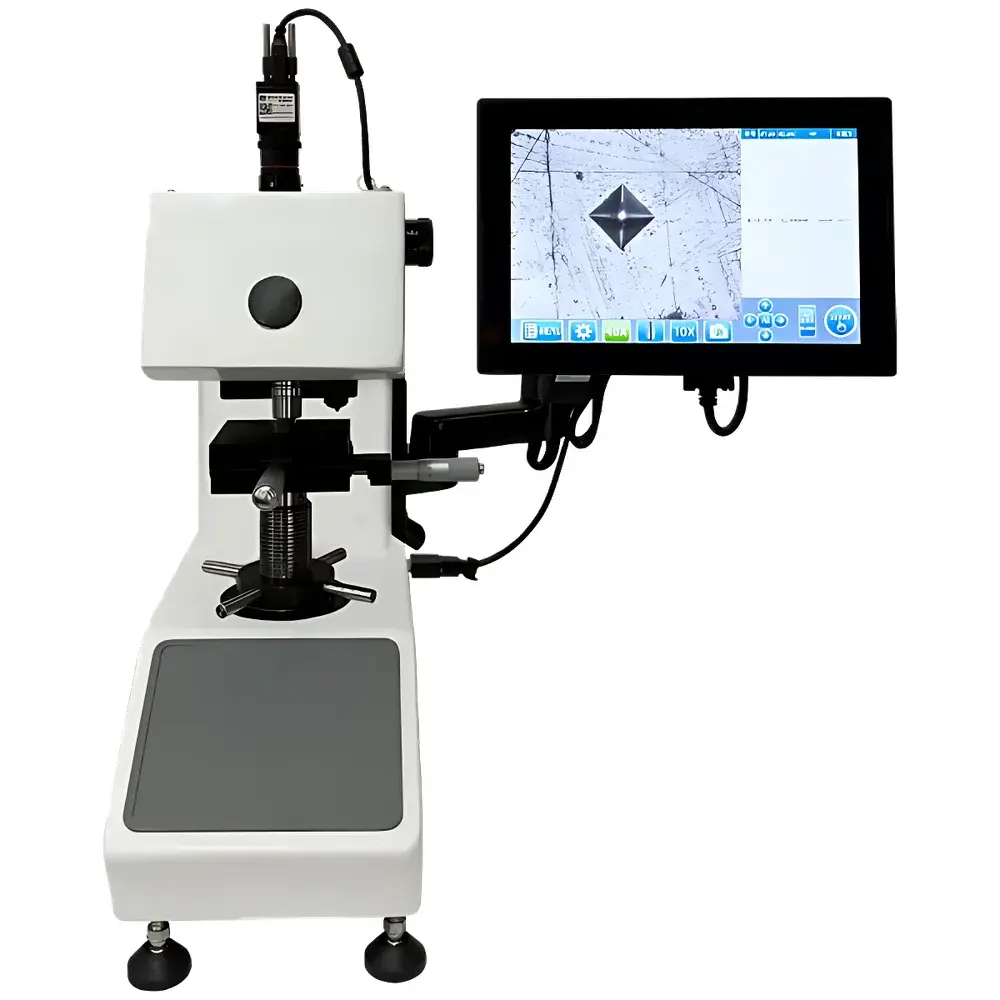
YANRUN MVS-1000AE Automated Digital Microhardness Tester
| Brand | YANRUN |
|---|---|
| Origin | Shanghai, China |
| Manufacturer Type | Direct Manufacturer |
| Product Category | Domestic |
| Model | MVS-1000AE |
| Instrument Type | Microhardness Tester |
| Hardness Measurement Range | 8–3000 HV |
| Test Forces | 0.098–9.807 N (10–1000 gf), 8 selectable steps |
| Hardness Scales | HV0.01, HV0.025, HV0.05, HV0.1, HV0.2, HV0.3, HV0.5, HV1 |
| Optical Magnification | 10× (observation), 40× (measurement) |
| Total on-screen magnification | ~160× (observation), ~640× (measurement) |
| Minimum Measurable Indentation Length | 0.03 µm |
| Dwell Time | 0–99 s (1 s increments) |
| Max Specimen Height | 70 mm |
| Distance from Indenter Center to Chamber Wall | 110 mm |
| X-Y Stage Travel | 25 × 25 mm |
| Stage Size | 100 × 100 mm |
| Dimensions (L×W×H) | 440 × 320 × 460 mm |
| Net Weight | 26.0 kg |
| Compliance | GB/T 4340 (Chinese national standard equivalent to ISO 6507 and ASTM E384) |
Overview
The YANRUN MVS-1000AE is an automated digital microhardness tester engineered for high-precision indentation hardness measurement at the microscale. It operates on the principle of Vickers and Knoop indentation testing, where a diamond pyramid indenter (136° apex angle for HV; rhombic pyramid for HK) is applied under controlled static load to produce a geometrically defined impression on the specimen surface. The diagonal lengths of the residual indent are measured optically—via a calibrated high-resolution imaging system—and converted into hardness values using standardized equations per ISO 6507-1, ASTM E384, and GB/T 4340. Designed for metallurgical laboratories, QC departments in precision manufacturing, and R&D facilities working with thin films, coatings, brittle ceramics, or miniaturized components, the MVS-1000AE delivers traceable, repeatable results across an extended hardness range (8–3000 HV) with minimal sample damage.
Key Features
- Fully automated test cycle: motorized loading, dwell, and unloading sequence compliant with ISO 6507-1 timing requirements.
- Dual-magnification optical path: 10× objective for rapid field navigation and 40× objective for high-fidelity indentation imaging; combined with 10× eyepiece yields up to 640× total magnification on display.
- High-accuracy digital image analysis: integrated YANRUN Materials Analysis Software performs sub-pixel edge detection and automatic diagonal measurement with resolution down to 0.03 µm.
- Eight-step test force selection: spanning 0.098 N (10 gf) to 9.807 N (1000 gf), enabling optimization for soft polymers, aluminum alloys, hardened steels, and ultra-hard ceramics.
- Robust mechanical architecture: precision trapezoidal lead screw Z-axis lift mechanism and gear-driven load application ensure long-term force stability and repeatability.
- Adjustable dwell time (0–99 s, 1 s increments) supports standardized hold durations per material specification and research protocols.
- Large-format X-Y motorized stage (100 × 100 mm platform, 25 × 25 mm travel range) facilitates multi-point mapping and cross-sectional hardness profiling.
Sample Compatibility & Compliance
The MVS-1000AE accommodates specimens up to 70 mm in height and accepts samples requiring indentation within 110 mm of the chamber wall—ideal for irregularly shaped parts, coated substrates, and wafer fragments. Its low-force capability (starting at 10 gf) makes it suitable for evaluating electroplated layers, PVD/CVD coatings, semiconductor device interconnects, and gemstone surfaces without cracking or delamination. The instrument conforms to GB/T 4340.1–2012 (equivalent to ISO 6507-1:2018 and ASTM E384–22), ensuring metrological validity for internal quality audits and third-party certification. Calibration verification is supported via certified reference hardness blocks traceable to NIM (National Institute of Metrology, China) and compatible with international calibration hierarchies.
Software & Data Management
The proprietary YANRUN Materials Analysis Software provides a validated Windows-based interface for real-time image capture, semi-automated or fully automated indentation measurement, statistical reporting (mean, SD, CV%), and hardness distribution mapping. All measurement data—including raw images, coordinate positions, force/dwell parameters, and calculated hardness values—are stored in encrypted project files with timestamped audit trails. Export options include CSV, PDF reports, and XML-compatible structured data for integration into LIMS or enterprise QA systems. While not natively 21 CFR Part 11-compliant, the software architecture supports user access control, electronic signatures, and configurable data retention policies—enabling alignment with GLP/GMP documentation requirements when deployed with institutional SOPs.
Applications
- Hardness profiling of case-hardened steel gears and bearing races.
- Quality assurance of thermal spray coatings and hardfacing deposits.
- Thin-film characterization in MEMS fabrication and photovoltaic R&D.
- Microstructural evaluation of weld heat-affected zones (HAZ) and brazed joints.
- Hardness gradient analysis across diffusion-bonded interfaces in dissimilar metals.
- Non-destructive assessment of precious metal alloys and gemstone treatments.
FAQ
What hardness scales does the MVS-1000AE support?
The instrument supports Vickers (HV) hardness scales HV0.01 through HV1 and can be configured for Knoop (HK) testing with optional rhombic pyramidal indenter.
Is the system compatible with ISO/ASTM calibration standards?
Yes—it complies with GB/T 4340, which is technically aligned with ISO 6507 and ASTM E384 for test method execution, uncertainty estimation, and result reporting.
Can the software generate hardness maps?
Yes, the X-Y motorized stage and automated measurement workflow enable grid-based indentation arrays, with post-processing tools to visualize spatial hardness variation as contour or heatmap overlays.
What is the minimum measurable indentation diagonal length?
The system achieves a measurement resolution of 0.03 µm, permitting reliable quantification of impressions as small as ~0.8 µm under 40× magnification.
Does the instrument require external PC hardware?
It operates as a standalone unit with embedded industrial-grade controller; however, full software functionality—including report generation and map analysis—requires connection to a Windows PC running the supplied YANRUN Materials Analysis Software.



