
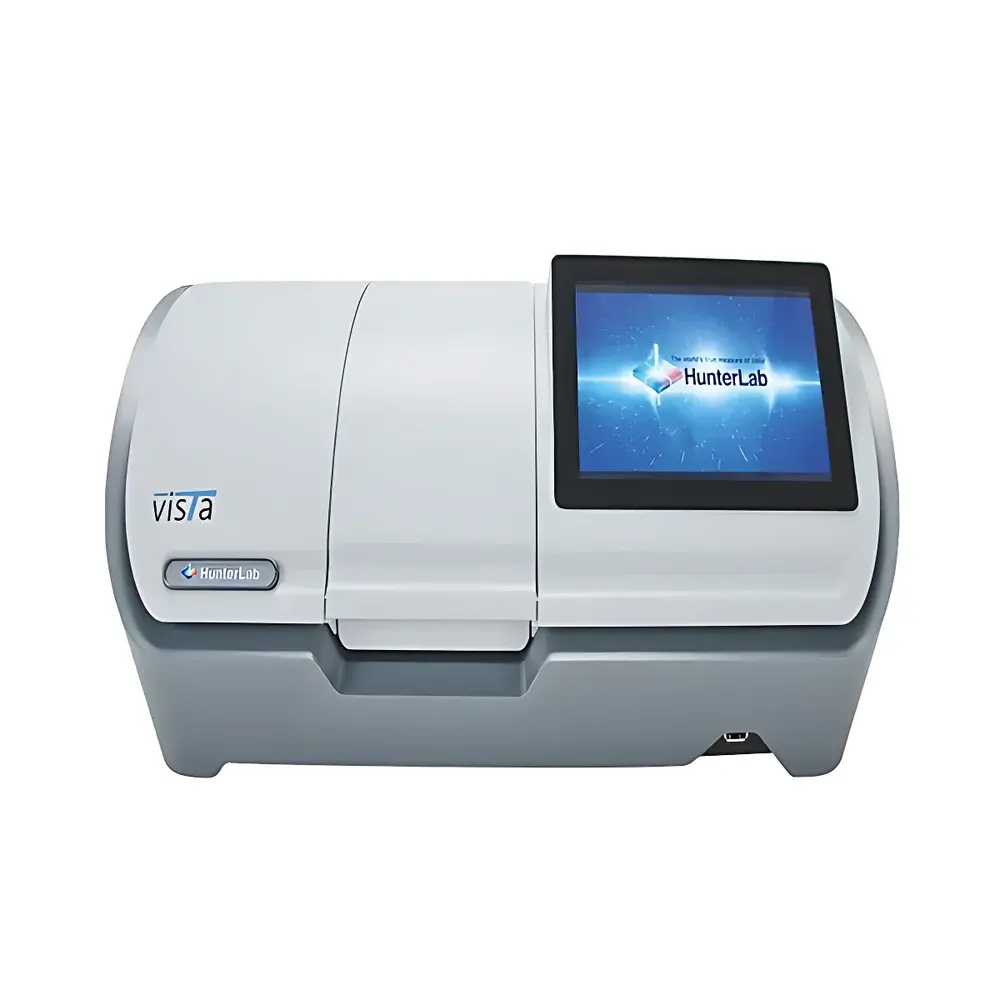
HunterLab Vista Haze and Color Spectrophotometer
| Brand | HunterLab |
|---|---|
| Origin | USA |
| Model | Vista Haze and Color Spectrophotometer |
| Instrument Type | Benchtop |
| Optical Geometry | 8°/diffuse (d) |
| Light Source | Full-spectrum LED |
| Spectral Range | 400–700 nm |
| Repeatability | Standard deviation ≤ 0.1% |
| Compliance | ASTM D1003 for haze measurement |
| Sample Measurement Modes | Transmission (liquids, films, solids) |
| Wavelength Accuracy | Verified with Nd-Pr filter set |
| Chamber Design | Triple-side open transmission compartment |
| Footprint | Compact benchtop form factor |
Overview
The HunterLab Vista Haze and Color Spectrophotometer is a benchtop dual-function spectrophotometric instrument engineered for simultaneous, traceable measurement of color and haze in transparent and translucent materials. Based on the fundamental principles of diffuse transmittance spectroscopy, the Vista employs an 8°/diffuse (8/d) optical geometry—compliant with CIE No. 15 and ISO 7724—to quantify spectral reflectance and transmittance across the visible spectrum (400–700 nm). Its integrated haze measurement capability operates in strict accordance with ASTM D1003, enabling quantitative assessment of light scattering behavior in plastics, pharmaceutical films, packaging resins, liquid formulations, and food-grade polymers. Unlike conventional colorimeters or single-mode spectrophotometers, the Vista delivers co-registered spectral data sets: full transmittance spectra (T% vs. λ), CIE L*a*b* and other industry-standard color spaces (e.g., CIE XYZ, Yellowness Index, Whiteness Index), and ASTM D1003-compliant haze values—all acquired in a single measurement cycle without repositioning or recalibration.
Key Features
- Compact benchtop architecture optimized for high-density laboratory environments—requires less than 0.25 m² footprint while maintaining full spectral functionality.
- Dual-mode optical path design supporting both standard transmission measurements and extended-format sample analysis via triple-side-open transmission chamber.
- Stable full-spectrum LED illumination source with thermal management system, ensuring consistent spectral output and eliminating lamp aging drift over time.
- Integrated Nd-Pr (neodymium-praseodymium) reference filter set for in-situ wavelength validation and long-term photometric stability verification.
- Modular sample handling system featuring precision-machined, low-reflectance sample holders; optional fixtures available for vials, cuvettes, molded plaques, and flexible films.
- Sealed optical cavity with removable, autoclavable sample compartment components to minimize cross-contamination and support GLP-aligned cleaning protocols.
Sample Compatibility & Compliance
The Vista accommodates a broad range of physical sample formats—including clear liquids (aqueous and organic solvents), rigid and flexible polymer films (PET, PP, PC), injection-molded plastic parts, glass substrates, and pharmaceutical blister packaging. Its transmission chamber supports samples up to 120 mm × 120 mm with thicknesses from 0.1 mm (thin films) to 25 mm (solid plaques). All haze measurements adhere to ASTM D1003 Procedure A (total transmittance method), with automatic correction for specular transmittance exclusion. Color data comply with ISO 11664 (CIE colorimetry standards), ASTM E308 (computation of tristimulus values), and USP for pharmaceutical packaging characterization. The instrument’s firmware and software architecture are designed to support audit trails, user access controls, and electronic signatures per FDA 21 CFR Part 11 requirements when deployed in regulated environments.
Software & Data Management
Vista instruments operate exclusively with HunterLab’s EasyMatch QC software—a validated, Windows-based platform supporting multi-user configuration, method library management, and automated pass/fail reporting against predefined tolerances. The software provides real-time spectral visualization, batch reporting with export to CSV, PDF, and XML formats, and integration-ready APIs for LIMS and MES systems. All raw spectral data (31-point or 10-nm interval, depending on configuration) are stored with metadata including operator ID, timestamp, instrument serial number, calibration history, and environmental sensor readings (optional ambient temperature/humidity logging). Audit trail functionality records all parameter changes, result modifications, and user logins—fully compliant with GLP and GMP documentation expectations.
Applications
- Quality control of optical clarity in medical device packaging films and IV bags, where haze thresholds directly impact sterility assurance and visual inspection efficacy.
- Color consistency monitoring in food-grade plastic containers—correlating L*a*b* shifts with thermal degradation during extrusion or sterilization cycles.
- R&D evaluation of anti-fog coatings on automotive glazing and greenhouse films, quantifying haze reduction under controlled humidity exposure.
- Pharmaceutical solid-dosage form development, measuring color uniformity and haze in film-coated tablets and capsule shells per ICH Q5C guidelines.
- Regulatory submission support for cosmetic packaging, generating ASTM D1003 haze reports alongside CIE DE2000 color difference metrics for shelf-life stability studies.
FAQ
Does the Vista require annual recalibration by HunterLab service engineers?
No—routine calibration is performed in-house using certified reference standards (e.g., NIST-traceable white tile, liquid transmission standards); however, annual performance verification per ISO/IEC 17025 is recommended for laboratories operating under accredited quality systems.
Can the Vista measure opaque or reflective samples?
No—the Vista is specifically designed for transmission-mode analysis of transparent and semi-transparent materials; reflectance measurements (e.g., on painted surfaces or powders) require a separate d/8° reflectance spectrophotometer such as the HunterLab UltraScan VIS.
Is haze measurement traceable to national metrology institutes?
Yes—ASTM D1003-compliant haze values are traceable to NIST Standard Reference Materials (SRMs) 1979 and 2001 when used with certified calibration kits and validated measurement protocols.
What data security features does EasyMatch QC provide?
EasyMatch QC supports role-based user accounts, encrypted database storage, configurable audit trail retention periods, and electronic signature workflows aligned with 21 CFR Part 11 Annex 11 requirements.
How is instrument-to-instrument agreement maintained across multiple Vista units in a global manufacturing network?
HunterLab provides inter-instrument agreement (IIA) validation packages, including matched reference standards and statistical comparison reports, to ensure harmonized color and haze reporting across geographically distributed sites.




