
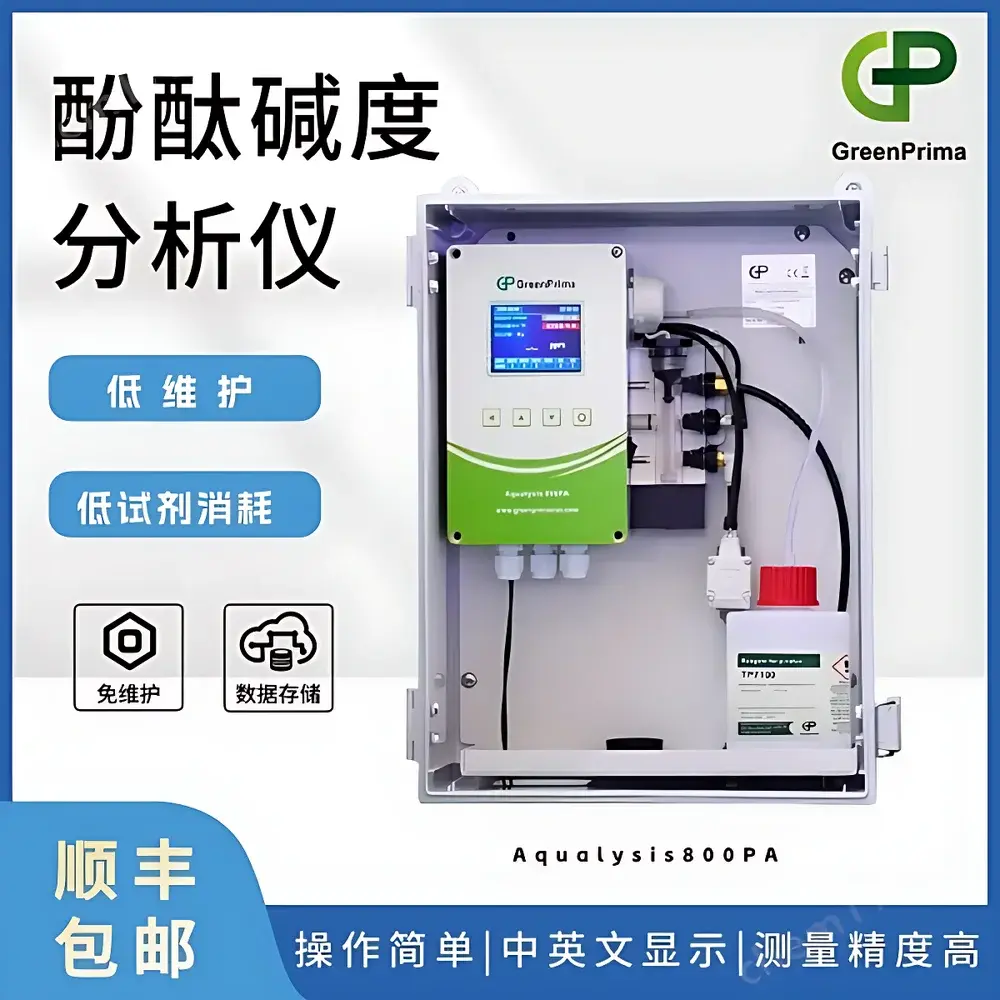
GreenPrima AquaLysis 800PA Phenolphthalein Alkalinity Analyzer for Boiler Water
| Brand | GreenPrima |
|---|---|
| Origin | United Kingdom |
| Manufacturer Type | Manufacturer |
| Origin Category | Imported |
| Model | AquaLysis 800PA |
| Measurement Method | Titrimetric Colorimetry |
| Measurement Time | 2–8 min (alkalinity-dependent) |
| Accuracy | ±2% of selected reagent upper limit |
| Repeatability | ±1% of selected reagent upper limit |
| Power Supply | 85–265 VAC, 47–63 Hz |
| Power Consumption | 25 VA (operational), 3.5 VA (standby) |
| Protection Rating | IP65 |
| Dimensions | 400 × 300 × 180 mm (H×W×D) |
| Weight | 4 kg |
| Display | Color LCD with Chinese/English interface |
| Measurement Modes | Continuous or interval (1–360 min) |
| Output | 4 programmable relay outputs (250 V, 4 A), 1 × 4–20 mA (max. 750 Ω), 1 × RS485 |
| Input | 2 programmable digital inputs (IN1: start analysis |
| IN2 | stop analysis) |
| Sample Flow Pressure | 0.2–5 bar (recommended: 1–2 bar) |
| Sample Temperature | 5–40 °C |
| Ambient Temperature | 10–40 °C |
| Sample pH Range | 4–10 |
| Interference Limits | Fe < 3 ppm, Cu < 0.2 ppm, Al < 0.1 ppm, Mn < 0.2 ppm |
| Rinse Time Programmable | 15–1800 s |
| Units | °dH, °f, ppm CaCO₃, mmol/L |
Overview
The GreenPrima AquaLysis 800PA Phenolphthalein Alkalinity Analyzer is an automated, on-line analytical instrument engineered for precise and reliable determination of phenolphthalein alkalinity (P-alkalinity) in industrial water systems—particularly boiler feedwater, cooling circuits, and process wash waters. It operates on the principle of acid–base titration coupled with photometric endpoint detection: a precisely metered volume of standardized hydrochloric acid is added incrementally to the sample until the pH drops below ~8.3, at which point phenolphthalein transitions from pink to colorless. An integrated spectrophotometric sensor monitors absorbance changes at a defined wavelength (typically 550 nm), enabling accurate identification of the stoichiometric endpoint. This method conforms to standard titrimetric protocols referenced in ASTM D1066, ISO 9963-1, and APHA Standard Methods 2320 B, ensuring regulatory traceability in steam generation and thermal cycle management.
Key Features
- Automated titration with dual-stage reagent dosing and real-time photometric endpoint recognition
- Microprocessor-controlled sequence logic with built-in self-diagnostic routines (e.g., pump stroke validation, valve actuation verification, optical path integrity check)
- Compact footprint (400 × 300 × 180 mm) and IP65-rated enclosure suitable for installation in utility corridors, boiler rooms, or outdoor kiosks
- Low-reagent consumption design: average reagent usage ≤ 1.2 mL per analysis cycle, supporting >6 months of unattended operation under typical 2-hour interval sampling
- Color LCD touchscreen with bilingual (English/Chinese) GUI, configurable alarm thresholds, and intuitive menu navigation
- Flexible measurement scheduling: user-defined interval (1–360 minutes), external trigger (dry contact or pulse signal), or flow-synchronized acquisition
- Four programmable relay outputs for control interlocking (e.g., acid dosing pump enable, blowdown valve activation, alarm annunciation)
- Dual digital inputs for integration with plant SCADA or PLC systems—supports start/stop command sequencing and emergency hold functionality
- Onboard data logging: stores ≥12,000 measurement records with timestamps, fault codes, calibration history, and diagnostic flags
- Standard analog (4–20 mA) and digital (RS485 Modbus RTU) interfaces for seamless integration into distributed control systems (DCS) or supervisory platforms
Sample Compatibility & Compliance
The AquaLysis 800PA is validated for use with clarified, low-turbidity aqueous streams meeting specified matrix constraints: pH 4–10, temperature 5–40 °C, and total suspended solids <5 mg/L. Critical interference limits are enforced to ensure measurement fidelity—Fe < 3 ppm, Cu < 0.2 ppm, Al < 0.1 ppm, and Mn < 0.2 ppm—as elevated transition metal concentrations may catalyze indicator degradation or cause precipitate formation during titration. The analyzer complies with IEC 61326-1 (EMC for industrial environments) and meets CE marking requirements for electrical safety (IEC 61010-1). Its operational logic supports audit-ready data integrity practices aligned with GLP and GMP frameworks, including time-stamped event logs, non-erasable calibration records, and password-protected configuration access—facilitating FDA 21 CFR Part 11 readiness when deployed with compliant data archiving infrastructure.
Software & Data Management
Firmware v3.2+ includes embedded data handling capabilities compliant with ISA-88 and ISA-95 hierarchical models. All measurements, alarms, maintenance alerts, and system diagnostics are timestamped with millisecond resolution and stored in non-volatile memory. The RS485 interface supports Modbus RTU protocol (slave ID configurable, baud rate 9600–115200), enabling direct communication with historian servers (e.g., OSIsoft PI, Emerson DeltaV, Siemens Desigo CC). Optional cloud gateway modules allow secure MQTT-based telemetry to AWS IoT Core or Azure IoT Hub, supporting remote firmware updates, predictive maintenance analytics, and centralized fleet monitoring. Calibration data—including standard concentration, date, operator ID, and deviation metrics—is retained for ≥24 months and exportable via USB flash drive in CSV format.
Applications
- Real-time P-alkalinity monitoring in high-pressure boiler feedwater circuits to prevent caustic embrittlement and maintain optimal pH–alkalinity balance
- Continuous control of neutralizing amine dosing in condensate return lines based on dynamic alkalinity trends
- Automated quality gate for makeup water entering closed-loop cooling towers, ensuring compliance with ASME PTC 19.11 and EPRI TR-102452 guidelines
- Process optimization in steelmaking facilities—specifically for blast furnace gas scrubber effluent and oxygen converter (BOF) scrubber recirculation loops
- Regulatory reporting support for EPA Clean Water Act (CWA) Section 301 discharges where alkalinity serves as a surrogate parameter for buffering capacity
FAQ
What is the difference between phenolphthalein alkalinity (P-alkalinity) and total alkalinity (M-alkalinity)?
Phenolphthalein alkalinity measures hydroxide (OH⁻) and half the carbonate (CO₃²⁻) contribution, titrated to pH ≈ 8.3. Total alkalinity (methyl orange alkalinity) quantifies OH⁻ + CO₃²⁻ + HCO₃⁻, titrated to pH ≈ 4.5. The ratio P/M indicates dominant alkalinity species and informs corrosion/inhibitor strategy.
Can the AquaLysis 800PA measure both P- and M-alkalinity in a single cycle?
No—it is configured exclusively for phenolphthalein endpoint detection. For total alkalinity, a separate instrument (e.g., AquaLysis 800MA) or manual lab titration per ISO 9963-2 is required.
Is field calibration required before commissioning?
Yes. Initial calibration must be performed using certified NIST-traceable alkalinity standards (e.g., 100 ppm and 500 ppm CaCO₃ equivalents) and verified against grab-sample laboratory results per ASTM D1066 Section 7.3.
How often does the optical sensor require cleaning or replacement?
The flow cell’s quartz cuvette and LED/photodiode assembly are designed for fouling resistance; routine inspection every 90 days is recommended. Cleaning is performed via automated purge cycles using deionized water—no disassembly required.
Does the analyzer support remote firmware updates?
Yes—via secure HTTPS-based OTA (over-the-air) update through optional Ethernet/WiFi gateway module, with SHA-256 signature verification and rollback capability.
Related Products







