
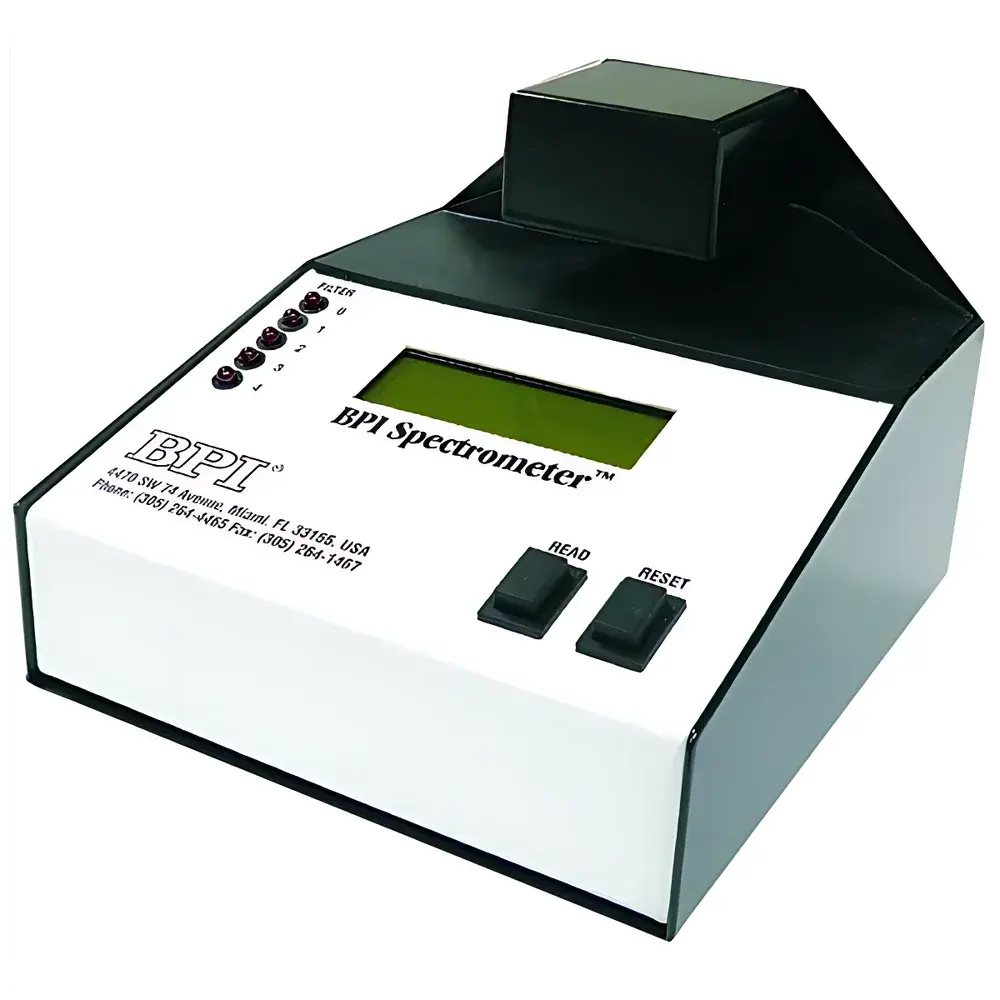
HunterLab BPI Spectrophotometer for Lens Chromatic Aberration and Color Measurement
| Brand | HunterLab |
|---|---|
| Origin | USA |
| Manufacturer Type | Authorized Distributor |
| Import Status | Imported |
| Model | BPI Spectrophotometer |
| Wavelength Range | 350–710 nm |
| Optical Resolution | <10 nm |
| Measurement Outputs | Visible Transmittance (Tv), UVA Transmittance, CIELAB L*a*b* color coordinates |
| Dimensions | 6.75" × 6.25" × 5" (L×W×H) |
| Weight | 8.5 lb |
| Power Supply | 110 V AC, 50/60 Hz, 1 A |
| Interface | USB 2.0 |
| Operating System | Microsoft Windows |
| Data Storage | Integrated database + exportable reports |
| Compliance | Supports ASTM D1003 (haze/transmittance), EN 1836:2015 (sunglasses), DOT FMVSS No. 208 & 212 (traffic signal visibility), ISO/CIE colorimetric standards |
Overview
The HunterLab BPI Spectrophotometer is a purpose-engineered optical measurement instrument designed specifically for quantitative spectral characterization of ophthalmic lenses, sunglass filters, and transparent polymeric optical materials. Operating on the principle of single-beam UV-Vis spectrophotometry, the system integrates a stabilized tungsten-halogen light source with a fixed-grating spectrometer to deliver high-fidelity transmittance spectra across the biologically and regulatory-relevant range of 350–710 nm. Unlike general-purpose colorimeters, the BPI is calibrated and validated for lens-specific photometric parameters—including visible light transmittance (Tv), UVA transmittance (315–400 nm), and CIELAB color space coordinates—enabling objective, traceable assessment of chromatic aberration, tint uniformity, batch-to-batch consistency, and regulatory compliance. Its compact benchtop architecture and self-contained optical path eliminate alignment dependencies, ensuring reproducible measurements without operator intervention or external calibration references during routine QC.
Key Features
- Fixed-wavelength-range spectrophotometer with 350–710 nm coverage and optical resolution better than 10 nm FWHM, optimized for lens transmission profiling
- Integrated tungsten-halogen illumination source with thermal stabilization for low drift and high photometric repeatability
- Dedicated lens holder geometry accommodating plano and curved ophthalmic substrates up to 80 mm diameter with repeatable sample positioning
- Onboard LCD display showing real-time Tv, UVA %, and L*a*b* values; no PC required for basic pass/fail verification
- USB 2.0 interface compatible with Windows 10/11 systems; driver-free enumeration under standard HID-compliant protocols
- Software-enabled spectral overlay functionality for comparative analysis—e.g., reference standard vs. production lot or customer-supplied master sample
- Compliance-ready reporting engine generating audit-trail logs, timestamped results, and PDF/CSV exports aligned with GLP documentation requirements
Sample Compatibility & Compliance
The BPI Spectrophotometer accommodates a broad range of optically transparent samples relevant to eyewear manufacturing and regulatory testing: CR-39, polycarbonate, Trivex, glass, photochromic, and polarized lenses—with or without anti-reflective coatings. Sample thickness is unrestricted within mechanical limits (max. 25 mm), and curvature does not impair measurement fidelity due to collimated beam geometry. Regulatory alignment includes full support for EN 1836:2015 Annex A (lens category classification), ANSI Z80.3–2020 (non-prescription sunglasses), and U.S. Federal Motor Vehicle Safety Standards FMVSS No. 208 (interior lighting visibility) and No. 212 (windshield transparency). The instrument’s Tv and UVA calculations conform to ASTM D1003 methodology, while its CIELAB output follows CIE 15:2018 and ISO 11664-4:2019 definitions. All factory calibrations are NIST-traceable and documented per ISO/IEC 17025–compliant procedures.
Software & Data Management
The included Windows-based SpectraMagic™ NX software provides full spectral acquisition, visualization, and analytical control. It supports multi-curve overlay with difference plotting, statistical process control (SPC) charting for Tv and L*a*b*, and automated pass/fail flagging against user-defined tolerances. Raw spectral data (.spc) and metadata are stored in an embedded SQLite database with field-level encryption options. Audit trail functionality records all user actions—including measurement initiation, parameter changes, and report generation—with timestamps, operator ID, and IP address (when network-connected). Export formats include PDF (with embedded digital signature), CSV (for LIMS integration), and XML (compatible with FDA 21 CFR Part 11–compliant validation packages). Software updates are delivered via secure HTTPS channel with SHA-256 integrity verification.
Applications
- Quantitative evaluation of lens tint matching across production batches and supplier lots
- Detection of unintended chromatic shifts caused by coating degradation, thermal stress, or UV exposure
- Verification of traffic signal recognition capability per DOT visibility thresholds (e.g., red/green/yellow discrimination at 100 m)
- Color specification development using CIELAB ΔE*ab metrics for custom-tint formulations
- Supporting ISO 12312-1:2022 compliance testing for solar filters used in eclipse viewing applications
- Root-cause analysis of haze or scattering anomalies through derivative spectral analysis in the 380–420 nm region
FAQ
Does the BPI require annual recalibration by HunterLab service engineers?
Yes—HunterLab recommends annual factory recalibration to maintain NIST-traceable accuracy. Field verification using certified reference standards (e.g., NIST SRM 2036) is advised quarterly.
Can the BPI measure reflectance or only transmittance?
The BPI is configured exclusively for transmittance measurements. Reflectance mode is not supported due to optical path design constraints.
Is the software compatible with Windows Server environments?
SpectraMagic NX is validated for Windows 10/11 Pro and Enterprise editions; Windows Server OS is not officially supported but may operate in desktop experience mode with administrator privileges.
What is the measurement repeatability for Tv at 555 nm?
Under controlled ambient conditions (23 ± 2 °C, <50% RH), repeatability is ±0.2% Tv (k = 2) for homogeneous CR-39 substrates measured in triplicate.
Does the system meet FDA 21 CFR Part 11 requirements out-of-the-box?
The hardware and software provide foundational controls (electronic signatures, audit trails, role-based access); however, full Part 11 compliance requires site-specific validation documentation and procedural SOPs per your quality system.





