
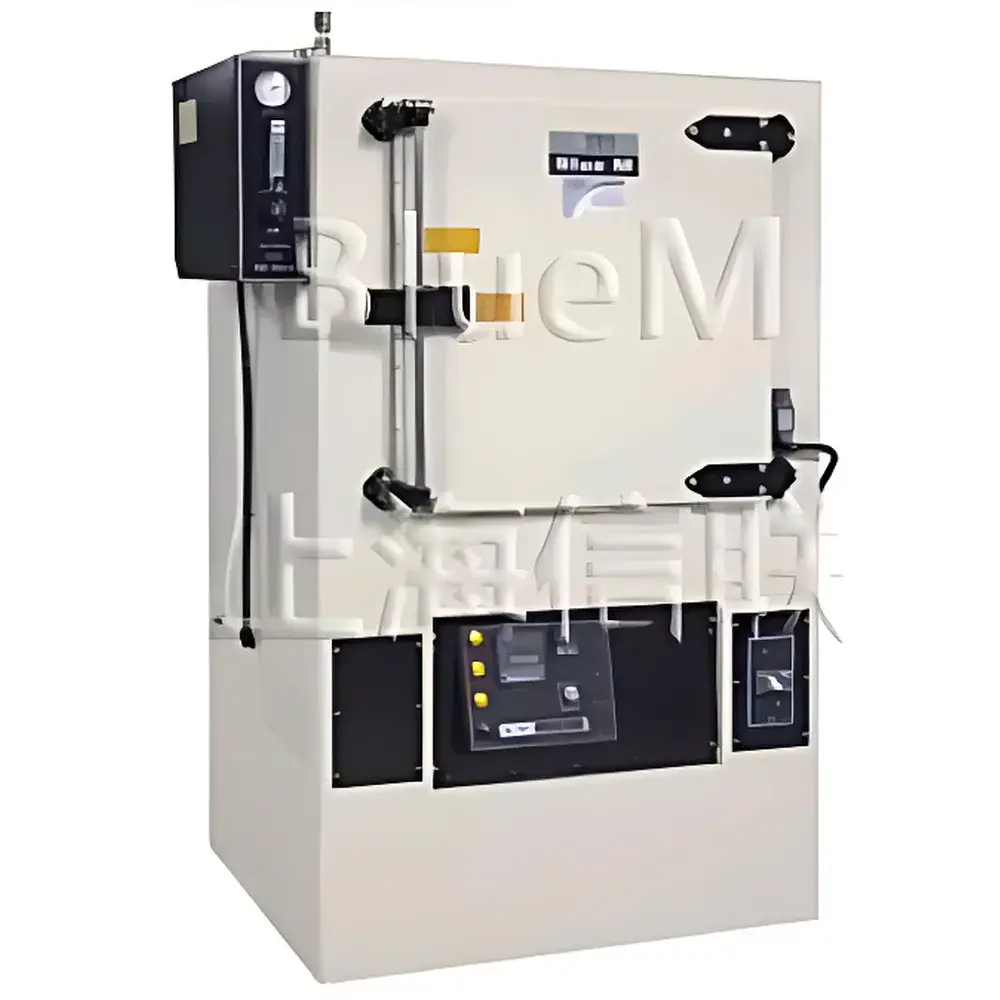
Blue M Model 146 Standard Mechanical Convection Oven
| Brand | Blue M |
|---|---|
| Origin | USA |
| Model | Blue M 146 Standard Mechanical Convection Oven |
| Instrument Type | Benchtop/General-Purpose Forced-Air Oven |
| Maximum Operating Temperature | 350 °C |
| Temperature Uniformity | ±1% of setpoint (at steady state, full load) |
| Control Accuracy | ±0.5 °C |
| Temperature Resolution | 0.1 °C |
| Heating Method | Horizontal mechanical convection (adjustable single-pass or recirculating airflow) |
| Internal Chamber Dimensions | 20″ × 18″ × 20″ to 48″ × 24″ × 36″ (508 × 457 × 508 mm to 1219 × 610 × 914 mm) |
| Rated Power | 7.5 kW |
| Typical Ramp Time to 350 °C | ≤60 min (dependent on chamber volume and load) |
| Insulation | 4″ (102 mm) fiberglass blanket |
| Construction | 16-gauge (1.5 mm) cold-rolled steel exterior |
| Door Seal | High-temperature silicone gasket with dual compression design |
| Optional Features | 3″ (76 mm) rear-mounted conduit port |
Overview
The Blue M Model 146 Standard Mechanical Convection Oven is an industrial-grade, general-purpose forced-air thermal processing system engineered for precision drying, curing, baking, conditioning, and stabilization applications in research laboratories, quality control environments, and manufacturing support labs. Unlike natural convection ovens, the Model 146 employs a mechanically driven horizontal airflow architecture—distinct from fan-assisted gravity convection—to ensure consistent heat distribution across the entire working volume, even under full-load conditions. Its core thermal management relies on a robust, horizontally oriented mechanical convection system that permits smooth transition between recirculated and single-pass airflow modes, enabling users to optimize thermal efficiency versus process contamination control. Designed and manufactured in the United States, the oven complies with UL 61010-1 and CSA C22.2 No. 61010-1 safety standards for laboratory equipment and meets structural requirements for Class I, Division 1 hazardous location compatibility when specified with appropriate options.
Key Features
- Heavy-duty 16-gauge (1.5 mm) cold-rolled steel outer casing with durable epoxy-polyester powder coating for long-term corrosion resistance in demanding lab environments
- Reinforced 304 stainless steel interior chamber, fully welded and stress-relieved to minimize thermal distortion and maximize dimensional stability over repeated thermal cycling
- 4-inch (102 mm) thick fiberglass insulation blanket surrounding all six chamber surfaces—reducing surface temperature rise and minimizing standby energy loss by up to 40% compared to standard 2-inch insulated ovens
- Patented Blue M Eterna™ heating elements: coiled high-nickel-chromium alloy wire wound on low-conductivity alumina ceramic formers, delivering uniform radiant output, extended service life (>15,000 hr at 350 °C), and reduced watt-density hot spots
- Dual-pressure, removable inner liner system with quick-release fasteners—enabling complete internal access for thorough cleaning, residue removal, or validation swabbing per ISO 14644 or FDA cGMP Annex 1 protocols
- Horizontally mounted, dynamically balanced DC multi-blade centrifugal fan with variable-speed control—providing stable airflow rates from 120 to 450 CFM while maintaining acoustic emissions below 62 dBA at 1 m
- 3-inch (76 mm) NPT-threaded rear conduit port, centrally located on the right side wall, facilitating unobstructed thermocouple feedthrough, data logger integration, or process gas line routing without compromising chamber integrity
Sample Compatibility & Compliance
The Model 146 accommodates a broad range of sample types—including polymer films, metal coupons, pharmaceutical excipients, ceramic green bodies, and coated substrates—within its scalable chamber configurations. Its mechanical convection design ensures minimal convective disturbance during delicate thermal treatments, making it suitable for ASTM D2244 (color stability), ASTM D5422 (curing kinetics), and ISO 293 (thermoplastic compression molding) procedures. All electrical components meet RoHS Directive 2011/65/EU requirements. Optional factory-installed data logging and audit trail modules support compliance with FDA 21 CFR Part 11, EU Annex 11, and GLP/GMP documentation standards. The oven’s temperature uniformity profile is validated per ASTM E2207 and routinely verified using calibrated NIST-traceable PT100 sensors placed at nine standardized locations (corners + center).
Software & Data Management
Standard operation utilizes a microprocessor-based digital controller with dual-display interface (setpoint/actual temperature), programmable ramp-soak profiles (up to 24 segments), and real-time deviation alarms. Optional Blue M Connect™ software enables remote monitoring via Ethernet or USB, automatic generation of IQ/OQ/PQ test reports, electronic signature capture, and time-stamped event logs—including door open/close events, power interruptions, and setpoint modifications—with full 21 CFR Part 11 audit trail capability. All firmware updates are delivered through secure HTTPS channels and require cryptographic authentication prior to installation.
Applications
- Accelerated aging studies per ISO 11348 and ASTM G154 for material degradation assessment
- Moisture content determination in accordance with AOAC 950.46 and USP
- Curing of epoxy, silicone, and polyimide coatings used in aerospace and electronics assembly
- Pre-conditioning of test specimens prior to tensile, impact, or hardness evaluation (ASTM D638, D256)
- Thermal stabilization of reference standards and calibration artifacts
- Baking out of vacuum chamber components and optical mounts in cleanroom maintenance workflows
FAQ
What is the difference between mechanical convection and fan-forced convection in Blue M ovens?
Mechanical convection refers to a precisely engineered horizontal airflow path driven by a dedicated centrifugal blower, independent of gravitational effects—enabling superior uniformity and repeatability across large loads. Fan-forced convection typically denotes simpler axial fans integrated into vertical airflow designs, which often yield greater top-to-bottom gradients.
Can the Model 146 be validated for GMP use?
Yes—when equipped with optional calibrated sensor ports, 21 CFR Part 11-compliant software, and factory-provided IQ/OQ documentation packages, the oven supports full qualification under pharmaceutical and medical device quality systems.
Is the 3-inch conduit port pre-wired or user-configurable?
It is a passive, threaded port; no internal wiring is included. Users install their own thermocouples, RTDs, or signal lines using appropriate feedthrough fittings rated for continuous 350 °C exposure.
Does the oven support nitrogen purging?
Yes—optional inert gas inlet/outlet ports and flow-metering kits are available to enable controlled atmosphere operation, including O₂ reduction to <100 ppm for oxidation-sensitive processes.
What maintenance intervals are recommended for the Eterna™ heating elements?
No scheduled replacement is required; lifetime expectancy exceeds 15,000 hours at 350 °C. Visual inspection every 6 months and continuity testing during annual calibration are sufficient under normal operating conditions.



