
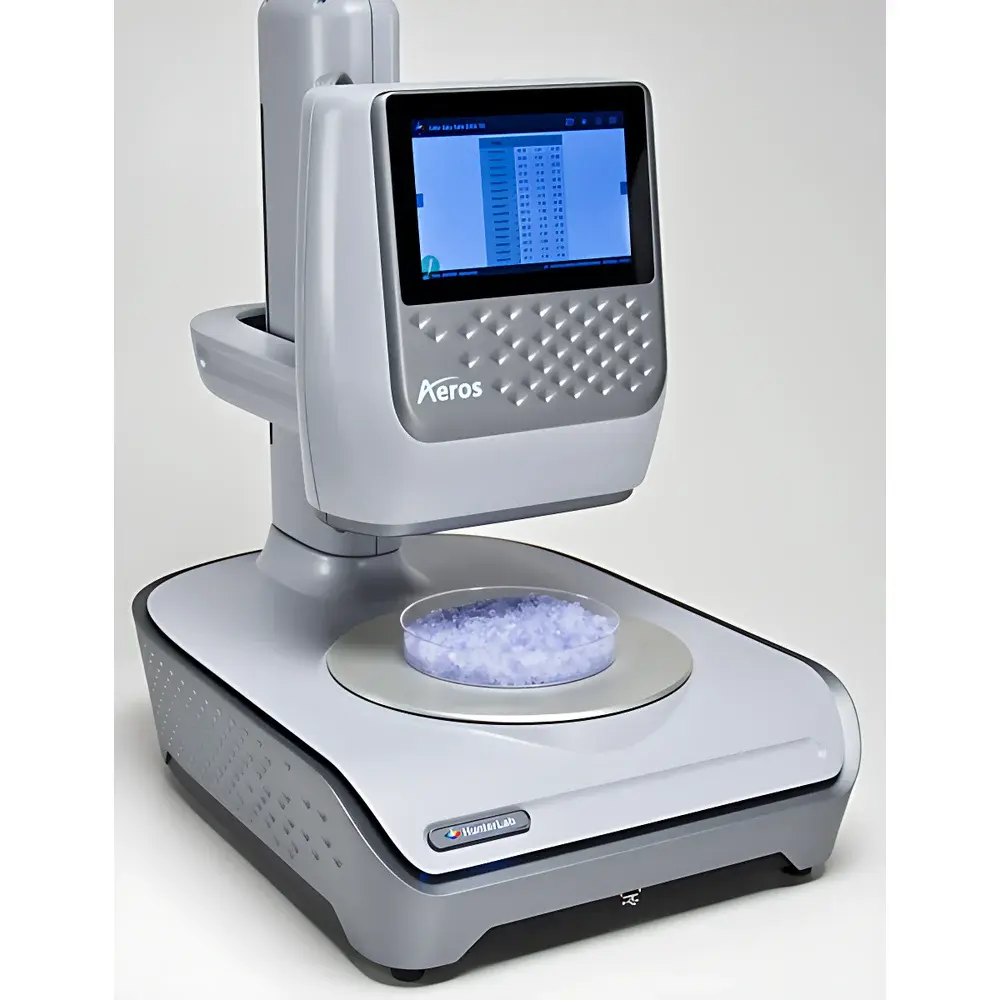
HunterLab Aeros Biscuit Color Measurement Instrument
| Brand | HunterLab |
|---|---|
| Origin | USA |
| Model | Aeros Biscuit Colorimeter |
| Instrument Type | Benchtop |
| Optical Geometry | 0/45° Integrating Sphere |
| Light Source | Full-Spectrum LED (Cool White) |
| Spectral Range | 400–700 nm |
| Repeatability | ΔE*ab ≤ 0.03 (mean, CIE Lab, standard conditions) |
| Measurement Area | Up to 223.2 cm² (34.6 in²) |
| Sample Handling | Non-contact, Auto-height Detection, Motorized Rotating Sample Tray (35 measurements per rotation, 5 s/rotation) |
| Display | Full-color capacitive touchscreen interface |
| Software | EasyMatch ESSENTIAL (standalone operation supported) |
| Compliance | Designed for GLP/GMP environments |
| compliant with ISO 11664-4 (CIE colorimetry), ASTM E308, and CIE 15 | 2018 |
Overview
The HunterLab Aeros Biscuit Color Measurement Instrument is a benchtop spectrophotometric colorimeter engineered specifically for objective, non-contact color evaluation of heterogeneous, irregular, and textured samples—such as biscuits, coffee beans, food pellets, plastic granules, and industrial particulates—without requiring sample homogenization, grinding, or compression. Unlike conventional 0/45° colorimeters optimized for flat, uniform surfaces, the Aeros employs a patented non-contact measurement architecture (patent pending) that combines intelligent auto-height sensing, motorized rotational sampling, and full-spectrum LED illumination within a thermally stable 0/45° integrating sphere optical path. This design eliminates mechanical pressure on fragile or deformable samples while ensuring representative spatial averaging across macroscopically variable surfaces. The instrument operates on CIE-compliant colorimetric principles: spectral reflectance data across 400–700 nm are acquired, mathematically integrated using CIE 1931 2° standard observer functions, and converted into CIE L*a*b*, L*C*h*, and ΔE*ab metrics under user-selectable illuminants (e.g., D65, A, F2). Its 223.2 cm² maximum measurement footprint enables statistically robust characterization of large-area or bulk-like specimens—critical for QC consistency in food, confectionery, and polymer manufacturing.
Key Features
- Non-contact measurement technology minimizes sample contamination, surface abrasion, and operator-induced variability—essential for hygienic food-grade applications and delicate particulates.
- Auto-height detection system uses precision infrared sensors to dynamically locate optimal focal distance (±0.2 mm resolution), eliminating manual height calibration and ensuring consistent geometry across varied sample topographies.
- Motorized rotating sample tray performs 35 discrete spectral acquisitions per 360° rotation (completed in 5 seconds), delivering spatially weighted mean color values with enhanced repeatability (ΔE*ab ≤ 0.03).
- Benchtop-integrated full-color capacitive touchscreen provides intuitive, icon-driven workflow navigation—no external PC required for routine measurement, pass/fail evaluation, or report generation.
- Industrial-grade sealed optical chamber houses long-life, thermally stabilized full-spectrum LEDs (rated >50,000 hours), eliminating lamp replacement cycles and spectral drift associated with xenon or tungsten sources.
- Embedded EasyMatch ESSENTIAL software supports standalone operation, including statistical process control (SPC) charting, tolerance band definition, batch reporting, and direct export to CSV, PDF, or XML formats.
Sample Compatibility & Compliance
The Aeros accommodates samples ranging from loose granules (e.g., roasted coffee beans, cereal flakes, extruded snack pieces) to irregular solids (e.g., artisanal biscuits, molded confections, injection-molded plastic components) with heights up to 45 mm and diameters exceeding 150 mm. Its non-contact methodology satisfies stringent hygiene requirements for FDA-regulated food processing facilities and avoids cross-contamination risks inherent in contact-based probes. The instrument’s firmware and optional EasyMatch QC software support configurable audit trails, electronic signatures, and user access levels—enabling alignment with 21 CFR Part 11 requirements when deployed in validated GxP environments. Hardware and measurement algorithms conform to ISO 11664-4 (colorimetric computation), CIE 15:2018 (instrumental colorimetry), and ASTM E308 (computing tristimulus values from spectral data).
Software & Data Management
EasyMatch ESSENTIAL runs natively on the instrument’s embedded Linux platform, enabling real-time color analysis, trend visualization, and comparative reporting without host PC dependency. Data outputs include CIE L*a*b*, ΔE*ab, whiteness/yellowness indices (e.g., CIE W10, ASTM E313), and custom formulation metrics. Export options include email transmission (SMTP-enabled), direct printing (USB/IP/network printers), and structured data transfer via TCP/IP to LIMS, MES, or SPC systems using industry-standard protocols (e.g., OPC UA, RESTful API). HunterLab Remote Access Support allows authorized service engineers to establish secure, encrypted connections for remote diagnostics, firmware updates, and live operator coaching—reducing downtime and supporting global multi-site deployments.
Applications
The Aeros is routinely deployed in R&D laboratories and production QC labs across food & beverage, pharmaceutical excipients, polymer compounding, and agricultural commodity sectors. Typical use cases include: monitoring roast degree consistency in whole-bean coffee; quantifying browning kinetics in baked goods during shelf-life studies; verifying color uniformity of extruded pet food kibble; validating pigment dispersion in masterbatch pellets; and assessing natural variation in nut or seed batches. Its ability to generate statistically representative color averages from spatially heterogeneous materials makes it particularly valuable where traditional spot-measurement tools yield misleading results due to localized texture or gloss effects.
FAQ
Does the Aeros require sample preparation such as grinding or pressing?
No—its non-contact, auto-height, and rotational sampling design enables direct measurement of intact, unaltered samples.
Can the Aeros be integrated into an existing LIMS or ERP system?
Yes—via native TCP/IP connectivity and configurable data export formats (CSV, XML, JSON), supporting seamless integration with major laboratory and enterprise platforms.
Is calibration traceable to NIST standards?
Yes—each instrument ships with a factory-calibrated ceramic tile certified to NIST-traceable standards; annual recalibration services are available through HunterLab-certified labs.
What maintenance is required beyond routine cleaning?
None—solid-state LED illumination, sealed optics, and brushless motor drives eliminate consumables and scheduled maintenance intervals.
How does the Aeros handle highly glossy or translucent samples?
The 0/45° geometry inherently suppresses specular reflection artifacts; for translucent matrices (e.g., gelatin candies), users may apply standardized backing plates or select diffuse illumination modes within EasyMatch software.





