
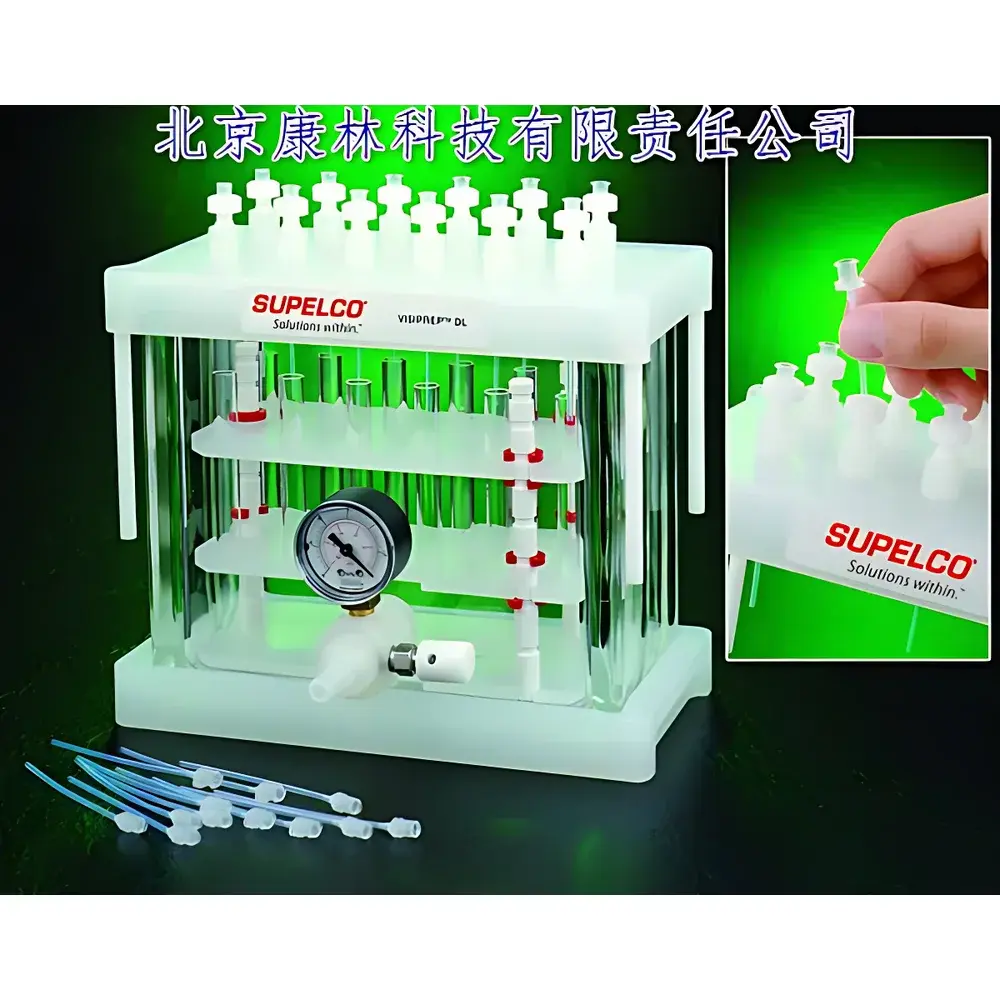
Supelco KLVIPSPE-12 12-Position Automated Solid Phase Extraction Manifold
| Brand | Supelco |
|---|---|
| Origin | USA |
| Model | KLVIPSPE-12 |
| Automation Level | Fully Automated |
| Channel Count | 12-Channel |
| Extraction Type | Cartridge-Based SPE |
| Flow Control | Precision Spiral-Valve Flow Regulation |
| Solvent Compatibility | Broad Spectrum (Including Acetonitrile, Methanol, Ethyl Acetate, Hexane, Dichloromethane, and Aqueous Buffers) |
| Max Simultaneous Samples | 12 |
| Sample Loading Volume Range | 1 mL to Unlimited (with Optional Large-Volume Samplers) |
| Wetted Materials | PTFE Tubing, Borosilicate Glass Chamber, Polypropylene Collection Rack |
Overview
The Supelco KLVIPSPE-12 is a fully automated, 12-position solid phase extraction (SPE) manifold engineered for reproducible, high-throughput sample preparation in regulated and research laboratories. It operates on vacuum-assisted, cartridge-based SPE principles—leveraging controlled negative pressure to drive sample loading, washing, and elution steps through bonded-phase sorbent cartridges (e.g., C18, SCX, SAX, Florisil, or mixed-mode media). Designed to meet the physical and chemical demands of modern analytical workflows—including LC-MS/MS, GC-MS, HPLC, and ICP-MS sample introduction—the system integrates robust fluidic architecture with chemically inert wetted materials to ensure method integrity across diverse matrices. Its modular design supports seamless integration into existing laboratory automation ecosystems and aligns with core principles of method validation per ICH Q2(R2), USP , and ISO/IEC 17025 requirements for sample preparation traceability.
Key Features
- 12-channel parallel processing with independent flow control per position via patented spiral-valve regulators—enabling precise, repeatable flow rates without cross-channel interference.
- Visiprep DL anti-cross-contamination architecture: Each port utilizes disposable PTFE transfer lines with polypropylene Luer-lock fittings; line replacement between samples eliminates carryover risk—a critical requirement for low-level bioanalysis and forensic toxicology.
- Chemically resistant borosilicate glass collection chamber: Resistant to solvent-induced clouding, etching, or leaching—even during prolonged exposure to aggressive organics (e.g., THF, chloroform) or strong acids/bases.
- Integrated vacuum regulation system featuring solvent-resistant spiral-valve vacuum gauge and 1/4″ vacuum port compatibility—ensuring stable, adjustable vacuum levels from 0.1 to 25 inHg (2.5–635 mbar).
- Modular polypropylene collection rack accommodates standard labware: 1–10 mL volumetric flasks, 10/16 mm test tubes, autosampler vials (12×32 mm), and scintillation vials (20 mL)—eliminating need for custom adapters.
- Ergonomic lid with integrated support feet: Enables stable benchtop placement during cartridge loading or fraction collection without requiring additional fixtures or stands.
Sample Compatibility & Compliance
The KLVIPSPE-12 processes complex, heterogeneous samples while maintaining matrix-specific recovery and selectivity. Validated applications include biological fluids (serum, plasma, urine, CSF), environmental water (drinking, wastewater, groundwater), food extracts (juices, dairy, alcoholic beverages), pharmaceutical formulations (oral solids, injectables, topical suspensions), and solid matrices (soil, sediment, tissue homogenates) following appropriate homogenization and solubilization protocols. All wetted components comply with USP Class VI biocompatibility standards. The system supports GLP/GMP-aligned workflows when paired with audit-trail-capable vacuum pumps (e.g., oil-free diaphragm pumps meeting FDA 21 CFR Part 11 data integrity criteria) and documented SOPs for column conditioning, breakthrough testing, and blank monitoring.
Software & Data Management
While the KLVIPSPE-12 operates as a hardware-only manifold (no embedded controller or touchscreen), it is fully compatible with laboratory information management systems (LIMS) and electronic lab notebooks (ELN) via standardized operational logs. Users document run parameters—including vacuum setpoint, dwell times per step, cartridge lot numbers, and solvent batch IDs—in accordance with ISO 17025 clause 7.7 (reporting of results) and FDA guidance on data reliability. When integrated with Supelco’s optional large-volume samplers (e.g., part #51719 or #51688), method scalability is maintained across 1–1000 mL sample volumes—facilitating EPA Method 525.3, 8270, or EU Directive 2009/128/EC-compliant residue analysis.
Applications
- Bioanalytical quantification: Isolation of small-molecule drugs, metabolites, and endogenous compounds from plasma/urine prior to LC-MS/MS analysis.
- Environmental monitoring: Extraction of PAHs, PCBs, pesticides, and pharmaceutical residues from surface water per EPA Methods 508.1, 531.1, and 8081B.
- Food safety testing: Cleanup of mycotoxins, veterinary drug residues, and plasticizers from milk, juice, and meat homogenates per AOAC Official Method 2012.01 and EN 15662:2018.
- Pharmaceutical QC: Desalting and buffer exchange of peptide therapeutics; removal of excipients from dissolution samples prior to HPLC-UV assay.
- Forensic toxicology: Selective enrichment of opioids, benzodiazepines, and stimulants from postmortem blood using mixed-mode cation-exchange SPE.
FAQ
Does the KLVIPSPE-12 require a dedicated vacuum pump?
Yes—operation requires connection to an oil-free diaphragm vacuum pump (e.g., Supelco #501-2001, 25 L/min capacity) and a polypropylene vacuum trap (#51153) to prevent solvent backflow and pump contamination.
Can I use non-Supelco SPE cartridges with this manifold?
Yes—the system accepts all standard 1–60 mL SPE cartridges via universal Luer-lock or threaded adapters; optional #51105 cartridge adapters enable tandem column configurations.
How is cross-contamination prevented during sequential runs?
By replacing the disposable PTFE transfer line (#51598) between each sample, eliminating residual analyte carryover—validated per CLSI EP26-A guidelines for carryover assessment.
Is the glass chamber autoclavable?
No—borosilicate glass is solvent- and thermal-resistant but not designed for steam sterilization; cleaning is performed with appropriate solvents followed by nitrogen purging.
What maintenance is required for long-term performance?
Quarterly inspection of valve seals, annual calibration of vacuum gauge (if used with digital readout), and routine replacement of PTFE tubing and O-rings per manufacturer’s preventive maintenance schedule.



