
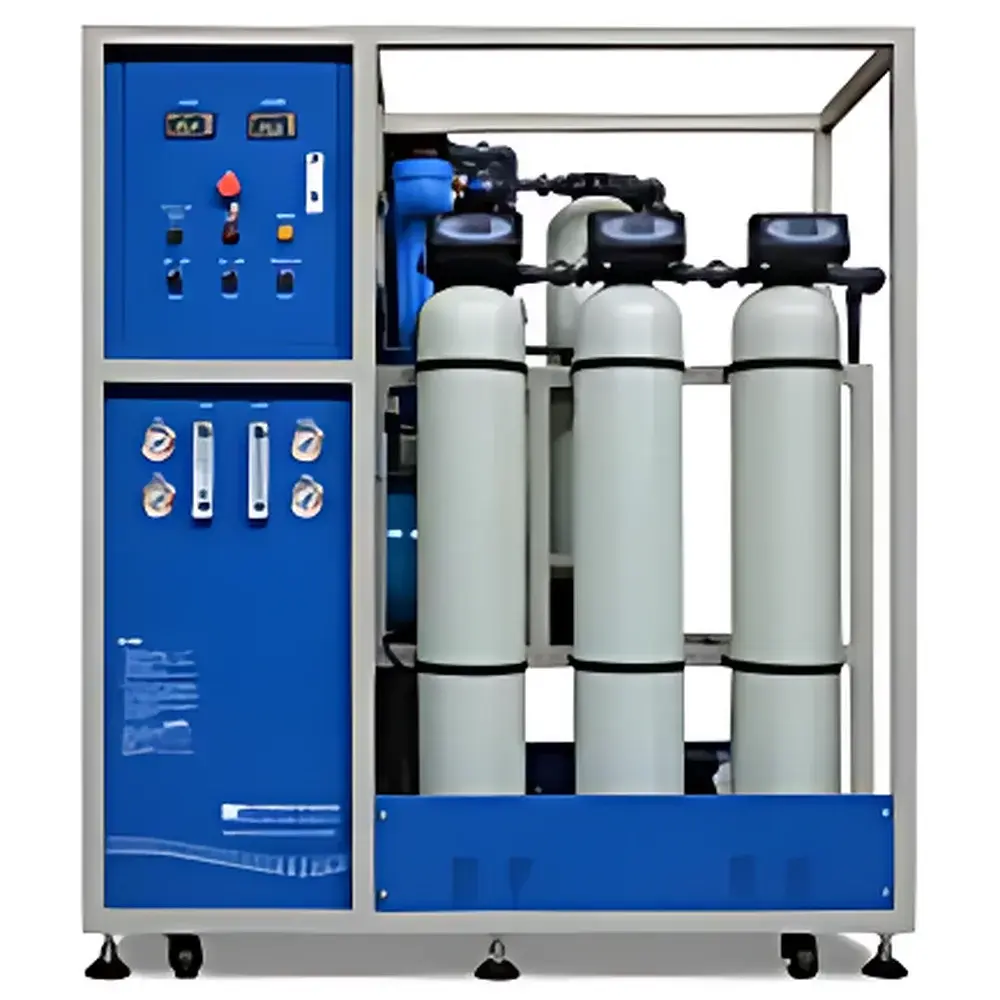
ULUPURE ULPS High-Speed Biochemistry-Dedicated Ultra-Pure Water System
| Brand | ULUPURE |
|---|---|
| Origin | Sichuan, China |
| Manufacturer Type | Direct Manufacturer |
| Regional Classification | Domestic |
| Model | ULPS |
| Pricing | Upon Request |
| Feed Water Quality | Municipal Tap Water (TDS < 500 ppm, Residual Chlorine ≤ 0.05 mg/L, Pressure 2–5 kg/cm², Temp 5–45 °C) |
| Product Water Grade | GB/T 6682–2008 Grade I / ASTM D1193–2023 Type I / ISO 3696:1995 Grade 1 / NCCLS EP21-A / WS/T 574–2018 Class A |
| Heavy Metals & Soluble Silica | < 0.1 ppb |
| Total Organic Carbon (TOC) | < 10 ppb |
| Particles (>0.1 µm) | < 1 particle/mL |
| Resistivity | ≥ 18.2 MΩ·cm (25 °C) |
| Conductivity | ≤ 0.055 µS/cm |
| Bacterial Count | < 0.1 CFU/mL |
| Flow Rate Options | 120 / 200 / 250 / 300 / 500 L/h |
| Standard Storage Tank | 250 L (for 120–250 L/h models) |
| Power Consumption | 1.8–2.1 kW |
| Dimensions (L×W×H) | 1500×700×1600 mm (120–250 L/h) |
| Weight | 200–2000 kg |
| Materials of Construction | 304 Stainless Steel Wetted Parts, Imported RO Membranes, International Brand Solenoid Valves & Fittings |
| Control Architecture | PLC-Based Automation with Optional HMI Touchscreen Interface |
Overview
The ULUPURE ULPS High-Speed Biochemistry-Dedicated Ultra-Pure Water System is an engineered solution for continuous, high-volume production of Type I ultrapure water compliant with stringent international standards including GB/T 6682–2008, ASTM D1193–2023 Type I, ISO 3696:1995 Grade 1, NCCLS EP21-A, and WS/T 574–2018 Class A. Designed specifically to support high-throughput clinical biochemistry analyzers—such as those manufactured by Roche, Hitachi, Beckman Coulter (Olympus), Abbott, Mindray, Kehua, and Dirui—the ULPS integrates a multi-stage purification architecture comprising pretreatment, reverse osmosis (RO), electrodeionization (EDI), and final ultrafiltration with dual-stage UV oxidation (185/254 nm). Its modular, integrated design ensures stable output under variable feed water conditions while maintaining consistent resistivity ≥ 18.2 MΩ·cm (25 °C), TOC < 10 ppb, and particle count 0.1 µm), meeting the critical requirements for reagent preparation, immunoassay luminometry, microbial culture media formulation, and precision instrument rinsing.
Key Features
- Intelligent PLC-based control system with optional 7-inch touchscreen HMI for real-time parameter visualization, alarm logging, and event history traceability—fully compatible with GLP/GMP audit requirements.
- Automated safety interlocks: low-feed-pressure shutdown, high-pressure alarm, phase-loss detection, overcurrent protection, tank-level-triggered pump cycling (auto-stop at high level, auto-restart at mid-level), and scheduled membrane flushing cycles.
- Enhanced pretreatment module featuring programmable automatic regeneration via servo-controlled multiport valves; service life extended to ≥24 months under typical municipal feed conditions.
- Constant-pressure delivery system utilizing digital PWM-controlled stainless steel centrifugal pumps (304 SS wetted path), ensuring stable flow across all operating points without pressure spikes or cavitation risk.
- Full-spectrum online monitoring: dual conductivity sensors (feed water + purified water), integrated TOC analyzer (optional), real-time particle counter (0.1 µm threshold), and UV absorbance detector (254 nm) for organic contamination trending.
- Robust mechanical construction: all fluid-contact components fabricated from electropolished 304 stainless steel; RO membranes and critical instrumentation sourced from Tier-1 global suppliers; fully CE- and RoHS-compliant electrical architecture.
Sample Compatibility & Compliance
The ULPS delivers water quality validated for compatibility with sensitive analytical platforms requiring minimal background interference—including photometric, electrochemical, and chemiluminescent detection systems. Its output meets or exceeds the maximum permissible limits defined in USP , EP 2.2.44, and JP 17 for pharmaceutical-grade water used in diagnostic reagent synthesis. All electronic records—including sensor readings, alarm timestamps, maintenance logs, and user actions—are timestamped and stored locally with configurable retention periods, supporting compliance with FDA 21 CFR Part 11 when paired with optional audit-trail-enabled firmware. System validation documentation (DQ/IQ/OQ/PQ templates) and calibration certificates for onboard sensors are available upon request.
Software & Data Management
The ULPS supports both standalone operation and network-integrated deployment via Modbus TCP or Ethernet/IP protocols. Its embedded controller logs >10,000 data points per channel with microsecond-level time stamping, exportable in CSV or XML format for integration into LIMS or ELN environments. Optional cloud-connectivity modules enable remote diagnostics, predictive maintenance alerts, and fleet-wide performance benchmarking. Firmware updates are performed securely via signed OTA packages with cryptographic verification, preserving system integrity during lifecycle management.
Applications
- Primary water source for automated clinical chemistry analyzers (e.g., Roche Cobas, Beckman AU series, Abbott Architect, Mindray BS series).
- Preparation of calibrators, controls, and assay diluents in immunodiagnostics and ELISA workflows.
- Media formulation and buffer preparation for microbiological culture and cell-based assays.
- Rinsing of pipette tips, cuvettes, and microfluidic cartridges where residual ions or organics could compromise assay fidelity.
- Feed water for LC-MS mobile phase preparation (when coupled with additional polishing stages).
FAQ
What feed water specifications are required for optimal ULPS performance?
Municipal tap water with TDS ≤ 500 ppm, free chlorine ≤ 0.05 mg/L, pressure between 2–5 kg/cm², and temperature within 5–45 °C. Lower inlet pressure (<1.5 kg/cm²) or insufficient flow rate may necessitate auxiliary feed tanks or booster pumps.
Is the ULPS compliant with regulatory requirements for diagnostic manufacturing environments?
Yes—the system’s architecture, documentation package, and data integrity features align with ISO 13485, GMP Annex 1, and CLIA-certified laboratory standards. Optional IQ/OQ/PQ protocols and 21 CFR Part 11-compliant audit trails are available.
Can the ULPS be integrated into existing hospital utility networks?
Absolutely. It supports dry-contact alarms, analog 4–20 mA outputs for conductivity/pressure, and industrial Ethernet protocols for SCADA-level supervision.
What maintenance intervals are recommended for consumables?
Pre-filters: every 3–6 months depending on feed quality; RO membranes: 2–3 years; EDI stacks: 3–5 years; UF cartridges: 12–18 months. All replacements are tool-free and modular.
Does ULUPURE provide validation support for laboratory accreditation?
Yes—ULUPURE offers on-site or remote validation assistance, including protocol development, execution oversight, and final report generation per ISO/IEC 17025 and CAP checklist requirements.
Related Products



