
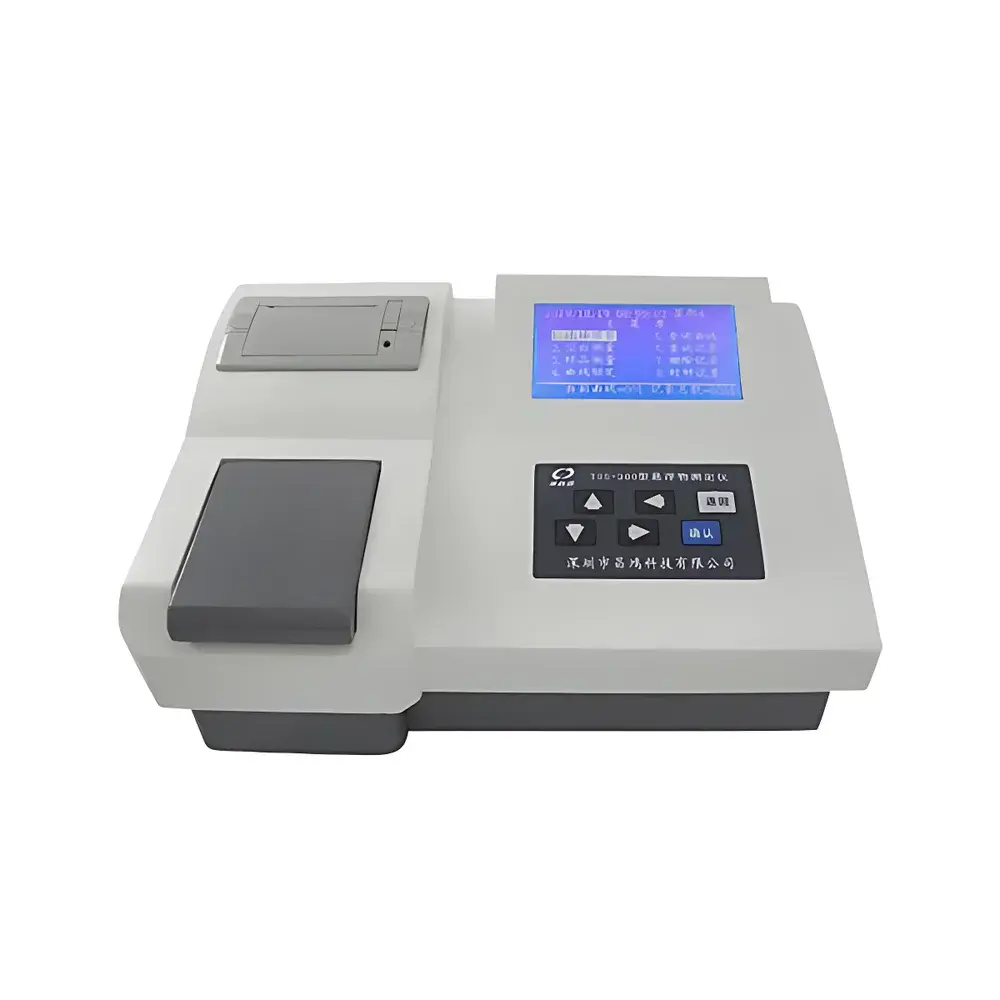
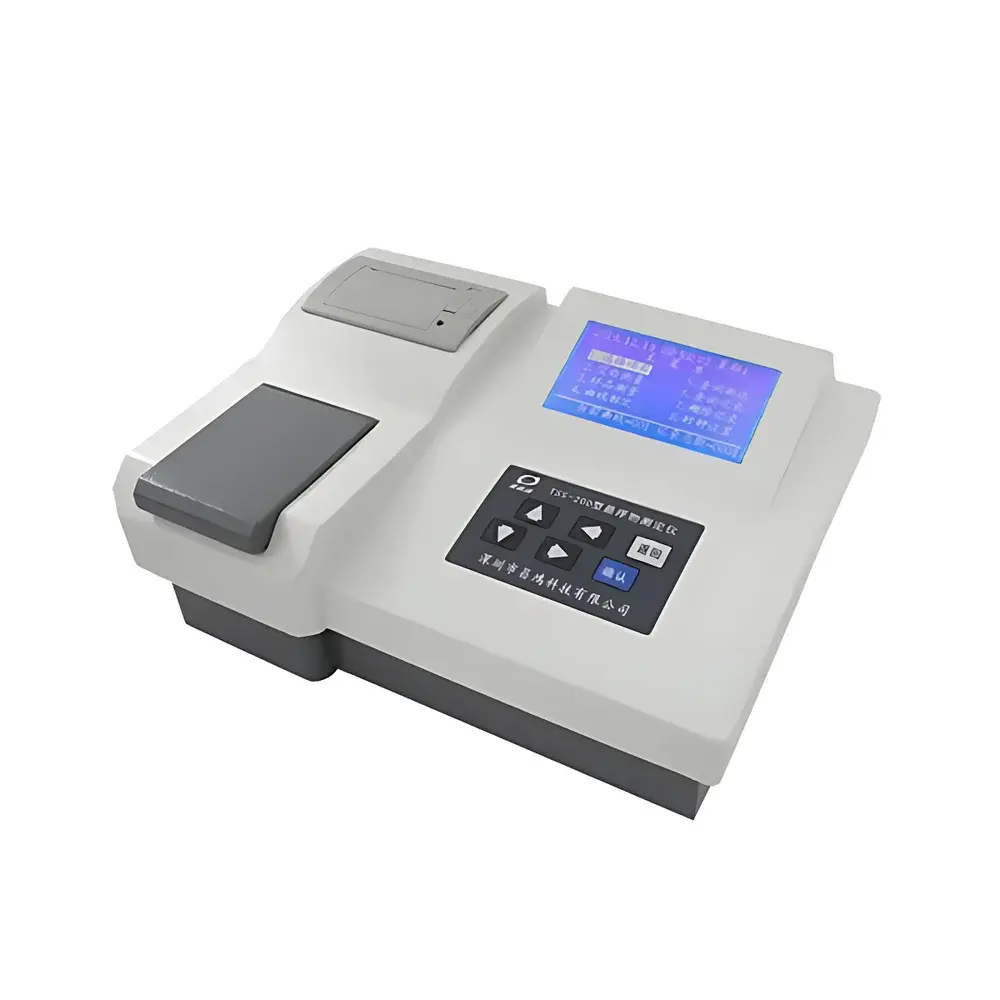
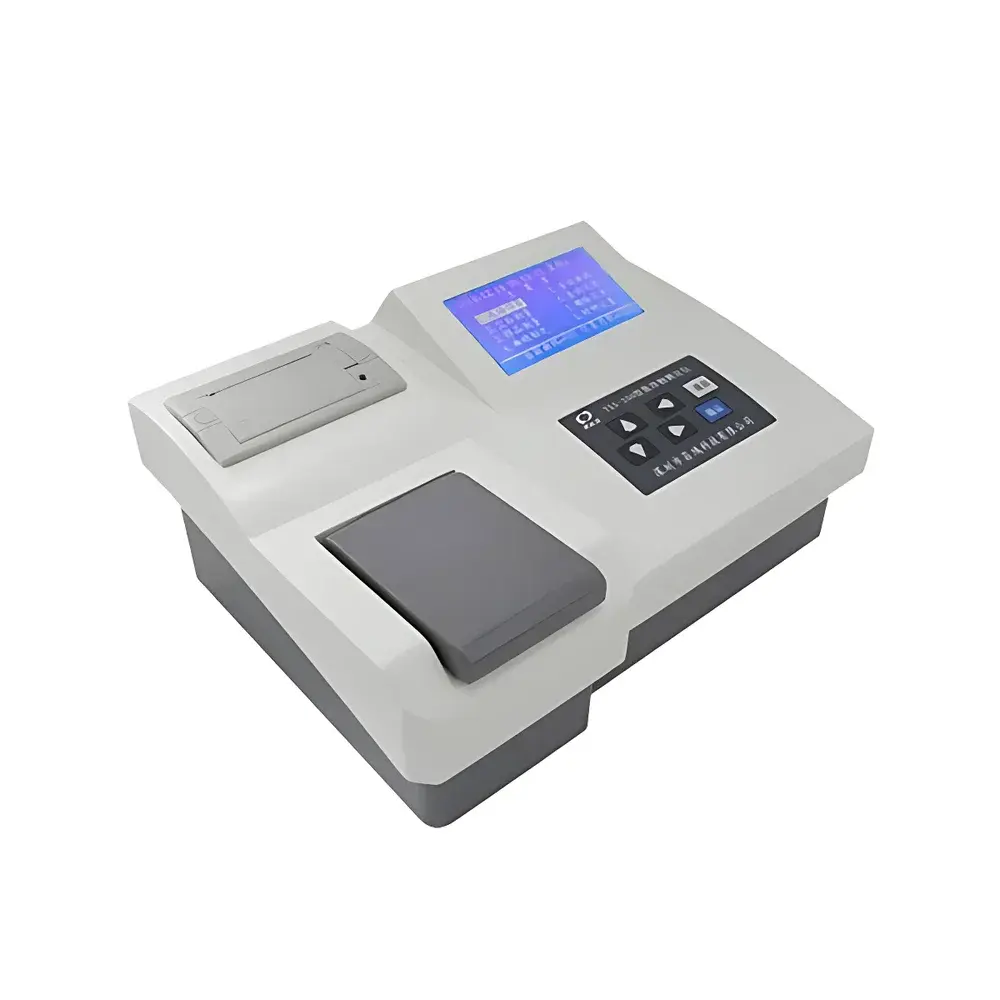
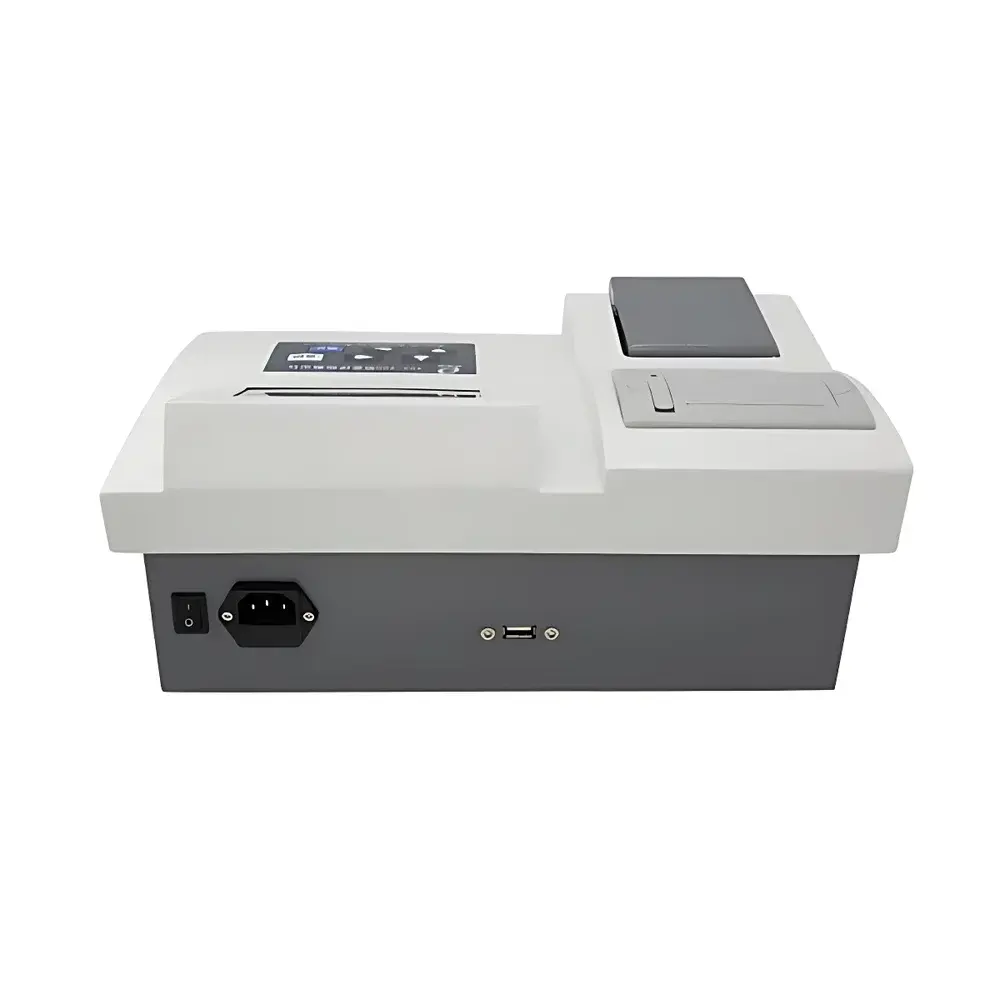
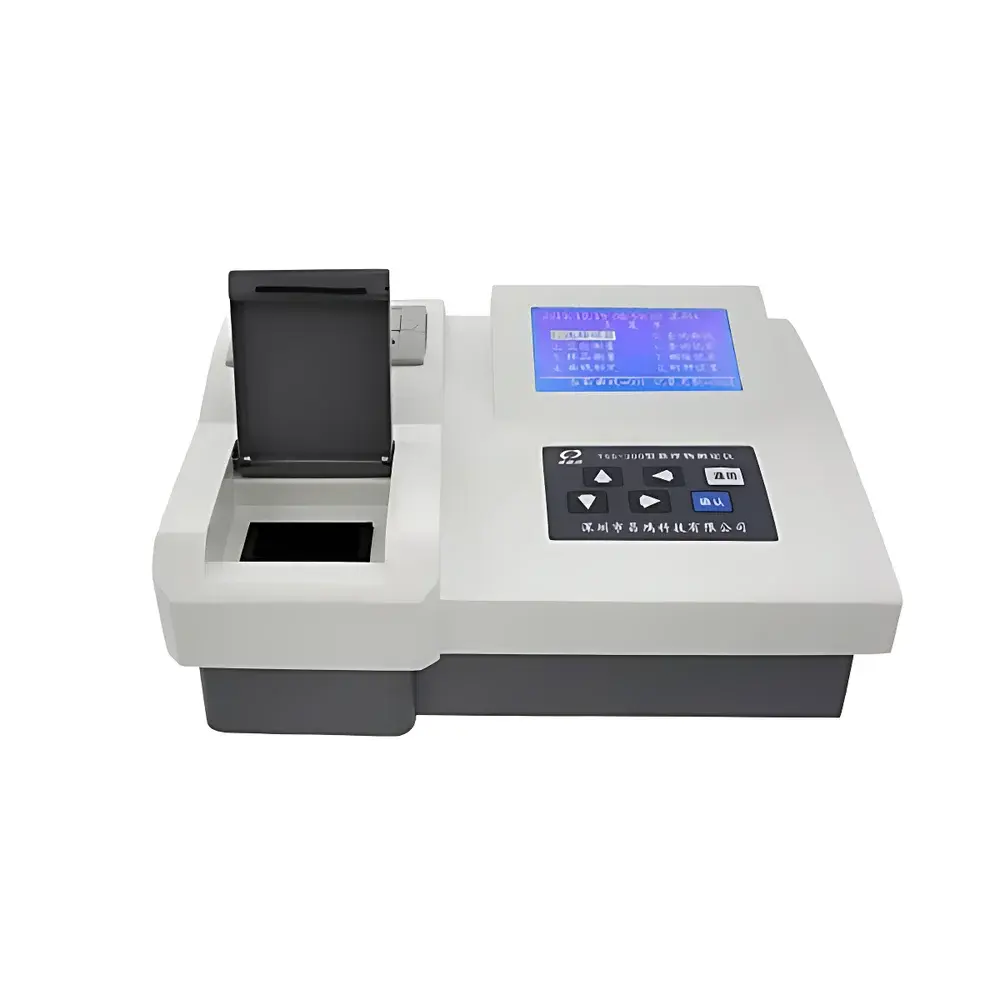
Shenchanghong TSS-200 Laboratory Suspended Solids Analyzer
| Brand | Shenchanghong |
|---|---|
| Origin | Guangdong, China |
| Manufacturer Type | Direct Manufacturer |
| Product Origin | Domestic (China) |
| Model | TSS-200 |
| Instrument Type | Benchtop Laboratory Analyzer |
| Measurement Range | 0–1000 mg/L |
| Accuracy | ≤ ±3% FS |
| Repeatability | ≤ ±2% FS |
| Resolution | 0.01 mg/L |
| Dimensions | 340 × 250 × 130 mm |
| Weight | 4 kg |
| Operating Temperature | 5–40 °C |
| Relative Humidity | ≤70% RH |
| Power Supply | AC (220 ±10%) V, 50 Hz |
| Light Source | Imported high-intensity LED (100,000-hour lifetime) |
| Optical System | Narrow-band interference filter |
| Display | Backlit LCD with Chinese menu interface |
| Data Storage | 20 built-in calibration curves + 400 measurement records (non-volatile memory) |
| Connectivity | USB port for data export |
| Optional | Thermal printer support |
| Housing Material | Molded ABS with corrosion resistance |
| Microcontroller | 16-bit low-power MCU |
Overview
The Shenchanghong TSS-200 Laboratory Suspended Solids Analyzer is a dedicated photometric instrument engineered for the quantitative determination of total suspended solids (TSS) in aqueous samples. It operates on the principle of absorbance spectroscopy at a fixed, optimized wavelength—typically within the visible range where particulate scattering and absorption correlate reliably with solid concentration. The analyzer employs a stable, long-life LED light source coupled with a precision narrow-band optical filter to minimize spectral drift and ambient light interference, ensuring consistent photometric performance across repeated measurements. Designed exclusively for laboratory use, the TSS-200 delivers rapid, operator-independent analysis without requiring sample digestion or filtration—making it suitable for routine monitoring in environmental testing labs, wastewater treatment facilities, and industrial quality control environments where regulatory compliance and method reproducibility are essential.
Key Features
- High-stability optical architecture featuring an imported LED source rated for 100,000 hours of operation and a narrow-band interference filter for minimal spectral deviation.
- Integrated 16-bit low-power microcontroller enabling precise signal processing, real-time correction, and robust system responsiveness.
- Backlit monochrome LCD display with intuitive Chinese-language menu navigation—designed for ease of use by technicians with varying levels of instrumentation experience.
- Non-volatile internal memory storing up to 20 user-defined or factory-calibrated absorbance-to-concentration curves and 400 individual measurement records, retained even after power loss.
- Durable molded ABS housing offering chemical resistance against common laboratory reagents, mild acids, and alkaline solutions encountered during sample handling and cleaning.
- USB interface compliant with standard CDC/ACM protocols for seamless data transfer to Windows-based PCs; optional thermal printer support enables hard-copy reporting for audit-ready documentation.
Sample Compatibility & Compliance
The TSS-200 is validated for use with clarified or lightly turbid liquid samples—including surface water, municipal wastewater, industrial effluents, and process water streams—provided they fall within the specified 0–1000 mg/L measurement range and exhibit no significant color interference at the operating wavelength. While not a gravimetric reference method per ASTM D5907 or ISO 11923, the instrument supports method validation workflows when correlated against standardized filtration-based procedures. Its design adheres to general electrical safety requirements for laboratory equipment (IEC 61010-1), and its operational parameters align with GLP-compliant environmental testing practices. For regulated environments, users may configure data export logs to meet internal QA/QC traceability requirements, though native 21 CFR Part 11 compliance requires third-party software integration.
Software & Data Management
Data acquisition and management are handled entirely through the onboard firmware—no external PC software is required for basic operation. All calibration curves are stored in protected flash memory and can be edited, duplicated, or deleted via the front-panel interface. Measurement results include timestamp, sample ID (user-entered), curve identifier, and raw absorbance value alongside the calculated TSS concentration. Exported USB data files follow plain-text CSV format with tab-delimited fields, facilitating direct import into Excel, LIMS platforms, or statistical analysis tools. The system does not implement encrypted storage, digital signatures, or role-based access control; therefore, laboratories subject to FDA or EU Annex 11 requirements must supplement with validated external data governance protocols.
Applications
- Routine TSS quantification in municipal wastewater influent, effluent, and sludge dewatering streams.
- Process water monitoring in pulp & paper, food & beverage, and pharmaceutical manufacturing where suspended particle load affects filtration efficiency or product clarity.
- Environmental field lab support for rapid screening prior to gravimetric confirmation per EPA Method 160.2 or ISO 11923.
- Educational laboratories teaching fundamental principles of turbidimetry, calibration curve development, and instrumental error sources in environmental chemistry.
- Industrial pretreatment verification to ensure compliance with discharge permit limits before release to public sewer systems.
FAQ
Is the TSS-200 compliant with EPA or ISO standard methods?
No—the TSS-200 is a photometric screening tool and does not replace gravimetric methods such as EPA 160.2 or ISO 11923. It may be used for trending, process control, or preliminary assessment when correlated with primary methods.
Can the instrument measure colored samples accurately?
Color interference may affect accuracy if the sample absorbs significantly at the instrument’s fixed measurement wavelength. Users should verify linearity and recovery using matrix-matched standards for colored effluents.
What maintenance is required for long-term stability?
Routine cleaning of the cuvette chamber and optical path with lint-free wipes and deionized water is recommended. The LED source requires no replacement within typical service life; however, annual verification against NIST-traceable standards is advised for QA/QC programs.
Does the device support multi-point calibration?
Yes—up to 20 independent calibration curves can be stored, each supporting multi-point linear or polynomial regression based on user-prepared standards.
Is remote data logging possible?
The TSS-200 lacks Ethernet or Wi-Fi connectivity. Continuous logging requires periodic manual USB export or integration with a host PC running custom serial/USB polling software.
Related Products







