
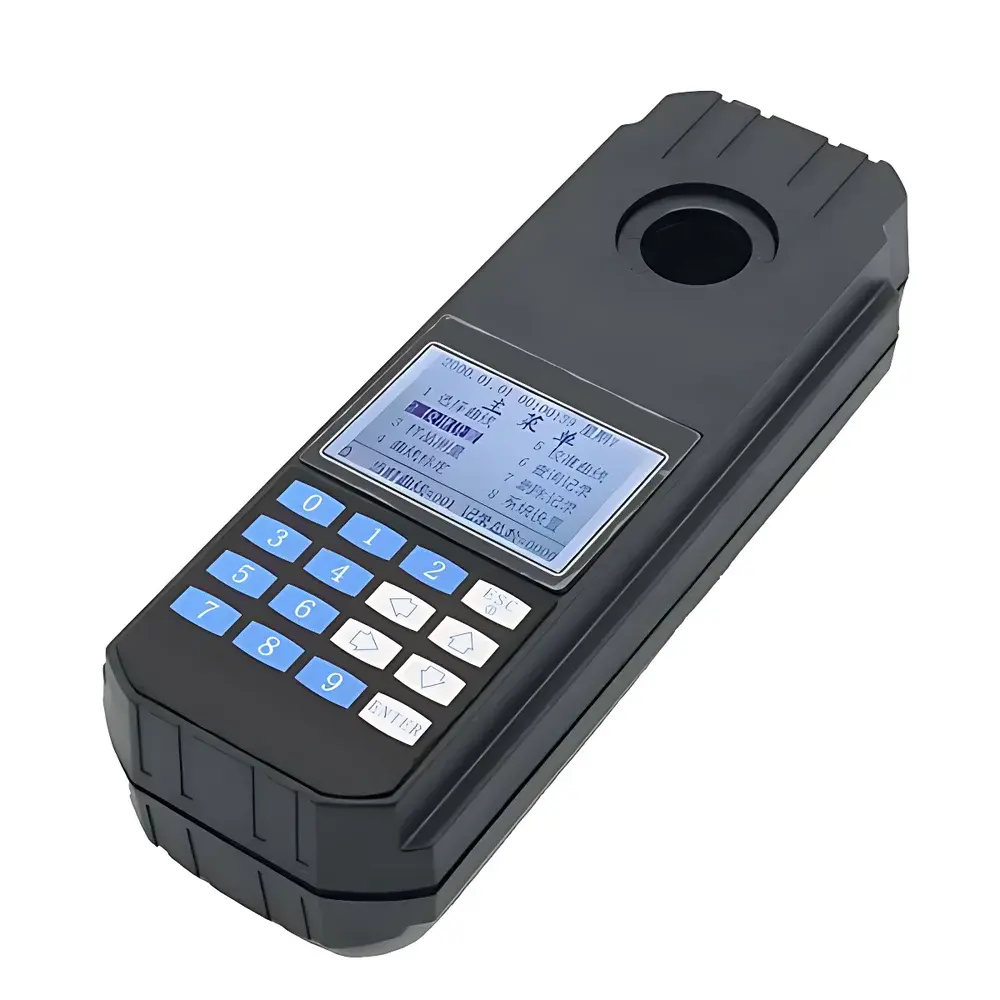
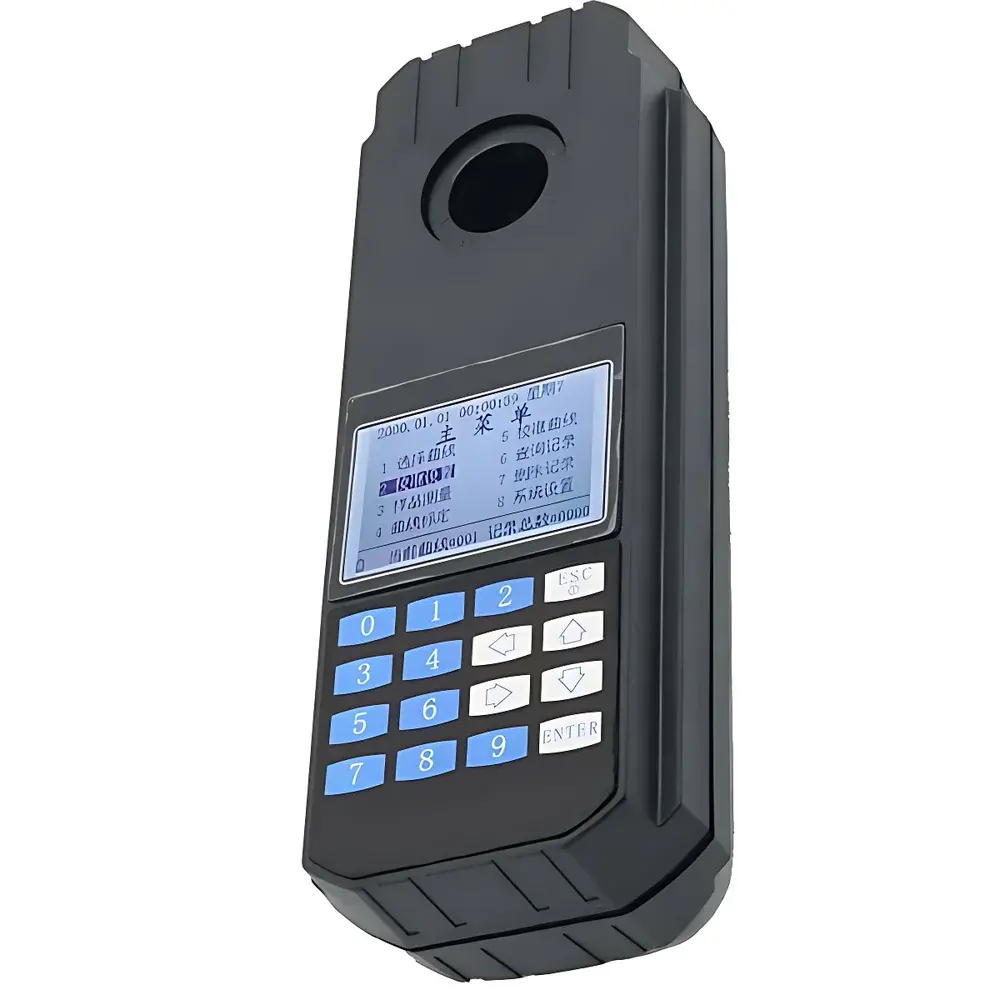
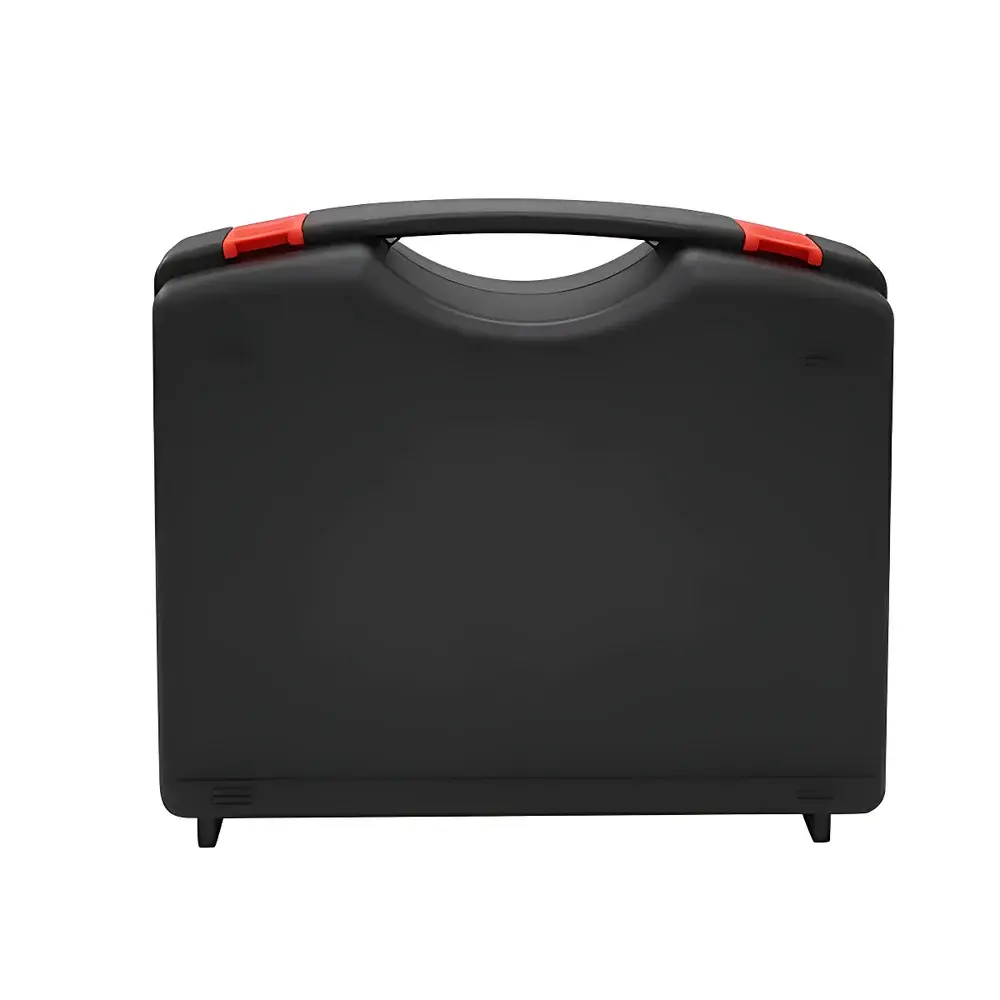
Shenchanghong PCHAG-103 Portable Silver Photometer
| Brand | Shenchanghong |
|---|---|
| Origin | Guangdong, China |
| Manufacturer Type | Direct Manufacturer |
| Country of Origin | China |
| Model | PCHAG-103 |
| Instrument Type | Portable |
| Detection Principle | Photometric Method (Visible Absorption) |
| Target Analyte | Silver (Ag⁺) in Aqueous Samples |
| Measurement Time | 20 min per sample |
| Accuracy | ±5% of Full Scale (F.S.) |
| Resolution | 0.01 mg/L |
| Measurement Range | 0.01–1.00 mg/L (dilutable for higher concentrations) |
| Repeatability | ≤3% RSD |
| Optical Stability | ≤0.002 A / 20 min |
| Display | Backlit LCD with Chinese interface |
| Data Storage | 10 calibration curves + 199 timestamped measurement records (date, time, absorbance, transmittance, concentration) |
| Dimensions (H×W×D) | 266 × 200 × 130 mm |
| Weight | 500 g |
| Power Consumption | 30 W |
| Housing Material | Corrosion-resistant ABS plastic |
| Light Source | High-brightness, long-life (100,000 h) LED with narrow-band optical filter |
Overview
The Shenchanghong PCHAG-103 Portable Silver Photometer is a field-deployable, benchtop-compatible analytical instrument engineered for quantitative determination of dissolved silver (Ag⁺) in water matrices using standardized visible-light photometry. It operates on the principle of absorbance measurement at a specific wavelength—typically within the 400–600 nm range—where silver complexes (e.g., with dithizone or 1,10-phenanthroline derivatives) exhibit characteristic chromogenic responses. The instrument integrates a stabilized LED light source, precision optical filtering, and a calibrated photodetector to deliver trace-level quantification in compliance with established colorimetric protocols referenced in ISO 8692, EPA Method 200.7 (modified for Ag), and GB/T 5750.6–2023 (Chinese Standard for Silver in Drinking Water). Designed for operation in non-laboratory environments—including wastewater outfalls, drinking water distribution points, and industrial effluent streams—the PCHAG-103 maintains metrological integrity without requiring temperature-controlled rooms or external gas supplies.
Key Features
- Stable optical architecture featuring a 100,000-hour lifetime high-intensity LED and narrow-band interference filter, minimizing spectral drift and ambient light interference.
- Backlit monochrome LCD display with full Chinese-language menu navigation—optimized for operators with varying technical fluency and field-use ergonomics.
- Onboard data management supporting storage of up to 10 user-defined calibration curves and 199 timestamped results (including date, time, absorbance, transmittance, and calculated concentration), retained after power loss.
- Robust mechanical design: injection-molded ABS housing rated for IP54-equivalent environmental resistance, suitable for humid, dusty, or chemically exposed field conditions.
- Low-power 16-bit microcontroller platform enabling consistent signal processing, real-time error diagnostics, and stable analog-to-digital conversion across battery or AC operation.
- Pre-configured method logic aligned with standard silver colorimetric reagent kits, ensuring interoperability with commercially available certified reference materials and QC standards.
Sample Compatibility & Compliance
The PCHAG-103 is validated for use with clarified, low-turbidity aqueous samples—including surface water, groundwater, potable water, treated wastewater, and process cooling water. Sample pretreatment (e.g., acid digestion, filtration through 0.45 µm membrane) may be required for complex matrices containing suspended solids, organic ligands, or interfering ions (e.g., Cu²⁺, Hg²⁺, Cl⁻). The instrument meets functional requirements outlined in ISO/IEC 17025:2017 for field-deployable testing equipment and supports GLP-aligned documentation through its embedded timestamping and non-volatile memory. While not inherently 21 CFR Part 11 compliant (lacking electronic signature and audit trail modules), its data export capability (via optional USB or RS-232 interface) permits integration into validated LIMS environments when paired with appropriate procedural controls.
Software & Data Management
All calibration, measurement, and storage functions are executed onboard without external software dependency. Calibration curves may be generated via multi-point standard addition or single-point verification using NIST-traceable silver standard solutions (e.g., 0.1, 0.5, and 1.0 mg/L Ag⁺ in 2% HNO₃ matrix). Measured values are stored with ISO 8601-formatted timestamps (YYYY-MM-DD HH:MM:SS), enabling chronological traceability for QA/QC review. Data export—when enabled via accessory cable—is delivered as plain-text CSV files compatible with Excel, LabArchives, or custom laboratory informatics systems. Firmware updates are performed via micro-USB port using manufacturer-provided utilities; no internet connection is required during routine operation.
Applications
- Regulatory monitoring of silver discharge limits in industrial effluents (e.g., photographic processing, electroplating, nanomaterial manufacturing).
- Routine surveillance of silver residual in municipal drinking water following silver-based disinfection or ion-exchange treatment.
- Field assessment of silver leaching from antimicrobial textiles, medical devices, or nano-enabled consumer products in aquatic exposure scenarios.
- Academic and environmental research involving metal speciation studies where rapid, semi-quantitative screening precedes ICP-MS confirmation.
- Emergency response deployment during suspected silver contamination events—providing actionable data within 20 minutes per sample without lab transport delays.
FAQ
What sample volume is required for analysis?
A minimum of 5 mL of filtered, acid-preserved water sample is recommended; exact volume depends on selected reagent kit protocol.
Can the PCHAG-103 measure other metals besides silver?
No—it is optically and chemically configured specifically for silver detection; separate instruments or modular upgrades are required for other analytes.
Is digestion required for total silver measurement?
Yes; for total recoverable silver, EPA Method 200.2-compliant hotplate or microwave-assisted acid digestion (HNO₃/HCl) must precede photometric analysis.
How often should calibration be verified in field use?
Calibration verification with a mid-range check standard is recommended before each sampling session and after every 10 samples—or immediately following exposure to extreme temperature/humidity shifts.
Does the device support battery operation?
The unit operates on AC power (included adapter); an optional rechargeable Li-ion battery pack is available for true cordless field deployment (up to 8 hours continuous use).
Related Products







