
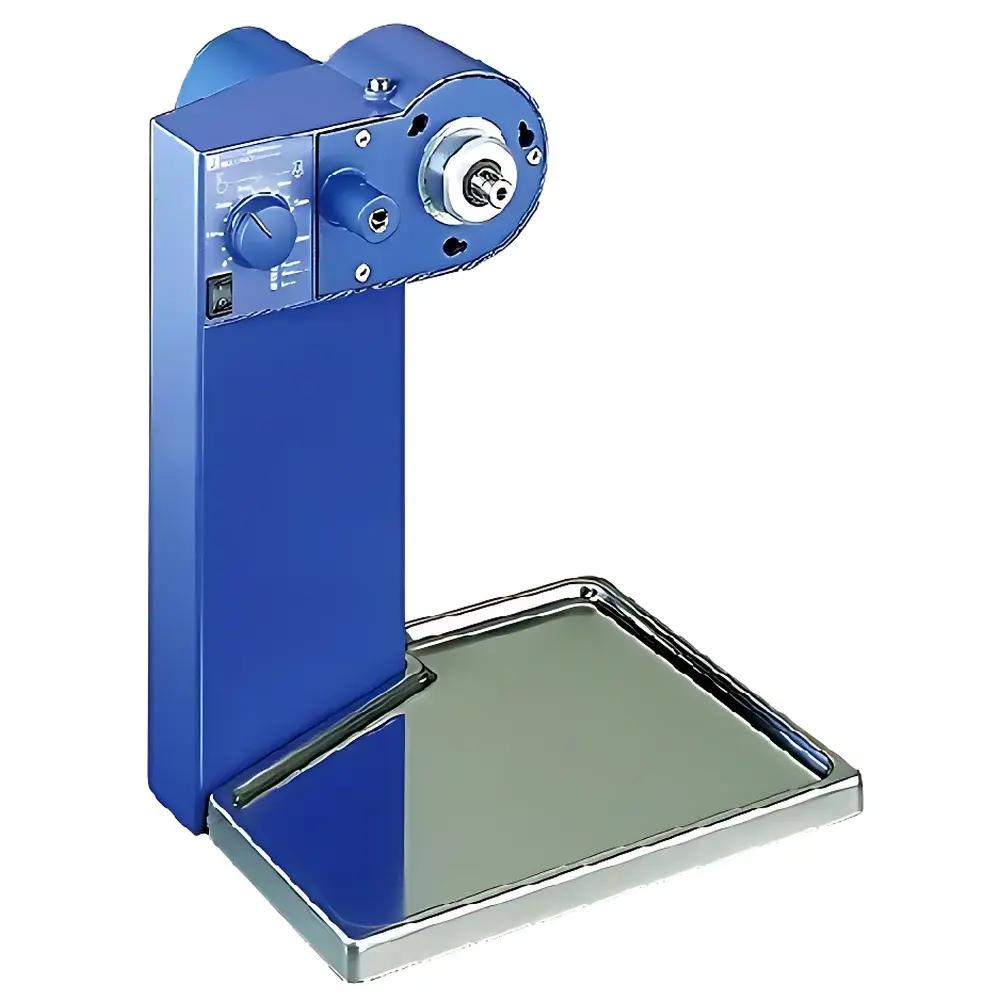
IKA MF10 Basic Grinder
| Brand | IKA |
|---|---|
| Origin | Germany |
| Model | MF10 |
| Instrument Type | Grinder |
| Sample Applicability | Hard and brittle materials |
| Output Particle Size | < 0.01 mm |
| Motor Input/Output Power | 1000 / 500 W |
| Speed Range | 3000–6500 rpm |
| Tip Linear Velocity (MF10.1 Shear Rotor) | 22.5 m/s |
| Tip Linear Velocity (MF10.2 Impact Rotor) | 31.4 m/s |
| Wetted Materials | AISI 316L stainless steel |
| Duty Cycle | 120 min ON / 30 min OFF |
| Overload Protection | Yes |
| Weight | 9.7 kg |
| Dimensions (W×D×H) | 320 × 300 × 380 mm |
| Ambient Operating Temperature | 5–40 °C |
| Relative Humidity Limit | ≤80 % RH |
| Ingress Protection Rating | IP22 |
Overview
The IKA MF10 Basic Grinder is a high-performance, benchtop laboratory grinder engineered for reproducible size reduction of hard, brittle, and fibrous solid samples. Designed in accordance with German engineering standards and manufactured under strict quality control in Staufen, Germany, the MF10 operates on the principle of high-speed mechanical comminution—utilizing either shear or impact forces depending on the installed rotor assembly. Its robust 1000 W input motor delivers up to 500 W of effective grinding power, enabling consistent throughput across diverse material classes including minerals (up to 6 Mohs hardness), construction aggregates, dried plant tissues, plastics, and paper-based substrates. The unit features a continuous-feed design with integrated sieve-based particle size control, allowing users to define final output granularity by selecting appropriate screen mesh sizes—making it suitable for preparatory sample homogenization prior to elemental analysis, XRD, SEM, or thermal characterization.
Key Features
- Two interchangeable rotor systems: MF10.1 shear rotor for fibrous and low-density materials (e.g., cellulose, herbs, polymers); MF10.2 impact rotor for hard, brittle substances (e.g., limestone, ceramics, ores)
- Stainless steel (AISI 316L) wetted parts ensure corrosion resistance, cleanability, and compliance with GLP laboratory hygiene requirements
- Variable speed control (3000–6500 rpm) enables optimization of energy input and particle morphology for each sample type
- Dual-stage safety architecture: electronic overload protection + thermal cut-off prevents motor damage during extended operation
- Modular sieve housing accepts optional replaceable screens (non-standard; ordered separately) for precise endpoint control down to <10 µm nominal output
- Benchtop footprint (320 × 300 × 380 mm) and 9.7 kg mass support stable placement on standard fume hoods or analytical workstations
Sample Compatibility & Compliance
The MF10 accommodates dry, non-volatile, non-explosive solid samples with moisture content 12.5 mm—suitable for controlled indoor laboratory environments per ISO 14644-1 Class 8 cleanroom ambient conditions.
Software & Data Management
The MF10 Basic model operates via analog speed dial and mechanical ON/OFF switch—intentionally omitting digital interfaces to maximize operational simplicity, reliability, and service longevity. No embedded firmware or data logging capability is included, aligning with ISO/IEC 17025:2017 Clause 7.7.1 requirements for manual instruments where traceability is maintained through procedural documentation rather than electronic audit trails. Users are expected to record operating parameters (speed, duration, rotor type, sieve size) manually in lab notebooks or LIMS-integrated SOP templates. Optional external tachometers or vibration sensors may be deployed for periodic performance verification per internal calibration schedules.
Applications
- Preparation of homogeneous powders for X-ray fluorescence (XRF) and inductively coupled plasma (ICP-OES/MS) analysis
- Routine size reduction of geological core fragments and ceramic sintered bodies prior to SEM-EDS mapping
- Homogenization of botanical matrices for phytochemical extraction validation studies
- Particle size standardization of reference materials used in sieve calibration protocols (ISO 9276-1)
- Feedstock conditioning for hot-press sintering and cold isostatic pressing (CIP) workflows
- QC grinding of polymer granules before melt flow index (MFI) testing per ASTM D1238
FAQ
Is the MF10 suitable for cryogenic grinding?
No. The MF10 is designed exclusively for ambient-temperature operation. Cryogenic applications require specialized liquid nitrogen–cooled mills compliant with EN 13463-1 for explosive atmospheres.
Can the MF10 process wet or oily samples?
No. It is strictly intended for dry, free-flowing solids. Moisture or oil content above 15 % may cause clogging, rotor imbalance, or electrical hazards.
Are sieve meshes supplied with the base unit?
No. All sieve inserts—including 0.25 mm, 0.5 mm, 1.0 mm, and custom perforated plates—are optional accessories requiring separate ordering (e.g., IKA order codes MF-SIEVE-025, MF-SIEVE-050).
What maintenance intervals are recommended?
Rotor balancing verification every 200 operating hours; full inspection of bearing preload and drive belt tension annually or after 1000 cycles—per IKA Service Manual SM-MF10 Rev. 3.2.
Does the MF10 meet USP <429> requirements for particle size distribution instrumentation?
No. As a mechanical grinder—not a particle size analyzer—the MF10 supports sample preparation for USP <429> methods but does not perform measurement or reporting functions defined therein.



