
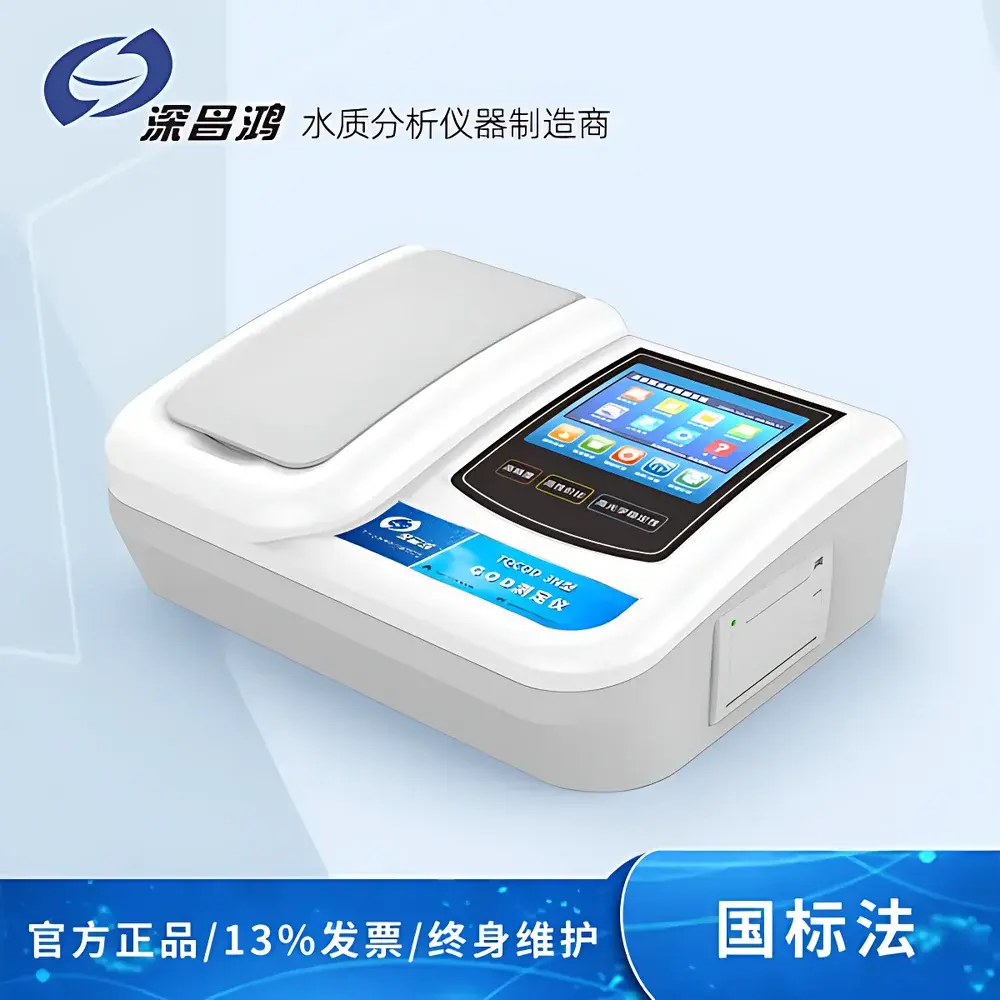
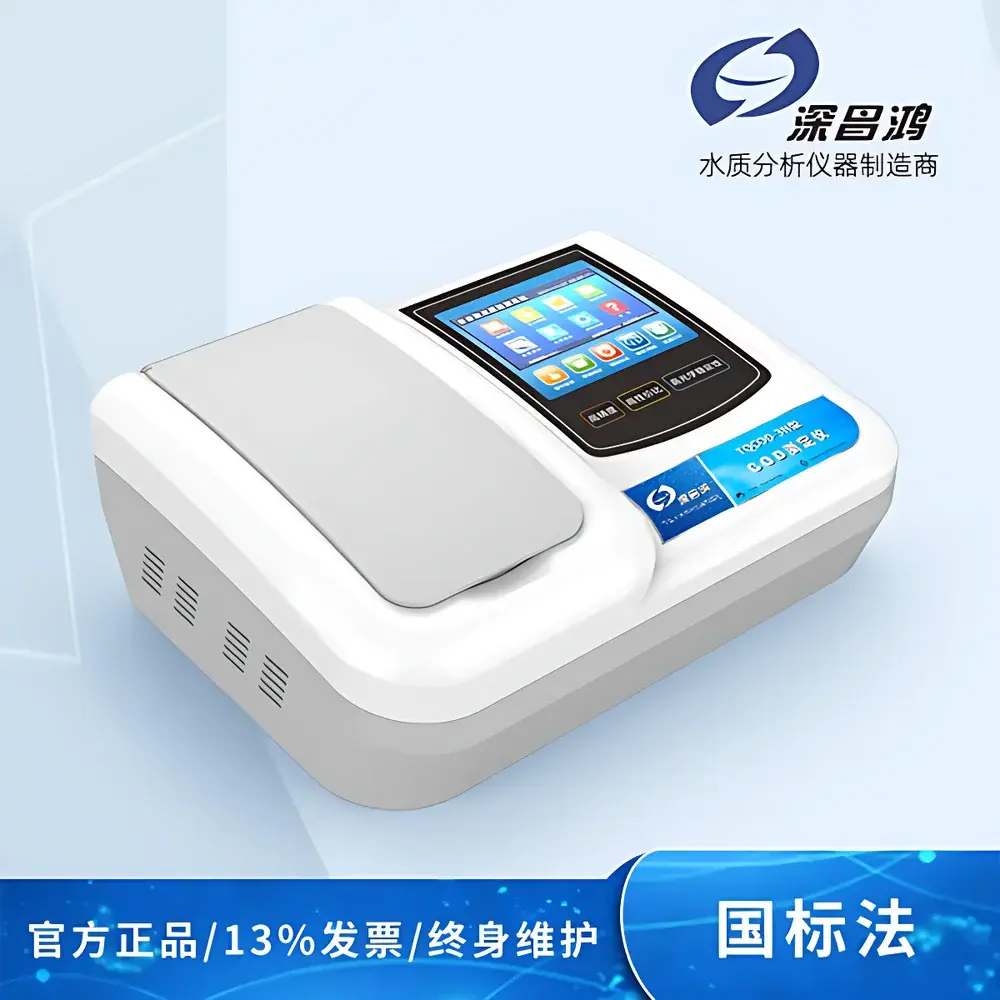
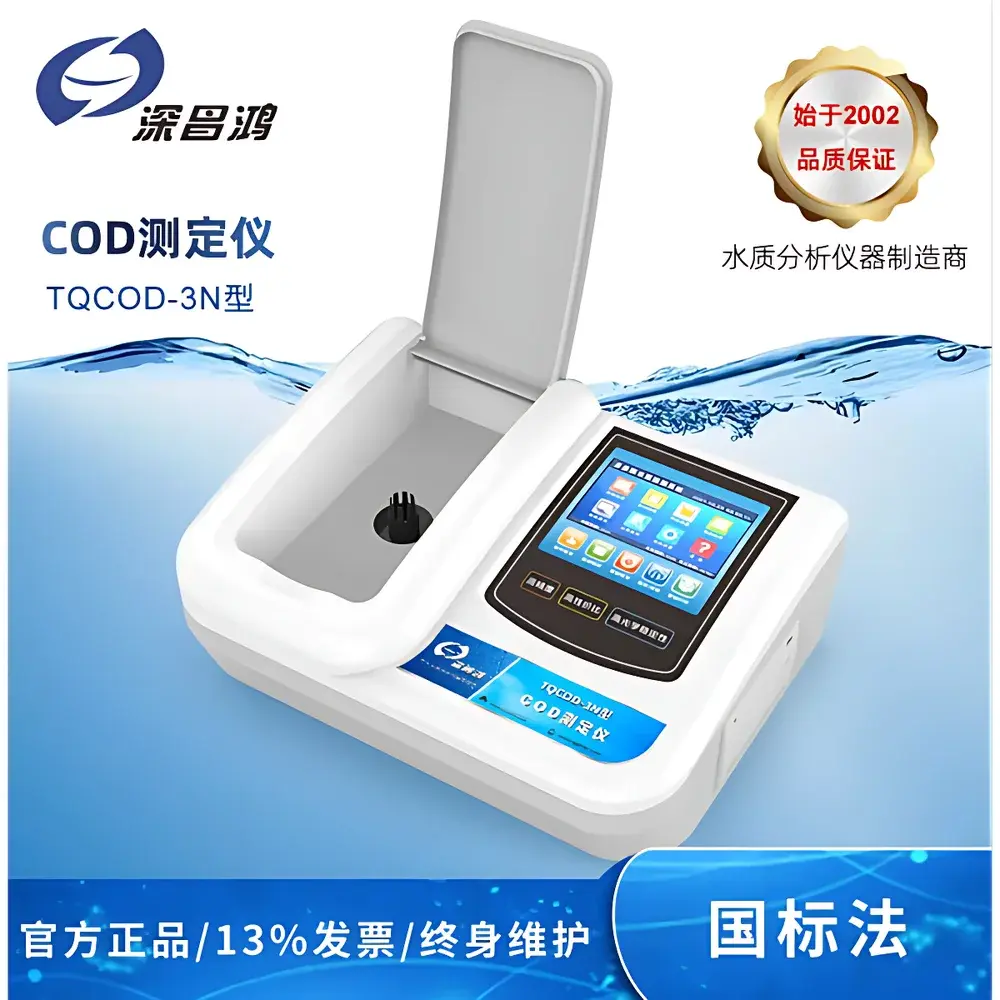
Shenchanghong TQCOD-3N Chemical Oxygen Demand (COD) Analyzer
| Brand | Shenchanghong |
|---|---|
| Origin | Guangdong, China |
| Manufacturer Type | Direct Manufacturer |
| Instrument Type | Laboratory Benchtop Analyzer |
| Model | TQCOD-3N |
| Measurement Principle | Sealed Catalytic Digestion + Spectrophotometric Detection at 610 ± 20 nm |
| Measurement Range | 5–2000 mg/L (extendable to 20,000 mg/L) |
| Accuracy | ≤ ±5% |
| Repeatability | ≤ ±3% |
| Detection Limit | 0.1 mg/L |
| Digestion Temperature | 165 °C |
| Digestion Time | 15 min |
| Temperature Control Range | Ambient to 200 °C |
| Chloride Interference Tolerance | ≤ 2000 mg/L |
| Optical Stability | ≤ 0.002 A / 20 min |
| Batch Capacity | 16 samples (optional 20/25/36-tube configurations) |
| Display | Color TFT Touchscreen with English & Chinese UI |
| Data Storage | Up to 100,000 records (including timestamp, operator ID, concentration, unit, method ID) |
| Connectivity | USB interface for PC data export |
| Power Protection | Dual-stage thermal cutoff (auto-shutdown at >200 °C) |
| Calibration | Multi-point non-linear temperature compensation |
| Reporting | On-device printing & software-assisted report generation |
Overview
The Shenchanghong TQCOD-3N Chemical Oxygen Demand (COD) Analyzer is a dedicated laboratory instrument engineered for precise, traceable, and compliant measurement of chemical oxygen demand in aqueous samples—primarily wastewater, surface water, industrial effluents, and treated discharge streams. It operates on the internationally recognized sealed catalytic digestion method (aligned with ISO 6060 and APHA Standard Methods 5220 D), followed by spectrophotometric quantification at 610 ± 20 nm using narrow-band interference filters and a stable cold light source. Unlike open-reflux or titrimetric methods, the sealed digestion approach minimizes reagent consumption, reduces operator exposure to hazardous chemicals (e.g., concentrated sulfuric acid and potassium dichromate), and improves inter-laboratory reproducibility. The system separates optical detection and thermal digestion functions—ensuring long-term photometric stability and eliminating thermal drift in absorbance readings. Designed for routine QC/QA workflows in environmental testing labs, municipal water authorities, and academic research facilities, the TQCOD-3N meets core functional requirements for GLP-compliant data integrity, including audit-trail-capable calibration logging, operator identification, and time-stamped result storage.
Key Features
- Optically isolated dual-unit architecture: Independent spectrophotometer and digestion block prevent thermal cross-interference and preserve baseline stability over extended operation.
- Cold LED light source with 16-step intensity adjustment enables dynamic range optimization—critical for accurate low-concentration (0.1–50 mg/L) and high-range (1000–20,000 mg/L) measurements without manual filter switching.
- Color TFT touchscreen with bilingual (English/Chinese) GUI, context-sensitive help prompts, and guided workflow navigation—reducing operator training time and minimizing procedural errors.
- Advanced calibration management: Stores full calibration metadata—including standard reference values, measured absorbances, calibration date/time, and operator ID—for full traceability and method verification per ISO/IEC 17025 Clause 7.7.
- Dual-layer thermal safety: Precision Pt100 sensor with multi-point non-linear compensation ensures ±0.5 °C accuracy across 165–200 °C; hardware-level overtemperature cutoff triggers automatic power disconnection above 200 °C.
- Extensive curve library support: 250 preloaded EPA- and ISO-aligned calibration curves plus capacity for 3500 user-defined curves—with individual curve validation, versioning, and archival capability.
- Robust data governance: 100,000-result local database with searchable fields (parameter name, concentration, unit, timestamp, operator ID, method ID); supports CSV export via USB and optional PC-based data review software.
Sample Compatibility & Compliance
The TQCOD-3N accommodates standard 16 mm OD borosilicate glass digestion tubes (10 included; optional 20/25/36-tube blocks available). It is validated for use with chromium-based COD reagents meeting ASTM D1252–12 (Method B) specifications and compatible with chloride masking agents (e.g., HgSO₄ or AgNO₃-based formulations) to suppress interference up to 2000 mg/L Cl⁻. While not certified to CE or UKCA, its operational parameters align with key regulatory frameworks governing environmental testing: ISO 6060 (water quality—determination of COD), APHA Standard Methods 5220 D (closed reflux, colorimetric), and China’s HJ/T 399–2007. All stored calibration and measurement records include mandatory GLP-relevant metadata, enabling retrospective audit readiness for internal QA reviews or external accreditation assessments (e.g., CNAS, ILAC-MRA signatory labs).
Software & Data Management
Data acquisition and reporting are supported via bundled Windows-compatible software (supplied on CD-ROM), which imports raw .CSV files exported through the USB interface. The software enables batch report generation (PDF/Excel), trend analysis across time-series datasets, and method-specific QC charting (e.g., control charts for duplicate precision, spike recovery tracking). Each measurement record contains immutable timestamps, operator authentication codes, and full calibration history linkage—satisfying documentation requirements under ISO/IEC 17025 Clause 7.8 and supporting FDA 21 CFR Part 11 compliance when deployed with institutional electronic signature policies. No cloud connectivity or remote access functionality is implemented—ensuring data sovereignty and alignment with air-gapped lab network security protocols.
Applications
- Regulatory wastewater monitoring per national discharge permits (e.g., China’s GB 8978–1996, EU Urban Wastewater Treatment Directive).
- Influent/effluent characterization in municipal and industrial WWTPs for process control and compliance reporting.
- Research-scale evaluation of advanced oxidation processes (AOPs), biodegradability assays, and inhibitor toxicity screening.
- Teaching laboratories for undergraduate environmental chemistry courses requiring hands-on COD methodology training.
- Third-party testing labs performing accredited environmental analyses under CNAS or equivalent schemes.
FAQ
What digestion method does the TQCOD-3N use, and how does it compare to open-reflux protocols?
It employs sealed-tube catalytic digestion at 165 °C for 15 minutes, conforming to ISO 6060 and APHA 5220 D. This eliminates volatile loss, reduces acid usage by ~40%, and improves repeatability versus open-reflux systems.
Can the instrument be used for samples with high chloride content?
Yes—when paired with appropriate chloride-masking reagents (e.g., mercury sulfate), it tolerates up to 2000 mg/L Cl⁻ without significant positive bias.
Is method validation documentation provided with the instrument?
Factory calibration certificates and performance verification reports (accuracy, repeatability, linearity) are supplied; users must perform initial method verification per their SOPs prior to routine use.
Does the system support LIMS integration?
Direct LIMS interfacing is not built-in, but structured CSV exports enable manual or scripted ingestion into most LIMS platforms via flat-file import modules.
What maintenance is required for long-term optical stability?
Annual verification of photometric accuracy using NIST-traceable neutral density filters is recommended; no user-serviceable optical alignment is required due to solid-state LED and fixed-pathlength design.







