
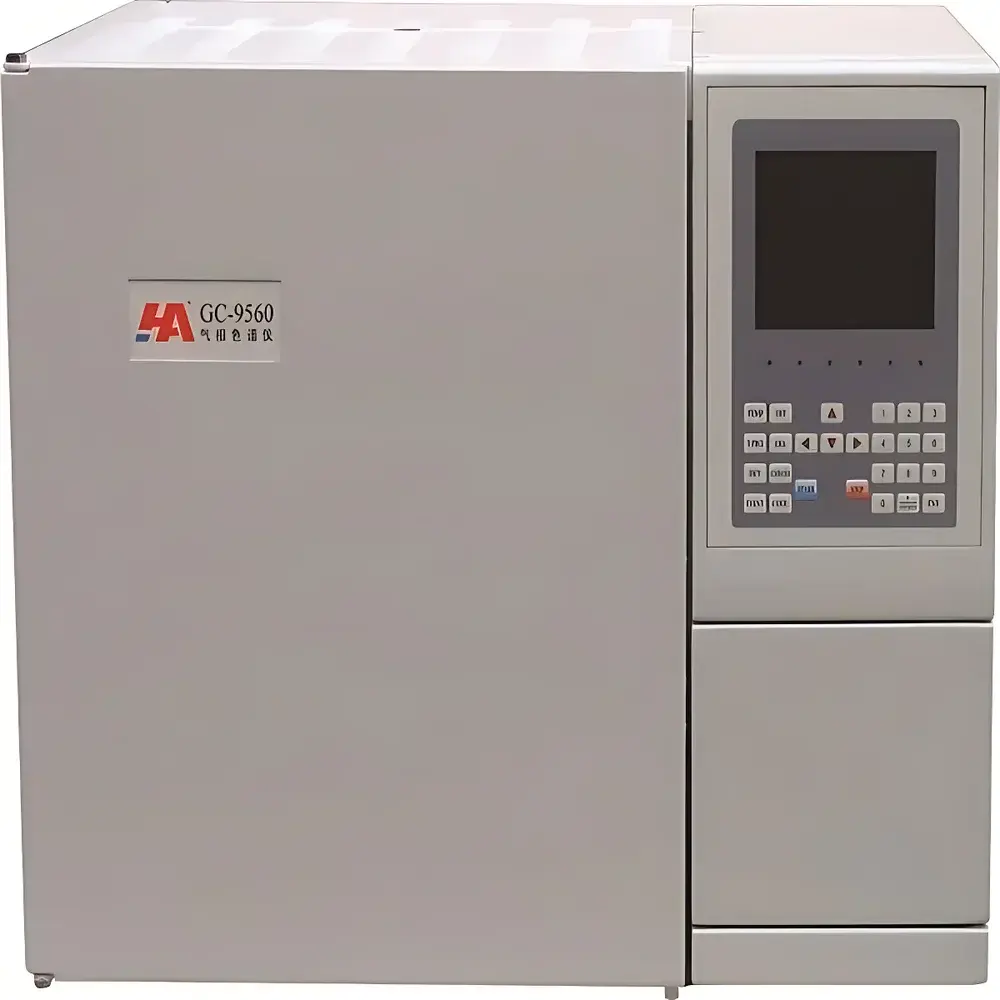
Huai Ai GC-9560-HD Dissolved Gas Analysis (DGA) Gas Chromatograph for Transformer Oil
| Brand | Huai Ai |
|---|---|
| Origin | Shanghai, China |
| Manufacturer Type | Original Equipment Manufacturer (OEM) |
| Regional Classification | Domestic (PRC) |
| Model | GC-9560-HD DGA System |
| Instrument Type | Laboratory Gas Chromatograph |
| Application Domain | Power Industry–Specific |
| Temperature Control Range | Ambient +8 °C to 399 °C |
| Maximum Ramp Rate | 40 °C/min |
| Column Oven Cooling Time | <5 min |
| Carrier Gas Flow Range & Control | 0–500 mL/min |
| Carrier Gas Pressure Range & Control | 0–0.4 MPa |
| Injector Max Operating Temperature | 399 °C |
| Injector Pressure Setpoint Range | 0–0.4 MPa |
| Injector Total Flow Setpoint Range | 0–500 mL/min |
| Detection Limits (as per DL/T 703–1999) | H₂ <2 µL/L, O₂ <5 µL/L, N₂ <5 µL/L, CO <2 µL/L, CO₂ <2 µL/L, Hydrocarbons <0.1 µL/L |
| Temperature Stability | ±0.1 °C across all zones (oven, injector, detectors, methanizer) |
| Detectors | Dual-channel TCD and FID with Ni-catalyst methanizer |
| Column Configuration | Parallel dual-column gas separation path |
Overview
The Huai Ai GC-9560-HD is a purpose-built dissolved gas analysis (DGA) gas chromatograph engineered exclusively for quantitative determination of key fault gases in transformer insulating oil. Designed in strict compliance with DL/T 703–1999 (“Gas Chromatographic Method for Determination of Dissolved Gases in Insulating Oil”), this system implements a validated parallel dual-column separation architecture coupled with orthogonal detection—thermal conductivity detection (TCD) for permanent gases (H₂, O₂, N₂) and flame ionization detection (FID), enhanced by an integrated nickel-catalyzed methanizer, for quantification of CO, CO₂, and hydrocarbon species (CH₄, C₂H₂, C₂H₄, C₂H₆). Its analytical workflow eliminates reliance on vacuum-based or CO₂-stripping methodologies (e.g., DL/T 423–91 and DL/T 450–91), offering superior reproducibility, reduced operator dependency, and full traceability under power industry QA/QC frameworks.
Key Features
- Dual-detector configuration: High-sensitivity TCD (≥2500 mV·mL/mg, n-hexadecane) and FID (detection limit ≤8×10⁻¹² g/s, n-hexadecane), both temperature-stabilized to ±0.1 °C
- Ni-catalyst methanizer operating up to 399 °C, enabling complete CO/CO₂ conversion to methane prior to FID detection
- Parallel dual-column gas separation path optimized for simultaneous resolution of H₂, O₂, N₂, CO, CO₂, and light hydrocarbons in a single injection
- Microprocessor-controlled oven with rapid thermal ramping (up to 40 °C/min) and accelerated cooling (<5 min from 350 °C to ambient)
- Integrated digital interface supporting full bidirectional communication: real-time parameter control, spectral acquisition, and event-driven sequencing via PC-based software
- Redundant safety architecture: dual overtemperature protection for column oven; automatic shutdown upon deviation beyond user-defined thresholds
- Intuitive LCD interface with touch-sensitive keypad, supporting ten customizable method storage slots and built-in diagnostics
Sample Compatibility & Compliance
The GC-9560-HD is validated for use with mineral-based, synthetic ester, and silicone insulating oils conforming to IEC 60296, ASTM D877, and GB/T 7595. It meets the analytical performance criteria stipulated in DL/T 703–1999—including detection limits, linearity (FID ≥10⁶, TCD ≥10⁴), baseline stability (TCD noise ≤20 μV, drift ≤100 μV/30 min; FID noise ≤2×10⁻¹³ A, drift ≤2×10⁻¹² A/30 min), and thermal precision (±0.1 °C). The system supports GLP-compliant operation through audit-trail-enabled software, electronic signature capability, and data integrity safeguards aligned with FDA 21 CFR Part 11 principles. All hardware components—including carrier gas regulation, pressure/flow controllers, and detector electronics—are calibrated traceable to national standards (CNAS-accredited procedures).
Software & Data Management
The GC-9560-HD operates with proprietary chromatography data system (CDS) software designed for power utility laboratories. It provides ISO/IEC 17025-aligned reporting templates for DGA interpretation per IEEE C57.104 and IEC 60599 guidelines. Key software capabilities include: real-time spectral visualization with peak integration using valley-to-valley and tangent skim algorithms; automated calibration curve generation with quadratic weighting; configurable sequence queues for unattended multi-sample runs; export of raw data (.CDF), processed reports (.PDF/.XLSX), and metadata in XML format; and optional Ethernet (10/100 Mbps) connectivity for centralized instrument management across SCADA-integrated substations or regional diagnostic centers. Audit logs record all parameter modifications, calibration events, and user logins with timestamps and operator IDs.
Applications
This instrument serves as a primary diagnostic tool in substation maintenance, transformer manufacturing QA, and third-party oil testing laboratories. Typical applications include: routine dissolved gas monitoring for early detection of thermal faults (e.g., hotspot formation >700 °C), partial discharge activity, arcing, and cellulose degradation; trending analysis of gas evolution rates (e.g., C₂H₂ accumulation indicating severe electrical stress); verification of oil reconditioning efficacy post-vacuum dehydration; and forensic root-cause analysis following equipment failure. Its robustness enables deployment in mobile labs, on-site containerized testing units, and fixed high-throughput environments meeting annual sample volumes exceeding 5,000 analyses.
FAQ
What standards does the GC-9560-HD comply with for transformer oil DGA?
It is fully compliant with DL/T 703–1999, and its performance aligns with IEC 60599, IEEE C57.104, and ASTM D3612 Class B requirements.
Can the system quantify all five key fault gases without sample pre-treatment?
Yes—using the dual-column parallel flow path and Ni-methanizer, it delivers simultaneous quantification of H₂, O₂, N₂, CO, and CO₂ in a single 12-minute run, with no offline derivatization or vacuum degassing.
Is remote monitoring and control supported?
Yes—via optional 10/100 Mbps Ethernet interface, enabling secure web-based access for instrument status, method upload, and real-time chromatogram viewing from any authorized workstation.
How is data integrity ensured for regulatory audits?
The CDS enforces 21 CFR Part 11–compatible controls: role-based access, electronic signatures, immutable audit trails, and encrypted database storage with daily backup scheduling.
What maintenance intervals are recommended for sustained accuracy?
Carrier gas filters require replacement every 6 months; TCD filaments and FID jets should be inspected quarterly; Ni-methanizer catalyst activity is verified semiannually via CO/CO₂ recovery tests per DL/T 703–1999 Annex B.
Related Products





