
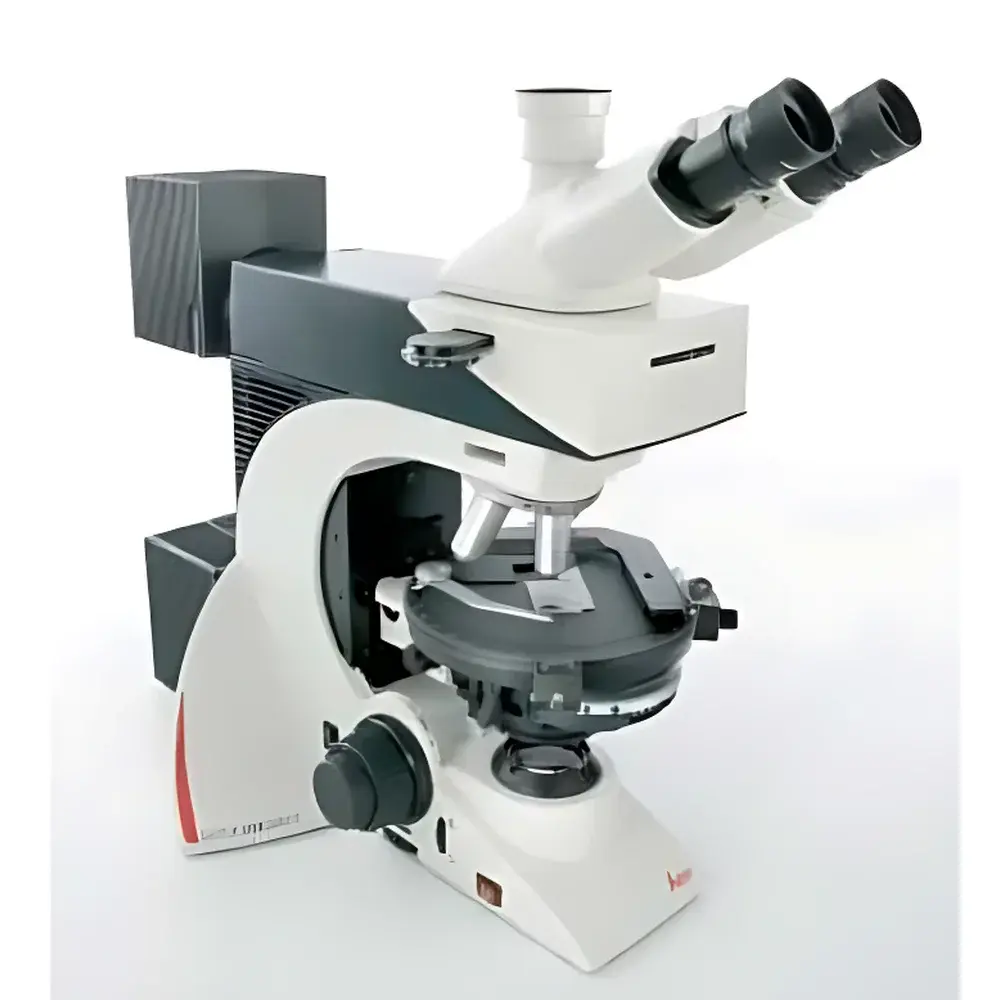
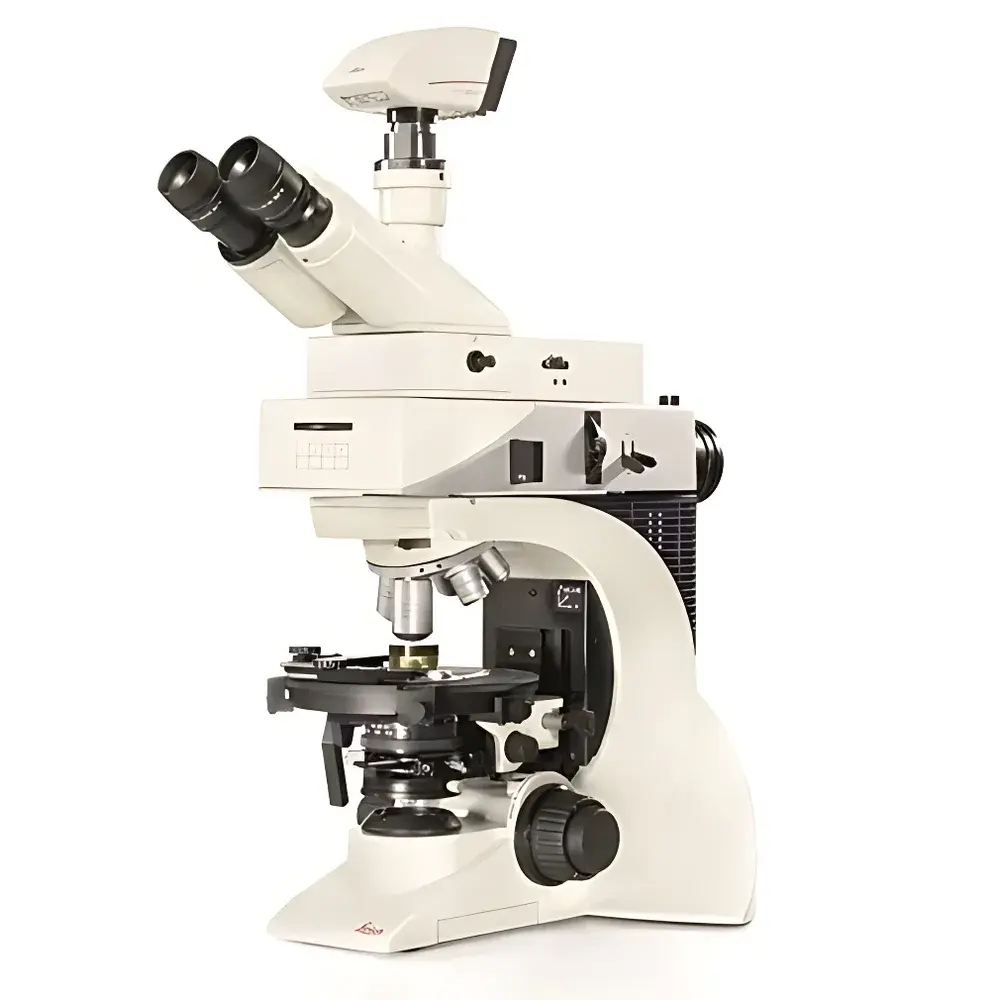
Leica DM2700 P Polarizing Microscope
| Brand | Leica |
|---|---|
| Origin | Germany |
| Model | DM2700 P |
| Illumination | Integrated LED (transmitted & reflected) |
| Field of View | 25 mm |
| Rotating Stage | 360° precision polarizing stage with optional 45° click stops |
| Objective Turret | 5-position, encoded, stress-free optics compatible |
| Observation Modes | Transmitted light — brightfield, darkfield, polarized, interference, conoscopy |
| Accessories Support | Motorized stage interface, heating/cooling stages, cathodoluminescence units, photometers, fluorescence modules, digital cameras (C-mount), analysis software integration |
| Compliance | Designed for ISO 9001 manufacturing |
Overview
The Leica DM2700 P is a research-grade upright polarizing microscope engineered for quantitative birefringence analysis and crystallographic characterization across geoscience, materials science, pharmaceutical development, and polymer engineering. Built upon Leica’s long-standing heritage in stress-free optical design, the DM2700 P employs a fully corrected, strain-free optical path optimized for interference contrast and conoscopy—enabling precise determination of optical axis orientation, retardation magnitude, sign of elongation, and extinction angles. Its modular architecture supports both transmitted-light (TL) and reflected-light (RL) observation paths within a single instrument platform, making it suitable for heterogeneous samples ranging from thin-sectioned geological specimens to opaque metallurgical alloys and anisotropic polymer films. The system features a rigid, thermally stable stand with minimal mechanical drift, ensuring measurement repeatability over extended acquisition sessions.
Key Features
- 25 mm field-of-view optical path with Plan Fluotar and EC Opto-Fluor objective series compatibility—ensuring flatness, chromatic correction, and high numerical aperture performance across magnifications from 2.5× to 100×.
- 5-position encoded objective turret with automatic magnification recognition—enabling seamless correlation between image metadata and objective-specific calibration parameters in Leica LAS X software.
- 360° continuously rotating, low-backlash polarizing stage with optional 45° detent positions—facilitating accurate angular alignment relative to vibration direction or crystallographic axes.
- Dual-path LED illumination: independently controllable, color-stable (4500 K) LEDs for both transmitted and reflected light—eliminating thermal drift, reducing power consumption by >70% vs. halogen, and extending service life to 72,000 hours.
- Integrated Bertrand lens (conoscopic module) and removable λ/4 and λ plates compliant with DIN 58879—supporting quantitative retardation measurement, sign determination, and uniaxial/biaxial symmetry analysis.
- Stress-free optical train including strain-free condensers, analyzers, polarizers, and compensation wedges—guaranteeing that observed birefringence originates solely from the specimen, not system artifacts.
Sample Compatibility & Compliance
The DM2700 P accommodates standard 26 mm × 48 mm rock thin sections, 1″–2″ semiconductor wafers, polymer films up to 2 mm thick, pharmaceutical tablet cross-sections, and ceramic fracture surfaces. Its dual-path illumination enables simultaneous evaluation of surface topography (via RL polarized contrast) and bulk anisotropy (via TL conoscopy). All optical components are manufactured under ISO 9001-certified processes and conform to DIN 58879 specifications for polarization accuracy (±0.2° angular tolerance, ≤0.5 nm retardation error). When configured with Leica LAS X software and time-stamped hardware logging, the system meets FDA 21 CFR Part 11 requirements for electronic records and signatures—making it suitable for regulated QC environments in pharma and medical device manufacturing.
Software & Data Management
Leica LAS X software provides full control of illumination intensity, objective selection, stage positioning, and image capture—including synchronized multi-channel acquisition for comparative polarized/unpolarized imaging. The platform supports automated retardation mapping using calibrated compensators, real-time birefringence quantification (in nm), and export of measurement data to CSV or HDF5 formats for statistical process control (SPC) integration. Audit trail functionality logs all user actions, parameter changes, and calibration events with timestamps and operator IDs—ensuring traceability required under GLP and GMP frameworks. Third-party API access allows integration with LIMS and ELN systems via RESTful endpoints.
Applications
- Geosciences: Identification of mineral assemblages, determination of optic sign and axial angle in silicates and carbonates, strain analysis in deformed rocks.
- Materials Science: Characterization of liquid crystal domains, stress-induced birefringence in injection-molded plastics, phase distribution in composites and ceramics.
- Pharmaceuticals: Polymorph screening of active pharmaceutical ingredients (APIs), crystallinity assessment in amorphous solid dispersions, tablet coating uniformity analysis.
- Electronics: Detection of residual stress in sapphire substrates, grain boundary analysis in polycrystalline silicon, delamination assessment in multilayer packaging films.
- Forensics & Quality Control: Fiber identification (e.g., nylon vs. polyester via interference color grading), adhesive curing state evaluation, contaminant particle classification.
FAQ
Does the DM2700 P support both transmitted and reflected polarized light observation?
Yes—the instrument integrates independent LED-based illumination paths for both transmission and reflection modes, each configurable for brightfield, polarized, and interference contrast.
Can I perform quantitative birefringence measurements without external accessories?
Yes—built-in Bertrand lens and DIN-compliant compensator slots enable direct retardation measurement down to ±1 nm resolution when used with calibrated objectives and software-assisted analysis.
Is the stage motorized or manually operated?
The standard configuration includes a precision manual 360° rotating stage; motorized XY and Z stages are available as optional upgrades with programmable positioning and coordinate mapping.
What software is required for image analysis and reporting?
Leica LAS X is the native platform; it supports automated measurement workflows, report generation with embedded calibration certificates, and export to industry-standard data formats for regulatory submission.
Are stress-free objectives included with the base system?
The DM2700 P ships with a full set of Leica EC Opto-Fluor polarizing objectives (2.5×, 5×, 10×, 20×, 50×, 100× oil), all certified for zero intrinsic birefringence per DIN 58879.




