
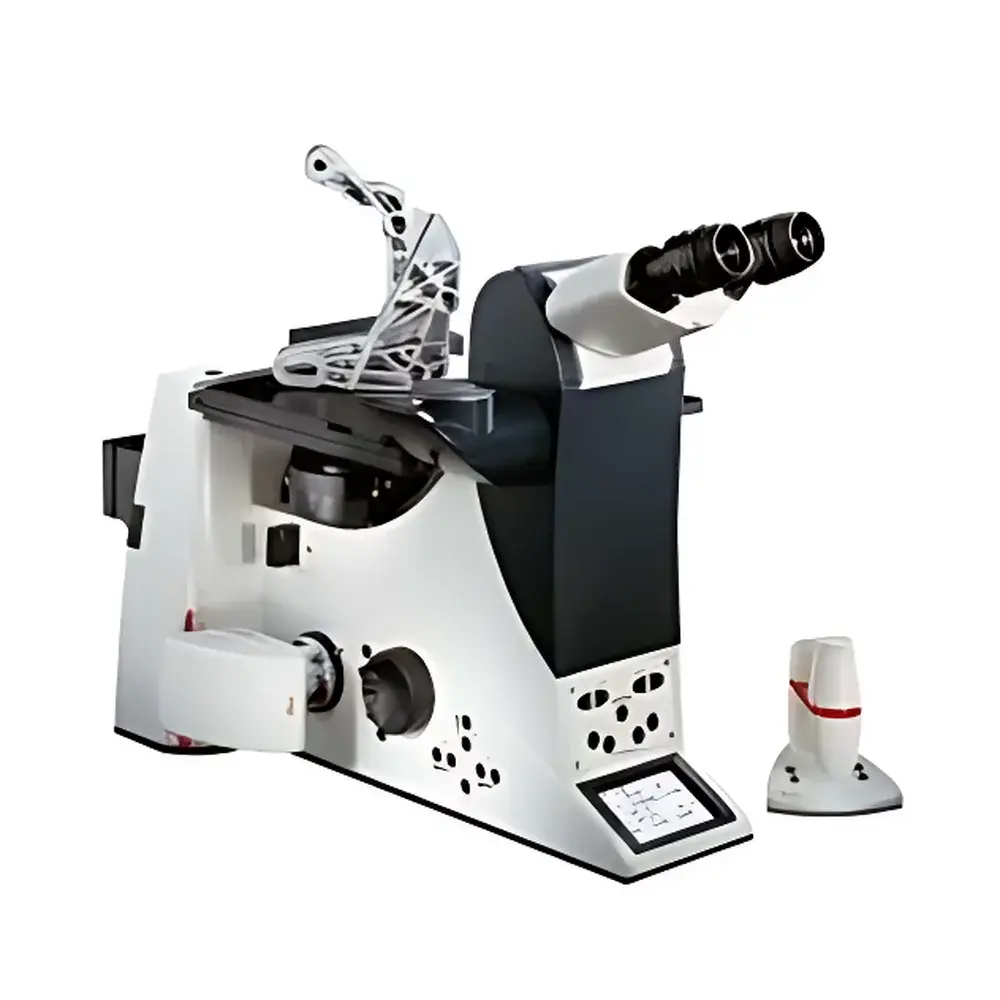
Leica DMI5000 M Inverted Research Microscope
| Brand | Leica |
|---|---|
| Origin | Germany |
| Model | DMI5000 M |
| Type | Inverted Metallurgical Microscope |
| Automation Level | Fully Motorized (Configurable) |
| Software Platform | Leica Application Suite (LAS) |
| Compliance | CE, ISO 9001, EN 61000-6-3/6-4 |
| Upgradability | Field-upgradable DIC, motorized stages, fluorescence modules, and materials analysis packages |
| Contrast Management | Integrated Contrast Manager (DIC, Phase Contrast, Brightfield, Polarization) |
| Illumination Control | Motorized Illumination Manager (field diaphragm, aperture diaphragm, intensity) |
| Focus Consistency | Parfocal Manager (≤ ±0.01 mm parfocal error across objectives) |
| User Interface | LAS-based GUI with macro scripting, audit trail (21 CFR Part 11 compliant optional), GLP/GMP reporting templates |
Overview
The Leica DMI5000 M is a high-precision inverted research microscope engineered for demanding metallurgical, materials science, and industrial quality assurance applications. Designed around a rigid, thermally stable inverted optical architecture, it positions the objective lenses beneath the specimen stage—enabling unobstructed access to large, heavy, or temperature-controlled samples such as castings, weldments, semiconductor wafers, and in-situ test rigs. Its optical path adheres to Leica’s HCX (High Contrast X) apochromatic design principles, delivering diffraction-limited resolution, exceptional flatness of field (≥95% flatness across FOV), and chromatic aberration correction from 350–1100 nm. The system operates on a modular platform: base configurations include manual focus and stage control, while fully motorized variants integrate synchronized Z-drive, XY-stage, filter turrets, and illumination units—all coordinated via the Leica Application Suite (LAS) software environment. This architecture supports both routine inspection and advanced quantitative microstructural analysis under standardized testing conditions.
Key Features
- Contrast Manager: A mechanically synchronized turret that inserts all required components (polarizers, Wollaston prisms, phase rings, analyzers) into the optical path in <1 second—ensuring repeatable, user-independent contrast mode transitions between DIC, polarized light, brightfield, and differential interference contrast.
- Illumination Manager: A motorized Köhler illumination system that dynamically adjusts lamp intensity, field diaphragm, and aperture diaphragm in real time during magnification changes—maintaining optimal signal-to-noise ratio and consistent photometric calibration without manual intervention.
- Parfocal Manager: Precision-machined objective nosepiece and stage drive ensure ≤±0.01 mm axial deviation across the full magnification range (5× to 100×), critical for automated image stitching, focus mapping, and metrology workflows requiring sub-micron repeatability.
- Modular Expandability: Supports field upgrades including motorized DIC sliders, encoded stage position feedback, fluorescence excitation modules (with LED or mercury lamp options), and integration with third-party EDS or EBSD detectors via standardized mechanical and electrical interfaces (ISO 80369-3 mounting, TTL trigger I/O).
- Ergonomic & Multi-User Design: Dual ergonomic viewing tubes with adjustable interpupillary distance and diopter compensation; LAS software profiles store instrument state per user—including exposure time, white balance, camera gain, and annotation presets—to ensure procedural consistency across QA shifts or R&D teams.
Sample Compatibility & Compliance
The DMI5000 M accommodates specimens up to 200 mm in diameter and 120 mm in height, with load capacity exceeding 5 kg—making it suitable for bulk metallographic mounts, heat-treated coupons, coated substrates, and electrochemical cells. Stage accessories include precision translation holders, tilting platforms (±10°), and heated/cryogenic stages (−20°C to +200°C). All optical and mechanical subsystems comply with EN 61000-6-3 (EMC emissions) and EN 61000-6-4 (industrial immunity), and the platform meets ISO 9001 requirements for traceable calibration documentation. Optional LAS modules support 21 CFR Part 11 compliance (electronic signatures, audit trails, role-based access control) and generate GLP/GMP-compliant reports aligned with ASTM E3, ISO 643, and USP particulate matter standards.
Software & Data Management
Leica Application Suite (LAS) serves as the central control and analysis hub. LAS v4.x provides hardware abstraction layers for seamless integration of cameras (up to 20 MP monochrome/RGB), motorized peripherals, and analytical modules such as grain size quantification (ASTM E112), inclusion rating (ISO 4967), phase fraction analysis, and line profile intensity profiling. Raw image data is stored in TIFF or proprietary LIF format with embedded metadata (objective ID, magnification, illumination settings, DIC shear direction, timestamp). Batch processing pipelines support automated report generation with configurable templates—exportable to PDF, Excel, or SQL databases. Version-controlled macro scripting enables SOP-driven workflows, while optional LAS Security Pack enforces user authentication, change logging, and electronic signature validation for regulated environments.
Applications
- Metallurgical evaluation per ASTM E3, E112, E384 (hardness mapping), and ISO 643 (ferrite/pearlite quantification)
- Weld seam inspection and HAZ (heat-affected zone) microstructure characterization
- Coating thickness measurement and delamination assessment on aerospace alloys
- Failure analysis of turbine blades, bearing steels, and additive-manufactured components
- In-process monitoring of sintering, annealing, and phase transformation kinetics using time-lapse imaging
- Quality control of powder metallurgy parts, brazed joints, and thermal spray coatings
FAQ
Is the DMI5000 M compatible with third-party digital cameras?
Yes—it features standard C-mount and F-mount adapters, along with SDK support for common machine vision protocols (GenICam, USB3 Vision), enabling integration with cameras from Basler, FLIR, and IDS.
Can the system be validated for GxP-regulated laboratories?
With LAS Security Pack installed and configured, the system supports IQ/OQ documentation, electronic audit trails, and 21 CFR Part 11 compliance—including user-level permissions, session locking, and immutable record retention.
What is the maximum working distance supported for high-magnification objectives?
The 50× and 100× long-working-distance objectives provide 7.8 mm and 2.1 mm WD respectively—sufficient for observation through protective glass covers or within environmental chambers.
Does Leica offer application-specific training for materials scientists?
Yes—Leica Microsystems delivers on-site or virtual workshops covering ASTM/ISO-compliant measurement protocols, LAS macro development, and quantitative image analysis validation per ISO/IEC 17025 requirements.




