
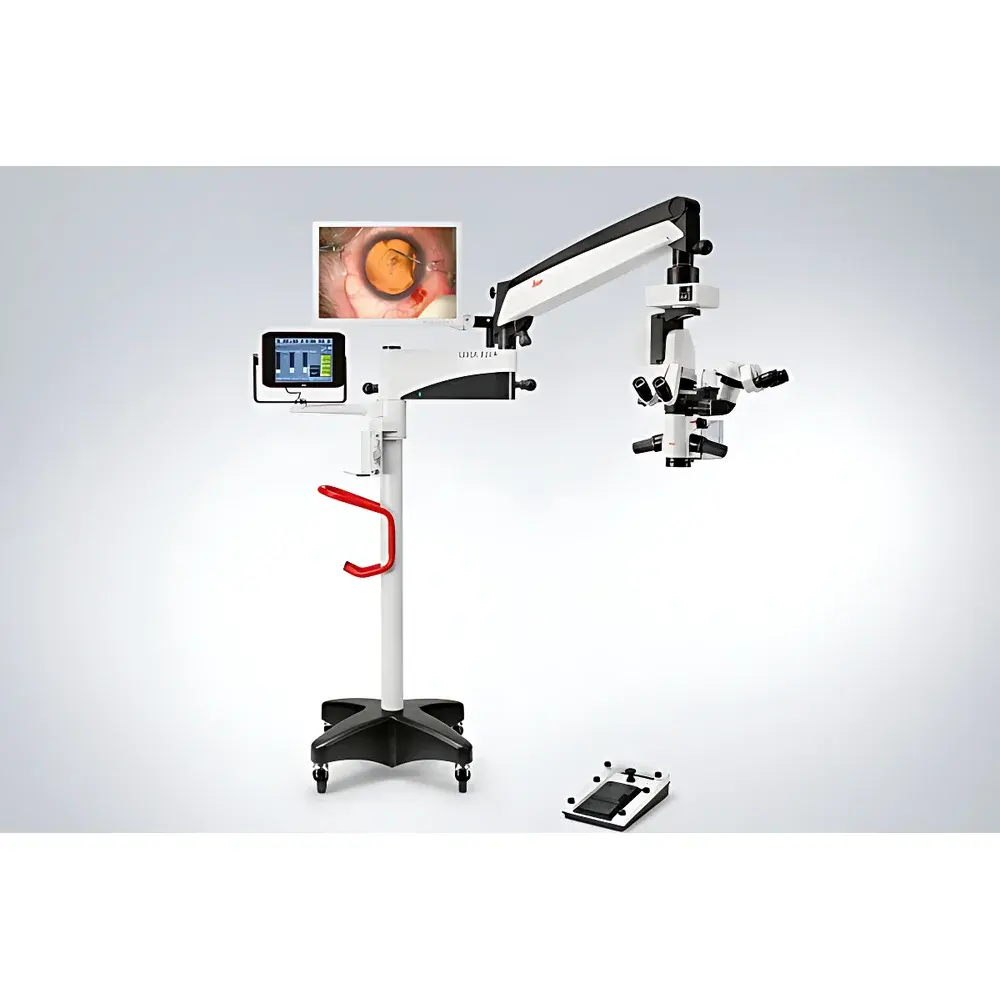
Leica M822 Red-Reflect Surgical Microscope
| Brand | Leica |
|---|---|
| Origin | Germany |
| Model | M822 |
| Illumination | Hybrid LED + Halogen with Enhanced Red-Reflect Capability |
| Ergonomic Design | Adjustable Height, Integrated Control Panel, Balanced Optical Path |
| Video Output | Full HD (1080p) Digital Imaging Interface |
| Modular Architecture | Compatible with Vitreoretinal Accessories (e.g., Endo-Illuminators, Laser Couplers) |
| Stand Options | Interchangeable Floor Stands F40 or F20 |
| Upgrade Pathway | Field-Upgradeable Optics and Imaging Modules |
| Compliance | CE-marked per Medical Device Regulation (MDR 2017/745), ISO 13485 Certified Manufacturing |
Overview
The Leica M822 Red-Reflect Surgical Microscope is a high-precision ophthalmic surgical imaging platform engineered specifically for anterior and posterior segment microsurgery. It employs a dual-source illumination architecture—integrating high-output white LED and stabilized halogen lighting—to generate a spectrally optimized red-reflection mode (center wavelength ~620–650 nm). This red-reflection enhancement improves contrast in lens capsule visualization during phacoemulsification, facilitates accurate capsulorhexis delineation, and supports intraoperative assessment of retinal pigment epithelium integrity in vitreoretinal procedures. The microscope’s optical path features apochromatic correction, zero-distortion relay optics, and a variable magnification range (typically 6×–40×) with continuous zoom and stepless focus adjustment. Its rigid, thermally stable mechanical structure minimizes drift during prolonged procedures, ensuring consistent focal plane registration across multi-hour surgeries.
Key Features
- Red-reflect illumination mode: Spectrally tuned output enhances red-wavelength reflectance from the lens capsule and retinal layers without compromising tissue photobiomodulation safety limits (IEC 62471 Class 1 compliance).
- Ergonomic workflow integration: Motorized height adjustment (F40/F20 stands), intuitive touch-enabled control panel, and balanced binocular tube reduce operator fatigue and support sustained surgical posture alignment per ISO 9241-5 ergonomic guidelines.
- Digital imaging infrastructure: Native 1080p HDMI and SDI video outputs enable real-time streaming to OR monitors, PACS integration, and encrypted DICOM-compliant image archiving.
- Modular accessory compatibility: Standardized optical ports accept FDA-cleared vitreoretinal modules—including endo-illumination couplers, diode laser adapters, and wide-angle viewing systems—without recalibration.
- Future-ready architecture: Firmware-upgradable control electronics and field-serviceable optical modules support technology migration (e.g., 4K upgrade kits, AI-assisted guidance overlays) within the same mechanical chassis.
Sample Compatibility & Compliance
The M822 is validated for use in human ophthalmic surgical environments including cataract extraction, trabeculectomy, pars plana vitrectomy, and corneal transplantation. It complies with EU MDR 2017/745 as a Class IIa medical device and adheres to IEC 60601-1 (3rd ed.) for electrical safety and IEC 60601-2-44 for ophthalmic instrument particular requirements. All optical components meet ISO 10934-1 standards for resolution performance verification. The system supports GLP-aligned documentation workflows via optional audit-trail logging (21 CFR Part 11–compliant when deployed with Leica LAS X software suite).
Software & Data Management
Imaging data acquisition and annotation are managed through Leica LAS X Core software (v4.13+), which provides DICOM-SR structured reporting, time-stamped procedural metadata capture, and role-based user access controls. Video recordings include embedded surgical phase markers (e.g., “capsulorhexis start”, “IOL insertion”) synchronized with external OR clocks. Raw image stacks support quantitative analysis plugins for capsule edge detection and intraoperative OCT co-registration (via third-party SDK integration). All data exports conform to HIPAA-compliant encryption protocols (AES-256) and may be archived directly to hospital PACS or cloud-based research repositories.
Applications
- Phacoemulsification: Enhanced red-reflection enables precise identification of anterior capsule tear propagation and nuclear fragment boundaries under low-contrast conditions.
- Vitreoretinal surgery: Improved choroidal and RPE visualization aids in identifying subretinal hemorrhage margins and guiding membrane peeling in epiretinal gliosis cases.
- Glaucoma surgery: High-resolution depth perception supports accurate scleral flap dissection and trabecular meshwork exposure during gonioscopy-assisted procedures.
- Surgical training & telementoring: Real-time HD video feed with low-latency (<120 ms) transmission enables remote proctoring and case-based debriefing in accredited fellowship programs.
- Clinical research: Standardized imaging parameters (exposure, white balance, gamma) ensure inter-operator reproducibility for longitudinal studies on surgical outcomes and complication rates.
FAQ
Does the M822 support integration with intraoperative OCT systems?
Yes—via standardized optical coupling ports and synchronization TTL triggers; compatible with commercially available iOCT platforms (e.g., Zeiss RESCAN 700, Haag-Streit Envisu C-Scan) for simultaneous structural and functional visualization.
Is the red-reflection mode adjustable in intensity and spectral bandwidth?
Intensity is continuously variable (0–100%); spectral output is fixed at peak emission 635 ± 5 nm, optimized for melanin and lens chromophore absorption profiles.
Can existing Leica surgical microscopes be upgraded to M822 specifications?
No—M822 is a discrete platform with proprietary optical train and control architecture; however, legacy M844/M820 users may migrate accessories and imaging modules under Leica’s Cross-Platform Compatibility Program.
What sterilization protocols apply to the M822’s non-disposable components?
All exposed surfaces comply with ISO 17664 for reprocessing; disinfection validated for 70% isopropyl alcohol, 0.5% sodium hypochlorite, and hydrogen peroxide vapor (VHP) cycles.
How is calibration maintained during long-term clinical deployment?
Automated daily self-calibration routines verify optical axis alignment and illumination uniformity; full metrological validation recommended annually per ISO/IEC 17025-accredited service providers.
Related Products




