
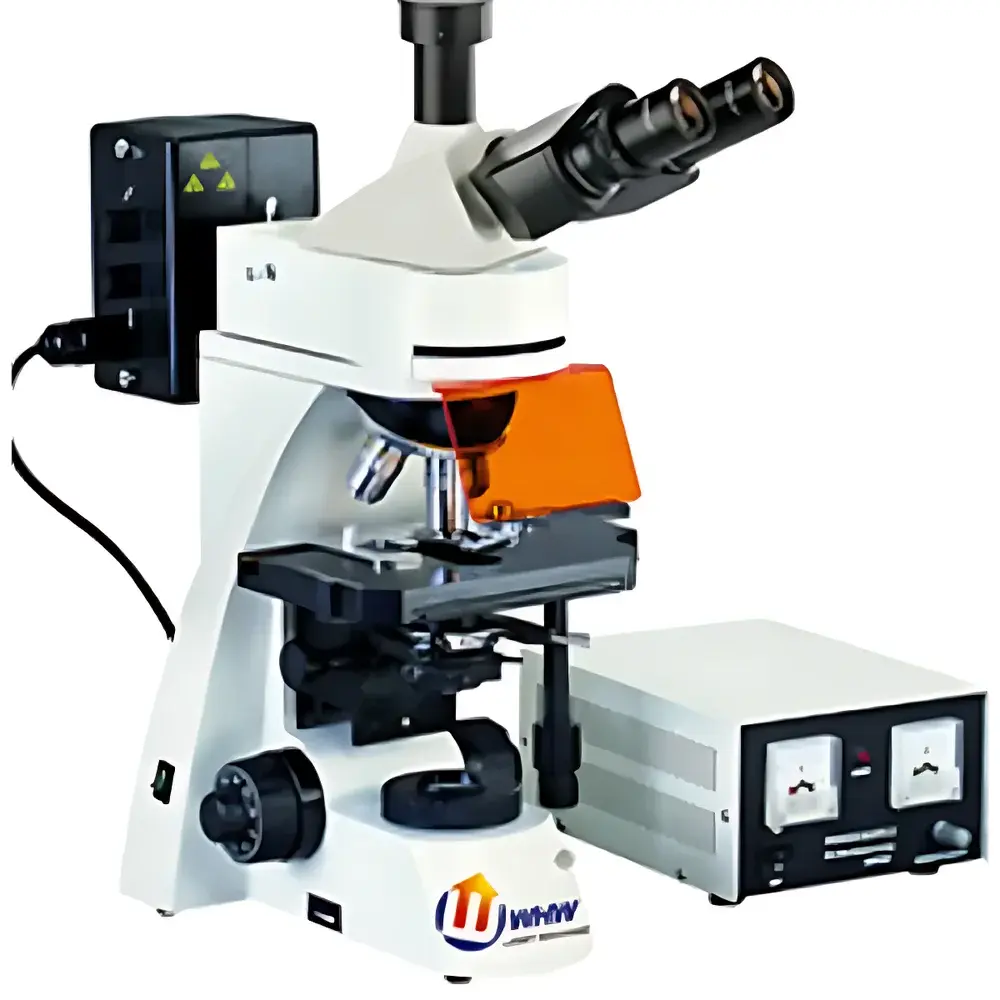
YANRUN FM-400 Upright Infinity-Corrected Epi-Fluorescence Microscope
| Brand | YANRUN |
|---|---|
| Origin | Shanghai, China |
| Manufacturer Type | Direct Manufacturer |
| Model | FM-400 Upright Infinity-Corrected Epi-Fluorescence Microscope |
| Optical Magnification | 40×–1000× |
| Eyepieces | Widefield WF10× (Φ20 mm) |
| Objective Lenses | Infinity-corrected Achromatic PL 4×/0.10, 10×/0.25, 40×/0.65 (spring), 100×/1.25 (spring, oil-immersion) |
| Trinocular Head | 30° Inclination |
| Focus Mechanism | Coaxial coarse/fine focus with adjustable tension, locking knob, travel limiter, fine-focus graduation: 2 µm |
| Nosepiece | Four-position inward-rolling ball bearing turret |
| Stage | 210 × 140 mm mechanical stage, 75 × 50 mm travel range |
| Condenser | Abbe condenser, NA 1.25 |
| Transmitted Illumination | 6 V / 20 W halogen lamp with brightness control, centerable field diaphragm and collector lens |
| Reflected Fluorescence Illumination | 100 W high-pressure mercury lamp, dual-voltage (110 V / 220 V) power supply unit |
| Excitation Filter Sets | UV (320–380 nm ex / 435 nm em), V (380–415 nm ex / 475 nm em), B (450–490 nm ex / 515 nm em), G (495–555 nm ex / 595 nm em) |
| Additional Features | Centerable field diaphragm in epi-illuminator, blue and ground-glass filters, halogen-compatible collector |
Overview
The YANRUN FM-400 is an upright, infinity-corrected epi-fluorescence microscope engineered for routine and advanced life science imaging in academic laboratories, clinical research units, and industrial quality control environments. Its optical architecture adheres to modern Köhler illumination principles for both transmitted and reflected light paths, ensuring uniform illumination, minimal chromatic aberration, and high contrast across the full magnification range (40× to 1000×). The system integrates a dedicated epi-illumination pathway with four standardized excitation/emission filter sets—UV, V, B, and G—enabling reliable detection of common fluorophores including DAPI, Hoechst, FITC, TRITC, and Cy3. The infinity-corrected optical design allows modular expansion with auxiliary components such as phase contrast modules, polarizing accessories, and digital imaging adapters—without compromising parfocality or image fidelity.
Key Features
- Trinocular observation head inclined at 30°, optimized for ergonomic extended use; equipped with widefield WF10× eyepieces (20 mm field number) for low-fatigue visual assessment.
- Four-position inward-rolling ball-bearing nosepiece ensures precise, repeatable objective alignment and long-term mechanical stability under frequent use.
- Coaxial coarse/fine focusing mechanism with adjustable coarse-focus tension, mechanical stop limiters, and 2 µm fine-focus graduation—critical for Z-stack acquisition and oil-immersion precision.
- Dual-illumination capability: transmitted halogen illumination (6 V / 20 W, continuously variable intensity) supports brightfield and phase contrast; reflected 100 W mercury arc lamp provides stable, high-intensity excitation across UV–visible bands.
- Epi-illuminator incorporates centerable field diaphragm and integrated excitation filter turret—enabling rapid, reproducible switching between fluorescence channels without realignment.
- Abbe condenser (NA 1.25) with centering screws and aperture diaphragm delivers optimal resolution and contrast in transmitted modes; compatible with optional phase contrast sliders (PH-I/PH-II).
Sample Compatibility & Compliance
The FM-400 accommodates standard glass microscope slides (76 × 26 mm) and coverslips (0.13–0.17 mm thickness) across all objective classes—including oil-immersion (100×/1.25) and glycerol-immersion (40×/1.0 FL) objectives. Its mechanical stage (210 × 140 mm, 75 × 50 mm travel) supports multi-well plate scanning and large tissue sections. While not certified to ISO 13485 or FDA 21 CFR Part 11 out-of-the-box, the instrument’s optical repeatability, mechanical traceability (e.g., calibrated fine-focus scale), and stable illumination output support compliance with GLP and GMP documentation requirements when integrated into validated laboratory workflows. All filter sets conform to ISO 8578:2017 specifications for fluorescence microscope bandpass characteristics.
Software & Data Management
The FM-400 is designed as a hardware platform for third-party digital imaging integration. It supports C-mount and CS-mount adapters (0.4×, 0.5×, 1×, and 0.5× with reticle) for seamless coupling with USB3.0 or HDMI-based CMOS/CCD cameras. No proprietary acquisition software is bundled; instead, the system is compatible with open-standard imaging platforms—including NIS-Elements (Nikon), ZEN (Zeiss), CellSens (Olympus), and open-source tools like Micro-Manager and Fiji/ImageJ—enabling full metadata logging, time-lapse capture, multi-channel overlay, and export in TIFF, JPEG2000, or OME-TIFF formats. When paired with audit-trail-capable software and controlled environmental documentation, the FM-400 meets baseline requirements for data integrity under ALCOA+ principles.
Applications
- Cell biology: nuclear staining (DAPI/Hoechst), cytoskeletal labeling (FITC-phalloidin), organelle tracking (MitoTracker, LysoTracker).
- Histopathology: fluorescence-assisted tissue evaluation (FATE), immunofluorescence on FFPE or frozen sections.
- Materials science: fluorescent dopant distribution mapping in polymers and thin films using UV-excitable probes.
- Microbiology: viability assays (SYTO 9/propidium iodide), biofilm architecture analysis.
- Phase contrast extension: live-cell imaging without staining via optional PHP phase objectives and PH-I/PH-II condensers.
FAQ
Is the FM-400 compatible with digital camera systems?
Yes—via standardized C-mount or CS-mount adapters (0.4× to 1× magnification options available), supporting both analog video and digital USB/HDMI interfaces.
Can I use oil-immersion objectives with the FM-400?
Yes—the 100×/1.25 NA oil-immersion objective is included and fully parfocal with other PL objectives; immersion oil (Type A or B) is required for optimal resolution.
Does the system support phase contrast without modification?
No—phase contrast requires optional components: PHP series phase objectives, PH-I or PH-II turret condensers, and matching phase annuli; these are sold separately.
What safety features are built into the mercury lamp housing?
The 100 W mercury lamp module includes thermal cutoff protection, UV-blocking enclosure, and interlock-compatible power supply; users must observe ANSI Z87.1-compliant eyewear during operation.
Are replacement excitation filter sets available for custom fluorophores?
Yes—YANRUN offers OEM-compatible filter sets (e.g., Cy5, Alexa Fluor 647) upon request; spectral transmission curves and OD values are provided per ISO 10110-7 documentation standards.




