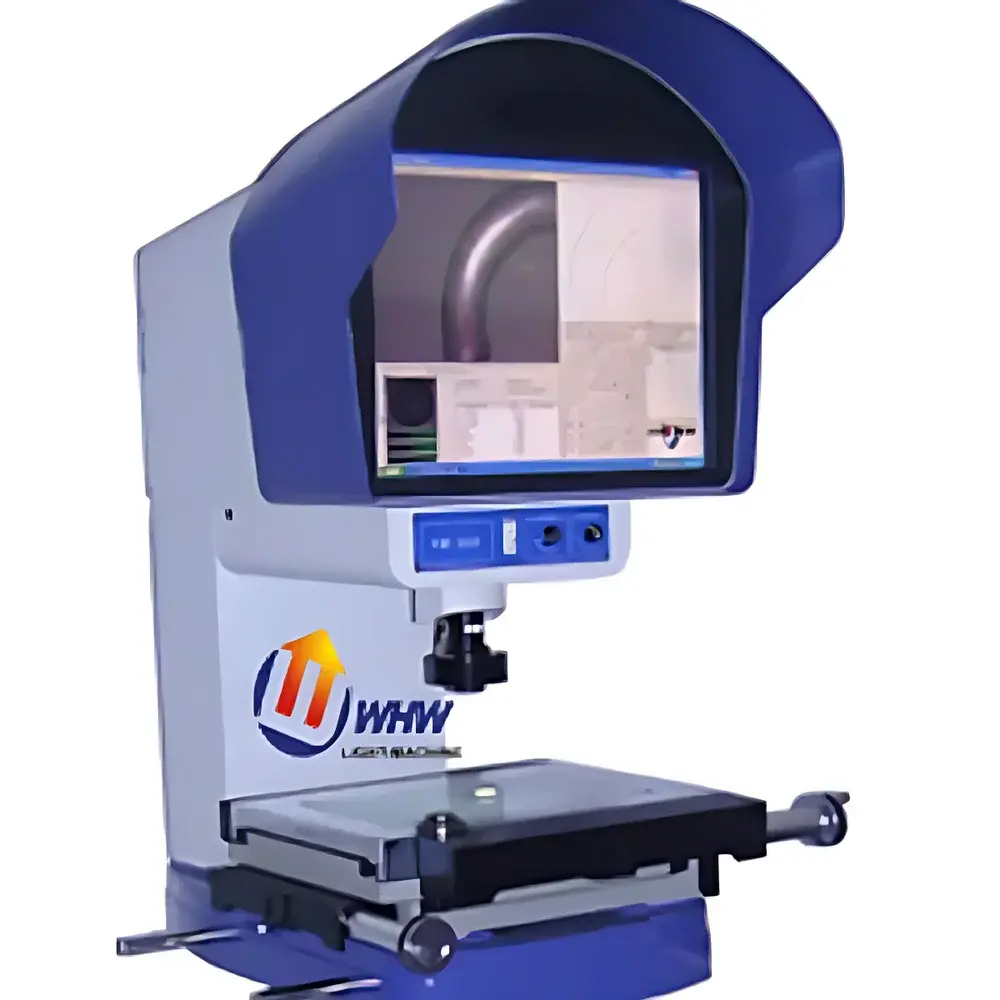
YANRUN YR-C2515 Heavy-Duty Automated Vision Measuring System
| Brand | YANRUN |
|---|---|
| Origin | Shanghai, China |
| Manufacturer Type | Direct Manufacturer |
| Model | YR-C2515 |
| Operation Mode | Fully Automatic |
| Metal Table Size (mm) | 450 × 280 |
| Glass Table Size (mm) | 306 × 196 |
| Motion Travel (mm) | 250 × 150 |
| Instrument Weight (kg) | 100 |
| Overall Dimensions (mm) | 650 × 800 × 1600 |
| Z-Axis Vertical Travel | 150 mm |
| Working Distance | 108 mm |
| X/Y/Z Digital Readout Resolution | 1 µm |
| X/Y Axis Accuracy | ≤ (3 + L/200) µm |
| Imaging System | Color 1/3″ CCD Camera |
| Zoom Objective Magnification | 0.7×–4.5× |
| Total Video Magnification | 30×–230× |
| Object Field of View | 7.0–1.1 mm |
| Illumination | Dual LED Sources (Top Surface & Bottom Transmitted), Adjustable Brightness |
| Optional Upgrades | 1/2″ Sony CCD Sensor, Interchangeable Telecentric or Metrology-Grade Lenses |
| Power Supply | AC 180–260 V, 50 Hz |
| Measurement Software | Embedded Auto-Measurement Suite with Edge Detection, Deburring Algorithm, Geometric Feature Recognition (Points, Lines, Circles, Angles, Center-to-Center Distances), Coordinate System Alignment (Part Registration & Datum Fixturing) |
Overview
The YANRUN YR-C2515 Heavy-Duty Automated Vision Measuring System is an industrial-grade coordinate metrology platform engineered for high-precision 2D and 2.5D geometric inspection of machined components, stamped parts, PCBs, and precision tooling. It operates on the principle of optical triangulation and pixel-based sub-pixel edge detection, integrating a motorized XYZ stage, telecentric imaging optics, and calibrated digital image analysis to deliver traceable dimensional measurements in compliance with ISO 10360 and VDI/VDE 2617 standards. Designed for sustained operation in QC laboratories and production-floor environments, its rigid granite base and reinforced aluminum frame minimize thermal drift and mechanical vibration—critical for maintaining repeatability under ambient temperature fluctuations typical in non-climate-controlled manufacturing spaces.
Key Features
- Heavy-duty structural architecture supporting consistent measurement stability across extended duty cycles; 100 kg mass contributes to inertial damping against floor-borne vibrations.
- Fully automated motion control with closed-loop stepper motors and linear encoders ensuring positional fidelity within ±1 µm resolution on all three axes.
- Dual-illumination LED system—programmable top-ring and bottom-diffused sources—enables optimal contrast enhancement for both opaque surface features and transparent or translucent part geometries (e.g., glass substrates, polymer films).
- Variable magnification optical path (0.7×–4.5× objective + digital zoom) provides scalable field-of-view coverage from 7.0 mm down to 1.1 mm, facilitating rapid navigation and high-magnification verification without manual lens swapping.
- Embedded metrology software implements NIST-traceable calibration routines, including lens distortion correction, stage orthogonality compensation, and temperature-induced scale factor adjustment (based on internal thermal sensor feedback).
- Robust mechanical Z-axis with 150 mm vertical travel accommodates tall fixtures, stacked assemblies, and multi-layered samples—unlike compact benchtop systems constrained to <80 mm lift height.
Sample Compatibility & Compliance
The YR-C2515 accepts parts up to 450 mm × 280 mm on its precision-ground metal stage or 306 mm × 196 mm on the optically flat glass insert—ideal for thin wafers, flex circuits, and injection-molded housings requiring backlight inspection. Its 250 mm × 150 mm measurement envelope meets ANSI B89.4.14 requirements for volumetric performance evaluation. The system supports GLP/GMP documentation workflows via audit-trail-enabled software logging, timestamped operator ID tagging, and exportable XML/CSV reports compliant with ISO 9001:2015 clause 7.1.5. While not FDA 21 CFR Part 11 certified out-of-the-box, the software architecture permits configuration for electronic signature integration and secure user role management upon customer-specific validation protocols.
Software & Data Management
The proprietary YANRUN MetroVision software suite runs on Windows OS and features a dual-mode interface: guided wizard mode for routine first-article inspections and script-driven batch mode for SPC-integrated production monitoring. Core algorithms include adaptive thresholding for low-contrast edges, Hough transform-based circle fitting, and iterative least-squares best-fit alignment for datum-referenced GD&T evaluation (per ASME Y14.5–2018). Measurement data exports natively to Microsoft Excel, Q-DAS QDB, and Minitab formats. Raw images and coordinate point clouds are stored with embedded metadata (calibration ID, environmental timestamp, operator ID), enabling full forensic traceability during internal audits or supplier qualification reviews.
Applications
- Dimensional verification of CNC-machined aerospace brackets, turbine blades, and hydraulic manifolds.
- PCB solder paste deposit volume estimation and pad registration accuracy assessment prior to SMT placement.
- Tooling wear analysis of progressive die sets through periodic cross-sectional profile comparison.
- Medical device component inspection—including catheter hubs, syringe barrels, and orthopedic implant fixtures—against ISO 13485-defined acceptance criteria.
- Automotive gasket thickness uniformity mapping using transmitted-light Z-height profiling at multiple XY locations.
FAQ
Does the YR-C2515 support true 3D surface topography reconstruction?
No—it performs 2.5D height profiling via focus-stacking only within its 150 mm Z-travel range and does not integrate laser triangulation or white-light interferometry for full 3D areal analysis.
Can measurement programs be password-protected and version-controlled?
Yes. The software supports hierarchical user permissions (Admin, Engineer, Operator), encrypted program files, and revision history tracking with SHA-256 checksum validation.
Is ISO/IEC 17025 calibration documentation available for purchase?
Yes—factory calibration certificates with uncertainty budgets (k=2) per ISO/IEC 17025:2017 are provided upon request, traceable to NIM (China National Institute of Metrology) primary standards.
What is the recommended recalibration interval under continuous use?
Annual verification is advised; however, interim performance checks using certified gauge blocks and step gauges should be conducted every 90 days per ISO 10012 guidelines.
Does the system meet CE or UKCA marking requirements for EU/UK deployment?
The YR-C2515 complies with EMC Directive 2014/30/EU and Low Voltage Directive 2014/35/EU; CE marking is applied post-third-party notified body assessment (TÜV Rheinland report available upon order confirmation).