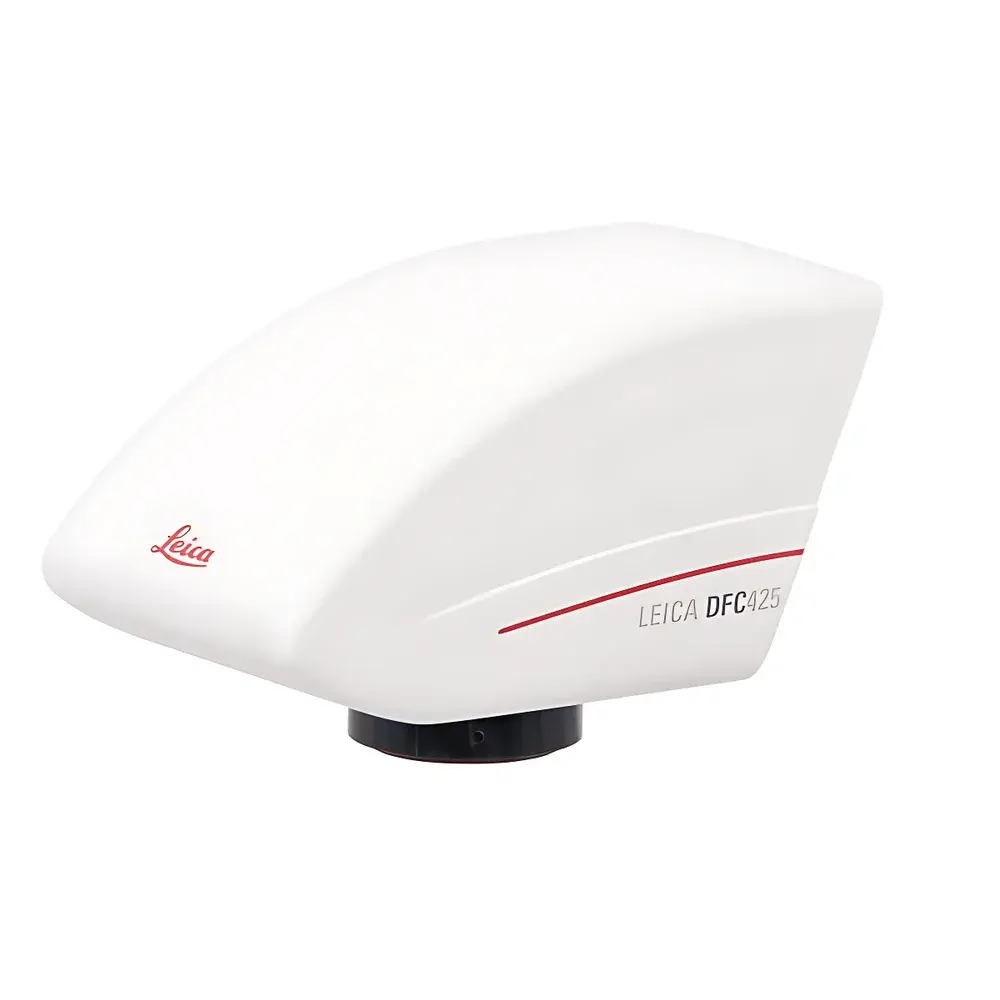
Leica DFC425 Color Digital Microscope Camera
| Brand | Leica |
|---|---|
| Origin | Germany |
| Model | DFC425 |
| Sensor Type | 5 MP CCD |
| Interface | C-mount |
| Preview Frame Rate | up to 20 fps at XGA resolution |
| Output Format | RGB 24-bit |
| Software Compatibility | Leica Application Suite (LAS) X, Windows/macOS/Linux |
| Compliance | CE, RoHS, FDA 21 CFR Part 11 ready (via LAS X audit trail) |
| Cooling | Passive thermal management |
Overview
The Leica DFC425 is a high-fidelity color digital microscope camera engineered for quantitative imaging in life science research, clinical histology, materials inspection, and industrial quality control. Built around a progressive-scan 5-megapixel CCD sensor, it delivers high quantum efficiency and low-noise performance under variable illumination conditions—including transmitted brightfield, phase contrast, differential interference contrast (DIC), and fluorescence with appropriate filter sets. Its optical design features a precision C-mount interface with standardized back focal distance (17.526 mm), ensuring mechanical and optical compatibility with Leica DM series upright and inverted microscopes as well as third-party optical systems adhering to ISO 8039 and DIN 29500 specifications. The camera operates on a fixed-gain architecture optimized for reproducible photometric response, supporting consistent intensity calibration across time-series experiments and multi-user laboratory environments.
Key Features
- 5.0-megapixel interline-transfer CCD sensor with 2/3″ optical format and 6.45 µm pixel pitch, delivering native XGA (1024 × 768) preview at up to 20 frames per second
- Hardware-based binning (2×2) mode for enhanced signal-to-noise ratio in low-light applications without interpolation artifacts
- Real-time gamma correction, white balance, and exposure control via USB 2.0 interface—no external frame grabber required
- Integrated hardware shutter synchronization for precise timing with external light sources or motorized stages
- Passive thermal stabilization system eliminating fan-induced vibration, critical for high-magnification live-cell imaging and microtome-integrated workflows
- Firmware-upgradable architecture supporting future protocol enhancements and regulatory-compliant metadata embedding (EXIF + custom tags)
Sample Compatibility & Compliance
The DFC425 supports a broad range of specimen types—from unstained tissue sections and live-cell monolayers to metallurgical grain structures and polymer composites—when paired with appropriate microscope optics and illumination. Its spectral response (400–700 nm) aligns with standard halogen, LED, and mercury/Xenon arc lamp emission profiles. For regulated environments, the camera integrates natively with Leica Application Suite X (LAS X), which provides full audit trail functionality compliant with FDA 21 CFR Part 11 requirements—including electronic signatures, user access levels, and immutable acquisition logs. It also meets ISO/IEC 17025 documentation standards for accredited testing laboratories and supports GLP/GMP-aligned image annotation workflows through customizable metadata fields (e.g., operator ID, SOP version, instrument calibration timestamp).
Software & Data Management
Control and image acquisition are managed exclusively through Leica’s LAS X platform—a modular, modular, DICOM-compliant software suite certified for use in CE-IVD and FDA-cleared diagnostic applications. LAS X enables synchronized multi-channel capture (e.g., brightfield + fluorescence overlay), batch processing with scripting (Python API), and direct export to TIFF, JPEG2000, or OME-TIFF formats preserving calibrated intensity values. All acquired images embed EXIF metadata (exposure time, gain, lens magnification, objective NA) plus user-defined contextual tags. Raw data integrity is maintained via checksum validation on write; archived datasets support FAIR principles (Findable, Accessible, Interoperable, Reusable) when deployed with Leica’s LAS X Server module and LDAP-integrated authentication.
Applications
- Quantitative morphometric analysis of histopathological slides in academic and diagnostic pathology labs
- Time-lapse documentation of cell migration, mitosis, and wound-healing assays under controlled environmental chambers
- Documentation and measurement of coating thickness, solder joint integrity, and surface defect mapping in electronics manufacturing QA
- Documentation of forensic trace evidence (fibers, hair, toolmarks) with metric scale bar embedding and NIST-traceable calibration
- Educational microscopy: real-time classroom projection with annotation tools and student account isolation
FAQ
Is the DFC425 compatible with non-Leica microscopes?
Yes—provided the microscope offers a standard C-mount port and maintains the required 17.526 mm back focal distance. Mechanical adapters may be needed for Nikon, Olympus, or Zeiss systems.
Does the camera support trigger input for synchronized acquisition?
Yes—it features a TTL-compatible hardware trigger input for external event synchronization (e.g., stage movement, laser pulse, or environmental stimulus onset).
Can exposure parameters be locked across multiple users?
Yes—LAS X allows administrator-defined acquisition templates with read-only parameter sets, preventing accidental deviation during routine QC procedures.
What is the maximum cable length for stable USB 2.0 operation?
Up to 5 meters using certified high-speed USB 2.0 cables; active extension solutions (USB repeaters or fiber-optic extenders) support distances beyond 25 meters without latency penalty.
Is firmware update capability available in the field?
Yes—updates are delivered via LAS X software and applied without requiring service center intervention or hardware modification.