
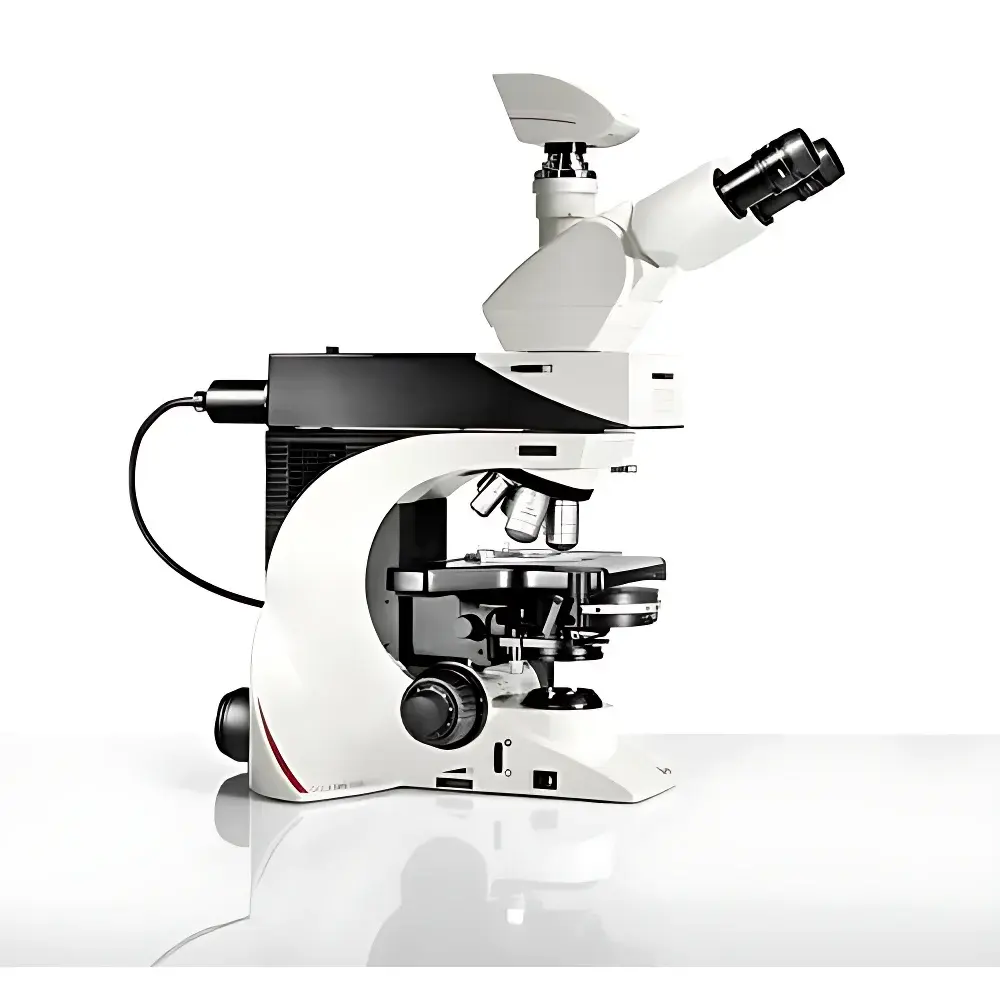
Leica DM2500 LED Upright Manual Microscope
| Brand | Leica |
|---|---|
| Origin | Shanghai, China |
| Manufacturer Type | Authorized Distributor |
| Product Category | Domestic (China-assembled) |
| Model | DM2500 LED |
| Instrument Type | Upright Fluorescence Microscope |
| Excitation Source | High-Stability White LED Transmitted Light Illumination |
| Certification | CE-IVD compliant for in vitro diagnostic applications |
| Ergonomic Configuration | Adjustable focus knobs, modular stage controls, optional tilting binocular tube, brightness-synchronized objectives |
| Optical Compatibility | DIC, Phase Contrast, Polarization, Fluorescence (with filter cube turret), Brightfield |
| Objective Turret | Optional 7-position revolving nosepiece |
| Illumination Uniformity | Köhler-optimized LED condenser with constant CCT (5700 K) across intensity range |
| Software Integration | Leica DMShare (wireless real-time image streaming to iOS/Android tablets) |
| Compliance | Designed to support GLP/GMP workflows |
Overview
The Leica DM2500 LED is an upright, manually operated research-grade biological microscope engineered for demanding life science applications—including routine histology, live-cell observation, fluorescence imaging, differential interference contrast (DIC), phase contrast, and polarized light microscopy. Built on Leica’s proven optical architecture, the DM2500 LED employs a high-efficiency, thermally stabilized white LED illumination system delivering consistent 5700 K correlated color temperature (CCT) across its full intensity range—eliminating spectral drift common in halogen or arc-lamp sources. This stability ensures reproducible color fidelity in brightfield and quantitative phase-based imaging, while enabling reliable long-term fluorescence excitation without thermal load on specimens. The microscope’s rigid mechanical platform, precision-machined optical path, and optimized Köhler illumination geometry ensure uniform illumination across the entire field of view—even at high magnifications and with high-NA objectives. Its modular design supports seamless integration of advanced contrast techniques without optical realignment, making it suitable for multi-user core facilities and regulated diagnostic environments.
Key Features
- Stable white LED transmitted-light illumination with constant 5700 K CCT from 1% to 100% intensity—no warm-up time, no bulb replacement, and minimal heat transfer to samples.
- Patented ergonomic focusing mechanism with height-adjustable coarse/fine focus knobs and customizable stage control layout for operator-specific anthropometry.
- Modular optical train supporting simultaneous compatibility with DIC prisms, phase annuli, polarization optics, and fluorescence filter cubes via standardized turret interfaces.
- Optional 7-position objective revolver accommodating objectives from 1.25× to 100×, including oil-immersion and long-working-distance variants—ensuring flexibility across tissue sections, cell cultures, and thick specimens.
- CE-IVD certified configuration available for in vitro diagnostic use in clinical pathology labs, meeting essential requirements under Regulation (EU) 2017/746.
- Integrated color-coded aperture controls for rapid, intuitive adjustment of condenser aperture diaphragm, DIC slider position, phase telescope alignment, and fluorescence excitation/emission filter selection.
Sample Compatibility & Compliance
The Leica DM2500 LED accommodates standard glass slides (1–3 mm thickness), petri dishes (up to 35 mm diameter), and multi-well plates (6–96-well formats) using optional stage adapters. Its mechanical stage offers 76 × 52 mm travel range with vernier scales and optional motorized XY control (via external controller). For fluorescence applications, the system supports standard Leica filter cubes (e.g., GFP, RFP, DAPI, TRITC) and third-party cubes with 25 mm diameter mounts. All optical components comply with ISO 8578 (microscope mechanical standards) and ISO 10934-1 (optical resolution testing). When deployed in regulated environments, the instrument’s manual operation mode aligns with FDA 21 CFR Part 11 principles for non-software-controlled instrumentation; electronic accessories (e.g., camera, DMShare) may be validated separately per laboratory SOPs.
Software & Data Management
While the DM2500 LED operates as a fully manual platform, it integrates natively with Leica’s digital ecosystem. The Leica DMShare app enables secure Wi-Fi streaming of live camera output to iOS and Android tablets—supporting side-by-side image comparison, annotation, and remote collaborative review without proprietary hardware. For traceable documentation, pairing with Leica LAS X software (v3.7+) provides metadata logging (objective, filter, exposure, user ID), automated report generation, and export to DICOM, TIFF, or PDF formats. Audit trails, user access levels, and electronic signatures can be configured to meet GLP, CAP, or CLIA requirements when used in conjunction with validated IT infrastructure.
Applications
- Routine histopathology screening and IVD-compliant tissue diagnosis using brightfield and H&E-stained sections.
- Live-cell imaging of unstained specimens via DIC and phase contrast—ideal for monitoring mitosis, organelle dynamics, and neuronal growth cones.
- Multi-channel fluorescence co-localization studies with low phototoxicity due to precise LED excitation control and minimal IR/UV leakage.
- Polarized light analysis of birefringent structures such as collagen fibers, starch granules, and liquid crystals.
- Teaching laboratories requiring robust, serviceable instrumentation with intuitive manual operation and repeatable setup protocols.
- Quality control in biomanufacturing for inspection of cell monolayers, scaffold integrity, and microcarrier-based cultures.
FAQ
Is the DM2500 LED compatible with third-party digital cameras?
Yes—the microscope features a standardized C-mount port (1× or 0.5× relay lens options) supporting most industrial CMOS/CCD cameras with 1/2″ or 2/3″ sensors.
Can the LED illumination be calibrated for photometric consistency across instruments?
Leica provides optional NIST-traceable calibration services for irradiance output (µW/cm²) and CCT verification using integrated sensor modules.
Does the system support motorized Z-focus or automated stage navigation?
Motorized focus and XY stages are available as field-upgradeable modules controlled via Leica Application Suite or external TTL-compatible controllers.
What fluorescence filter sets are included by default?
Standard configurations include a triple-band set (DAPI/FITC/TRITC); additional single-band or custom cubes can be ordered separately.
How is maintenance performed on the LED illumination system?
The LED module is rated for >25,000 hours lifetime with no scheduled replacement; periodic cleaning of condenser lenses and alignment verification are the only recommended preventive procedures.



